





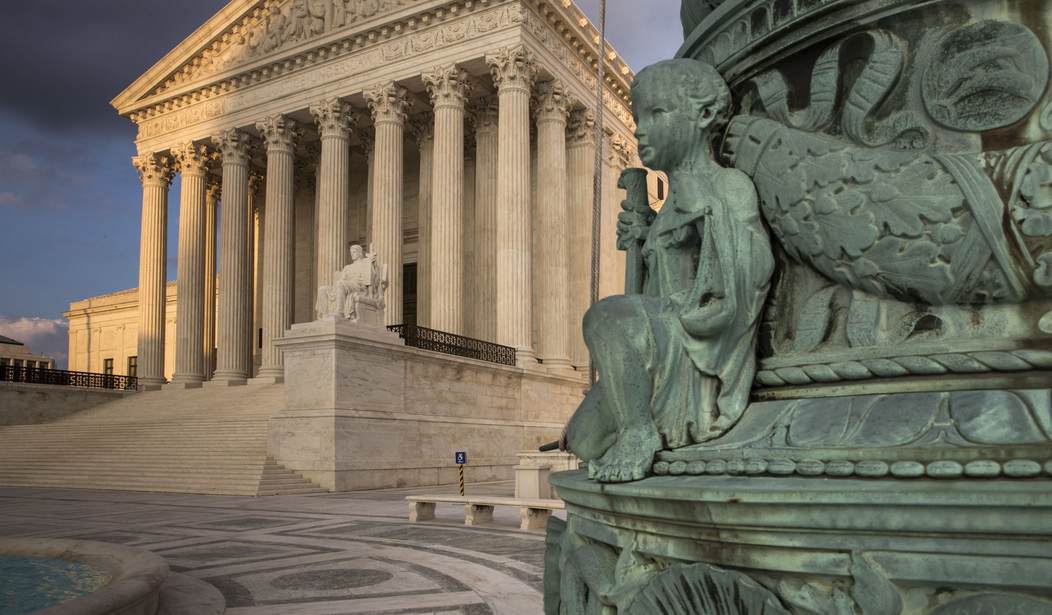
A football coach prays quietly at midfield after a game and gets fired for it. Not for disrupting anything. Not for pressuring students. For praying. Alone. On a public field. The Supreme Court, in Kennedy v. Bremerton School District (2022), ruled 6-3 that firing him was unconstitutional. In doing so, the Court formally ended the legal framework that had governed church-state law for 50 years — and that had been used to justify exactly this kind of institutional hostility toward private religious expression.
That framework was the Lemon test. It was already dying. Kennedy buried it. Understanding why matters for anyone who's watched courts and school districts weaponize Establishment Clause doctrine against individual believers rather than protect citizens from government overreach.
The Wall That Wasn't in the Constitution
The First Amendment's Establishment Clause says Congress shall make no law respecting the establishment of religion. For 150 years, it bound only the federal government. In Everson v. Board of Education (1947), the Supreme Court applied it to the states and, while doing so, borrowed Thomas Jefferson's 1802 phrase about "a wall of separation between church and State." Jefferson wasn't at the Constitutional Convention. He was in France when the First Amendment was drafted. His letter wasn't a legal authority. None of that stopped the phrase from becoming constitutional doctrine.
The irony of Everson: the Court announced the harshest possible separationist rule — no tax "in any amount" supporting religious institutions — and then held that reimbursing Catholic school bus fare was constitutional. Both sides claimed victory. What the Court actually produced was an unworkable principle and a carve-out broad enough to swallow it.
The Three-Prong Test That Nobody Could Apply
In Lemon v. Kurtzman (1971), Chief Justice Burger assembled the framework that would dominate for 50 years: a challenged action had to have a secular purpose, a principal effect that neither advanced nor inhibited religion, and no excessive government entanglement with religion. Fail any prong, and it fell.
The problems were structural. Secular purpose was easy to manufacture — just write it into the statute. The principal effect asked courts to assess the subjective religious experience of observers, which isn't a determinate inquiry. Excessive entanglement was absurd: the more the government monitored religious organizations to ensure compliance, the more entangled it became.
Justice Scalia, writing separately in Lamb's Chapel (1993), said it plainly: the Lemon test was "some ghoul in a horror movie that repeatedly sits up in its grave and shuffles abroad, after being repeatedly killed and buried." The Court cited it when convenient and ignored it otherwise. The ghoul kept walking.
The results were predictable in their unpredictability. Van Orden v. Perry (2005) and McCreary County v. ACLU (2005) came down the same day. One upheld a Ten Commandments monument on the Texas Capitol grounds. The other struck down a Ten Commandments display inside a Kentucky courthouse. Two objects. Two opposite results. Same day.
Coercion That Wasn't
The Warren and Burger Courts used the separationist framework to eliminate school prayer. Engel v. Vitale (1962) struck down a 22-word voluntary nondenominational prayer composed by New York's Board of Regents. Abington v. Schempp (1963) extended the ban to Bible reading. Lee v. Weisman (1992) struck down clergy-led graduation prayers on the theory that students felt subtle coercive pressure by being present. Santa Fe Independent School District v. Doe (2000) applied the same logic to student-initiated, student-led prayer broadcast before football games.
In each case, the Court treated voluntary individual religious expression within a school setting as the state's expression and prohibited it. By 2022, the logic had reached the point where a coach praying alone at midfield was a constitutional violation. Kennedy ended it.
Kennedy Ends It
Joseph Kennedy, assistant coach at Bremerton High in Washington State, prayed briefly at the 50-yard line after games. Players joined him voluntarily over the years; he never solicited or organized group participation. The school district responded by placing him on administrative leave and declining to renew his contract.
The Supreme Court reversed 6-3. Justice Gorsuch's majority opinion explicitly rejected Lemon — not limited, not distinguished, rejected. Establishment Clause claims are now evaluated by reference to historical practices and understandings. Is the practice consistent with the original meaning and the traditions of the republic? That's the standard.
Justice Sotomayor dissented, attaching photographs of Kennedy surrounded by players, arguing the prayer wasn't private. The majority's response: the district disciplined Kennedy for praying alone, before anyone joined, and that conduct was what the constitutional question turned on.
The Real Question
The Founders built a tension into the First Amendment. The Establishment Clause says the government can't promote religion. The Free Exercise Clause says it can't burden it. A school that fires a coach for his personal prayer satisfies the Establishment Clause as the Warren Court read it. The same school violates the Free Exercise Clause as the current Court reads it. The question has always been where neutrality ends and hostility begins.
I'm not a lawyer. I spent 30 years advising institutions on how to manage risk and apply rules consistently. The Lemon test failed both. It was gamed by advocates and applied inconsistently by courts for half a century. A standard grounded in historical practice is less elegant but more honest — judgment grounded in what the Founders built, not a formula applied selectively.
What Kennedy did on that field — kneeling alone in a brief prayer after a high school football game — is what Americans have done in public settings since before the republic was founded. The Founders who wrote the Establishment Clause to prevent a state church did not write it to suppress a coach's personal faith. They understood the difference between government endorsement and individual expression. After Kennedy v. Bremerton, so does the Supreme Court.
Jay Rogers is a financial professional with more than 30 years of experience in private equity, private credit, hedge funds, and wealth management. He has a BS from Northeastern University and has completed postgraduate studies at UCLA, UPENN, and Harvard. He writes about issues in finance, constitutional law, national security, human nature, and public policy
Editor’s Note: Do you enjoy Townhall’s conservative reporting that takes on the radical Left and woke media? Support our work so that we can continue to bring you the truth.
Join Townhall VIP and use promo code FIGHT to receive 60% off your membership.

Join the Conversation
VIP members get the ability to comment on articles.