





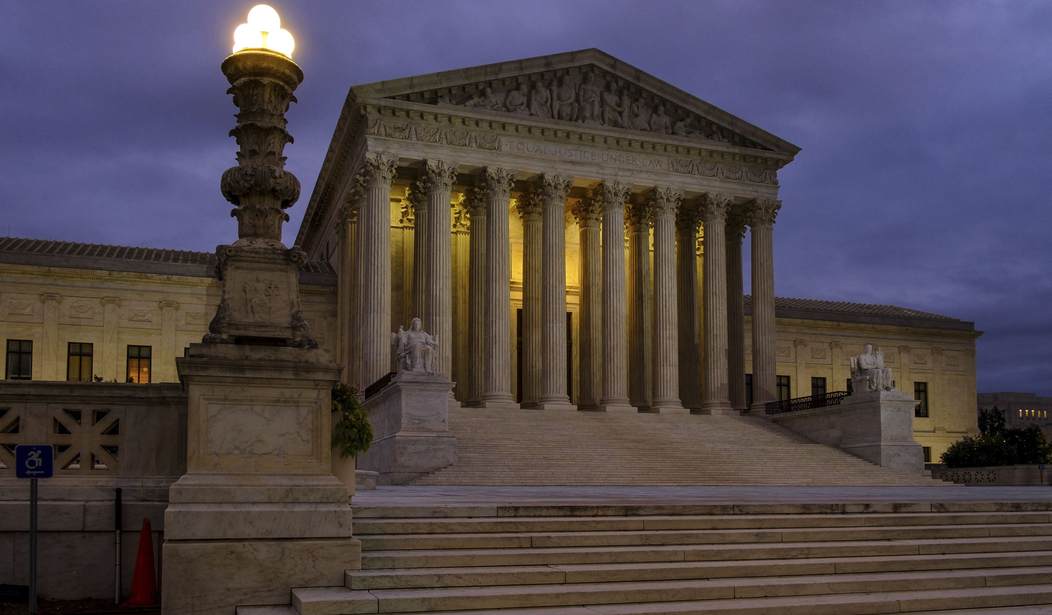
The U.S. Supreme Court heard arguments on April 1 in Barbara v. Trump, the case challenging President Trump’s executive order restricting automatic birthright citizenship for children born to those present illegally or on temporary visas. A ruling is expected before summer recess. Before the decision lands, the constitutional text and legislative record deserve a clear-eyed review.
Citizenship, properly understood, is not geography. It is allegiance. The 14th Amendment’s Citizenship Clause states: “All persons born or naturalized in the United States, and subject to the jurisdiction thereof, are citizens.” The five words that are at the center of the debate are: “subject to the jurisdiction thereof.” Senator Jacob Howard, the clause’s primary drafter, stated on the Senate floor in 1866 that the provision excluded foreigners and aliens. Senator Lyman Trumbull agreed: “subject to the jurisdiction” meant “not owing allegiance to anybody else.” That is a documented congressional record.
The modern interpretation derives from United States v. Wong Kim Ark (1898), which held that a child born to lawful, permanent residents was a citizen. That holding was correct on its facts. It did not extend automatic citizenship to children of tourists or unauthorized entrants—administrative practice did that, without legislative authorization, over the following century. The 1884 decision in Elk v. Wilkins confirms the narrower reading: a Native American born on U.S. soil was held not to be a citizen under the clause because his tribal allegiance placed him outside its jurisdictional scope.
The social contract tradition that the founders drew on requires mutual consent. Citizenship carries obligations that run in both directions—allegiance from the citizen, protection and service from the state. A nation that grants membership on the basis of geography alone has not extended freedom; it has dissolved the concept of membership. That dissolution has a compounding fiscal cost that no Congress ever voted to accept, and no court ever authorized.
The universal jus soli standard embedded in current practice was not the product of legislation or judicial decree. The State Department's Foreign Affairs Manual—agency guidance, not statute—became the operative interpreter of the 14th Amendment for every birth certificate and Social Security number issued for over a century. Congress never voted on this. The gap between Wong Kim Ark's actual holding and the standard that followed from it is documented. The constitutional record is available, and it does not support the current interpretation.
The practical consequence is industrialized birth tourism. In 2015, federal agents raided luxury apartment complexes in Irvine and surrounding South Orange County, operating as high-end birth tourism facilities. Clients paid $15,000 to $50,000 for packages including customs evasion coaching. 2018 raids followed in Los Angeles and Orange County. Each child born through these operations holds full U.S. citizenship and the eventual right to sponsor family through chain migration. With the national debt approaching $39 trillion, climbing at $7.5 billion per day, the fiscal case for reform is straightforward.
The international comparison is a useful context. The United Kingdom eliminated unconditional birthright citizenship in 1981. Germany, Australia, and virtually every other developed democracy moved on from universal jus soli decades ago. Of the roughly 33 countries that still maintain some form of automatic birthright citizenship, nearly all are in the Western Hemisphere. The United States is exceptional among peer democracies not because its Constitution requires this standard, but because no Congress has found the political will to correct it.
The remedies do not require a constitutional amendment. The Birthright Citizenship Act of 2025 (H.R. 569 / S. 304) would codify a parental legal status requirement into statute, bringing U.S. law into alignment with most developed democracies. The State Department can enforce existing law against birth tourism visa fraud. The Executive Branch can require parental legal status documentation before issuing federal credentials. None of these options exceeds existing legal authority.
If the Court rules against the executive order, the legislative remedies become more pressing, not less. The fight does not end with a ruling; it shifts to Congress and the regulatory agencies. The Center for Immigration Studies and the Claremont Institute have built the constitutional scholarship to sustain this debate through multiple legislative cycles.
American citizenship is the most valuable legal status on the planet. Its terms of membership deserve deliberate democratic decisions, not a century of administrative default that no Congress ever authorized. The Court has an opportunity to clarify what the Amendment’s authors actually wrote. Whatever the ruling in late June, the policy debate continues. The constitutional record is clear.
Jay Rogers is a financial professional with more than 30 years of experience in private equity, private credit, hedge funds, and wealth management. He has a BS from Northeastern University and has completed postgraduate studies at UCLA, UPENN, and Harvard. He writes about issues in finance, constitutional law, national security, human nature, and public policy.
Editor’s Note: Do you enjoy Townhall’s conservative reporting that takes on the radical Left and woke media? Support our work so that we can continue to bring you the truth.
Join Townhall VIP and use promo code FIGHT to receive 60% off your membership.


Join the Conversation
VIP members get the ability to comment on articles.