





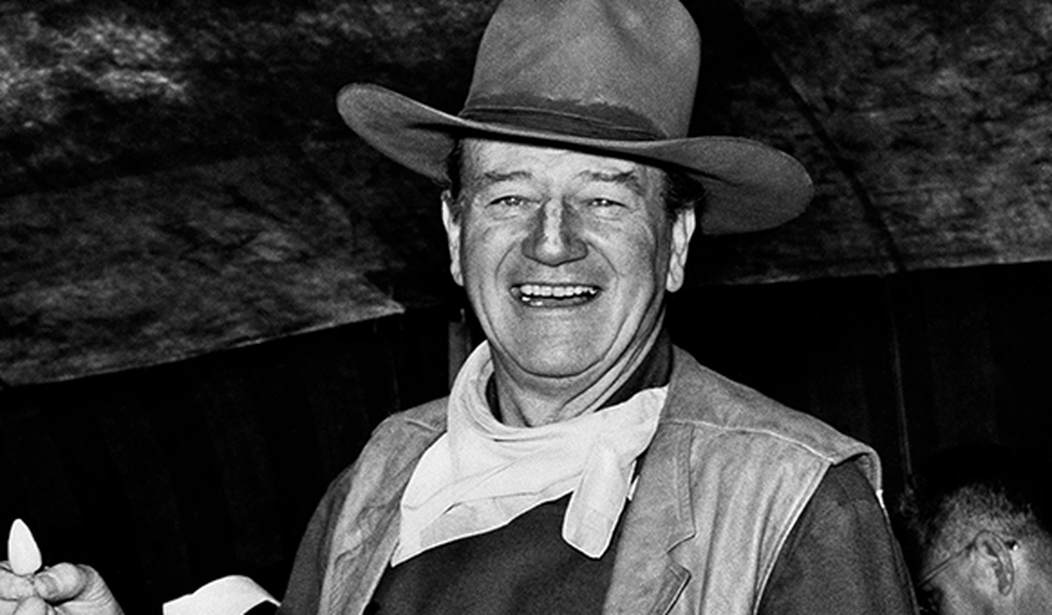
There is a scene near the end of True Grit (1969) that should be required viewing in every middle school in America. A battered, one-eyed U.S. Marshal named Rooster Cogburn, reins clenched between his teeth and a revolver in each hand, charges alone into a gang of outlaws across an open field — not because the odds favored him, but because the alternative was to leave a child to die. No committee. No permission slip. No retreat to examine his feelings about it. Just a man who decided the moment demanded action and answered it. That performance earned John Wayne his only Academy Award for Best Actor. More to the point, it put on screen something the current era is working to suppress: the archetype of the self-reliant American man.
This is not nostalgia. It is diagnosis. As a father whose son graduated from West Point, an Eagle Scout, a coach, and a decades-long student of American character, I do not look back at Wayne as a relic. I look at him as a blueprint.
Marion Robert Morrison was born May 26, 1907, in Winterset, Iowa. A bodysurfing accident broke his collarbone, ended his USC football scholarship, and left him no backup plan. So he hauled furniture in the prop department at Fox Film Corporation. Director Raoul Walsh saw him moving studio furniture and cast him in The Big Trail (1930), the role that gave him his screen name. The film flopped. Wayne spent the next eight years grinding through more than sixty B-picture Westerns. Then Stagecoach arrived in 1939. He had earned it.
It would be lazy to dismiss Wayne as two-dimensional. Marcus Aurelius wrote: "You have power over your mind — not outside events. Realize this, and you will find strength." Rooster Cogburn, Ethan Edwards in The Searchers, Tom Dunson in Red River — these are men who absorb reversal without requiring a support group. Stoic resilience, made cinematically legible. Aristotle's Nicomachean Ethics calls courage the mean between cowardice and recklessness — the deliberate choice to act despite fear. That is every Wayne character at the moment of consequence.
Wayne served as president of the Motion Picture Alliance for the Preservation of American Ideals and became Hollywood's most prominent anti-communist voice. According to biographer Michael Munn, Stalin was sufficiently threatened that he ordered the KGB to assassinate Wayne — reportedly around 1949. Nikita Khrushchev confirmed the order in a private 1958 meeting, telling Wayne: "That was a decision of Stalin during his last five mad years. When Stalin died, I rescinded that order." The account rests on secondary witnesses and is disputed by some historians. The underlying fear it reflects is not.
Contrast that with today's leading men, who treat the expression of a traditional value as an act of courage. Wayne stood before a hostile federal committee and named his convictions publicly. He did not negotiate his identity for better reviews.
The boys growing up today face a cultural environment hostile to the formation of masculine virtue. Schools pathologize competitive instinct. Entertainment has abandoned the aspirational male archetype for figures in perpetual emotional crisis. I have coached youth sports long enough to know the difference between a boy who has been taught that his drive is a problem and one who has been shown that his drive can be aimed at something worthy.
Wayne's body of work is the counternarrative. Not reactionary, foundational. Discipline, accountability, the capacity to act without external validation: these are not obsolete values. They built functioning families, coherent communities, and deployable soldiers. Wayne once said: "Tomorrow is the most important thing in life. Comes into us at midnight very clean. It's perfect when it arrives, and it puts itself in our hands." That is Aristotle in a Stetson. The Duke earned his legacy the hard way. The rest of us have no excuse for doing otherwise.
Jay Rogers is a financial professional with more than 30 years of experience in private equity, private credit, hedge funds, and wealth management. He has a BS from Northeastern University and has completed postgraduate studies at UCLA, UPENN, and Harvard. He writes about issues in finance, constitutional law, national security, human nature, and public policy.
Editor’s Note: Do you enjoy Townhall’s conservative reporting that takes on the radical Left and woke media? Support our work so that we can continue to bring you the truth.
Join Townhall VIP and use promo code FIGHT to receive 60% off your membership.


Join the Conversation
VIP members get the ability to comment on articles.