





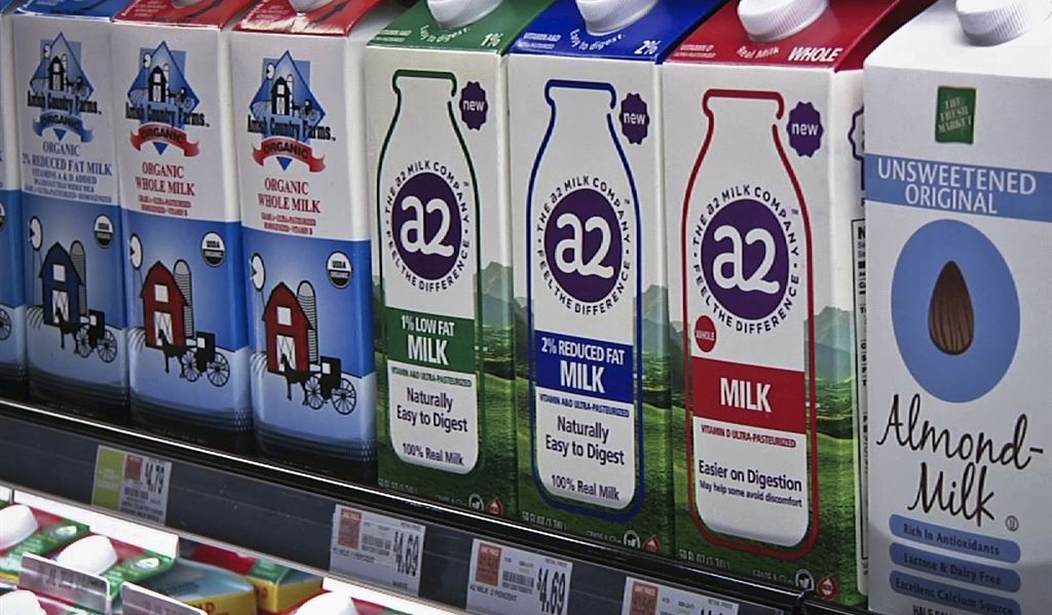
Despite what vegan virtue-signalers would have you believe, ditching dairy won’t help save the planet.
Now that the myth that our everyday purchasing choices and diets can stop the changing climate, veganism has become synonymous with saving the planet. As more and more people bump the environment up their list of political priorities, the market for non-dairy “milk” grows.
Veganism is taking hold more than ever before, especially among the young. Almost half of all vegans are under the age of 35, no doubt driven by a desire to stop climate change. While China churns out new coal power plants at a rate of knots, veganism has somehow become synonymous with saving the planet in the West. As a result, dairy milk is out of fashion and the demand for products to replace it is booming.
Among the young, middle-class, and eco-conscious, sales of non-dairy alternatives are skyrocketing. Despite a recent spike in oat milk sales, arguably the biggest runaway success in the non-dairy beverage market over recent decades is soy. According to the World Wide Fund for Nature, global soybean production is 15 times higher today than it was in the 1950s.
That’s unsurprising given the level of demand for the product in the West. Soy “milk” sales are booming. American households are spending almost $200 million per year on soy beverages. Unfortunately, whatever soy drinkers might think, their beverage of choice is a disaster for the environment.
Soy production is a major driver of deforestation, especially in the Amazon. Its production is wildly inefficient, meaning you have to chop down a lot of trees to produce a modest amount of soy “milk.” Soy contributes much more than its fair share to the loss of biodiversity. It causes soil erosion since the soil is often not protected by vegetation. That leads to the loss of topsoil, which is detrimental for plant growth.
The growth of the soy industry has led to the displacement of entire communities in some parts of the world, where people rely on their natural environment to survive, only to see it pummeled by big companies making soy “milk” to sell in the West. The waste generated by soybean production is difficult to dispose of and often leads to damaging pollution. And as if all that wasn’t enough, soy production emits a hefty amount of greenhouse gases – the same charge leveled at dairy farming.
Greenhouse gas emissions from dairy farming are substantial too, of course, but innovation is doing what it does best by making the production of dairy milk much less harmful to the environment in cost-effective ways at every level, from farm to industry. Emissions have already fallen by a whopping 16.1 percent since 1990 and it doesn’t stop there. A new initiative backed by Jeff Bezos and Bill Gates is working on a seaweed-based supplement for cows which drastically reduces their methane output. Even a pessimist would struggle to argue that the dairy industry will be a significant net contributor to climate change for many more years.
There are other non-soy alternatives to milk, of course, but each has its own problems. Almond “milk” production requires so much water it has contributed to Californian droughts, and its pollination requirements are so strenuous it demands 70 percent of commercial bees in the US, killing around a third of them each season.
Meanwhile, coconut farming acts as a wrecking ball for soil’s fertility nutritional qualities, making it much more difficult to use that land productively in the future. Oat drinks often contains glyphosate and the fact that oats are used as animal feed leads to some obvious hypocrisy where veganism is concerned. Rice beverage production emits methane, just like cows – and sometimes contains arsenic.
Putting aside recent volatility in milk prices thanks to Bidenomics, all these non-milk products are also considerably more expensive than dairy milk, making veganism the preserve of the righteous middle and upper classes. Perhaps most importantly, all these milk alternatives taste abysmal in comparison to the real thing. In some cases, they can’t even be legally marketed as ‘milk.’
Ultimately, those insisting we taper our lifestyles to stop climate change appear to resent technological progress and wish the Industrial Revolution had never happened, so these products’ poor taste probably doesn’t bother them too much. It might even feed into their guilt complex, satisfying their thirst for noble self-sacrifice on the altar of green wokery.
Meanwhile, right-thinking folk will continue drinking dairy milk until the cows come home. Innovation is making farming more sustainable before our eyes. If the planet is dying, it’s thanks to the rampant pollution of China – and no amount of horrid-tasting soy “milk” on your cornflakes is going to change that.
Jason Reed is a writer on politics, policy, and culture for a wide range of outlets on both
sides of the Atlantic. He tweets @JasonReed624.



Join the Conversation
VIP members get the ability to comment on articles.