





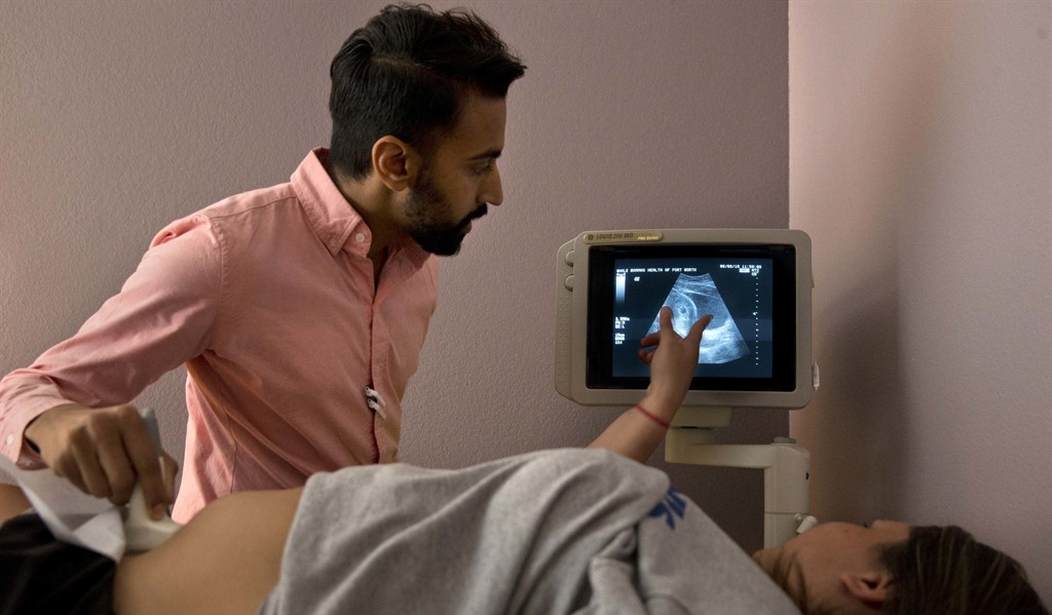
Last week, a YouTube influencer with millions of followers announced that he and his wife had terminated their pregnancy after receiving a Trisomy 21 diagnosis. The post went viral. The backlash was fierce. And somewhere in the middle of all of it, a conversation that rarely happens in public became a national news story.
I have a five-year-old daughter named Josie. She has Down syndrome.
For decades, the abortion debate has been waged in abstractions. Supporters don't call themselves pro-abortion. They call themselves pro-choice. The child in the womb isn't referred to as a baby. It's a fetus. A clump of cells. A pregnancy. The language is deliberate, and it serves a purpose: distance. Distance from what abortion actually is.
This distancing works remarkably well until it doesn't.
When a couple announces they terminated a pregnancy because their child had a specific genetic diagnosis, something shifts. Suddenly, the abstraction collapses. We're not talking about a clump of cells anymore. We're talking about a child with a diagnosis. A child who, even without a name, has an identity. A child whose chromosomes we can describe in clinical detail. A child who, ironically, is easier to recognize as a person precisely because we can identify what makes them different.
Down syndrome is caused by an extra copy of chromosome 21. It is, by definition, a genetic anomaly. And a genetic anomaly is proof of something important. This is a distinct human being with their own unique DNA. Not an extension of the mother's body. Not generic biological material. A person, genetically distinct from the moment of conception, with a condition written into every cell.
Here's what troubles me. The same people who support abortion access without qualification will often express genuine sadness about killing a baby because of a Down syndrome diagnosis. They'll say it's a tragedy. They'll say they understand, but it's hard. They'll feel something in their gut that they can't quite explain. And I think that instinct is telling them something true.
We don't feel that way about the removal of a tumor. We don't grieve the loss of an appendix. We grieve an abortion because we know, even those who work very hard not to know, that we're talking about a life.
The influencer's post cited a statistic that stopped a lot of people in their tracks. Up to 90 percent of women terminate pregnancies after a Down syndrome diagnosis. He shared it matter-of-factly, as context. But for those of us raising children with Down syndrome, that number lands differently. It means that my daughter's peers, the children she could have grown up alongside, are largely absent. Not because Down syndrome is incompatible with life. But because we decided at scale that their lives weren't worth continuing.
Josie is five. She is stubborn, funny, and obsessed with her favorite show, Boss Baby. She goes to school, makes friends, and has opinions about what she wants for breakfast. It’s almost always pepperonis. Her life is not a tragedy. Her life is about triumph and her ability to overcome obstacles every day.
I work at Alliance Family Services, which operates a network of pregnancy medical clinics. Every day, we serve women facing unexpected, frightening, complicated pregnancies. I understand what fear does to a person. I understand that a prenatal diagnosis can feel like the ground is rattling beneath you. I have enormous compassion for any parent sitting in a doctor's office, hearing news they never expected.
But compassion for the parents cannot come at the expense of honesty about the child. What happened this week was painful. But it was also clarifying. When abortion has a face, a diagnosis, a set of characteristics we can name, we stop pretending it's a simple medical procedure. We start feeling the weight of it. And that instinct, that unease, that grief, deserves to be taken seriously rather than argued away.
The conversation we rarely have is the one that matters most. It’s not whether we have the legal right to make this choice, but what we lose when we make it. And who we're deciding, quietly and in enormous numbers, doesn't belong here.
Josie belongs here. So do all the others.
Editor’s Note: Do you enjoy Townhall’s conservative reporting that takes on the radical Left and woke media? Support our work so that we can continue to bring you the truth.
Join Townhall VIP and use promo code FIGHT to receive 60% off your membership.

Join the Conversation
VIP members get the ability to comment on articles.