
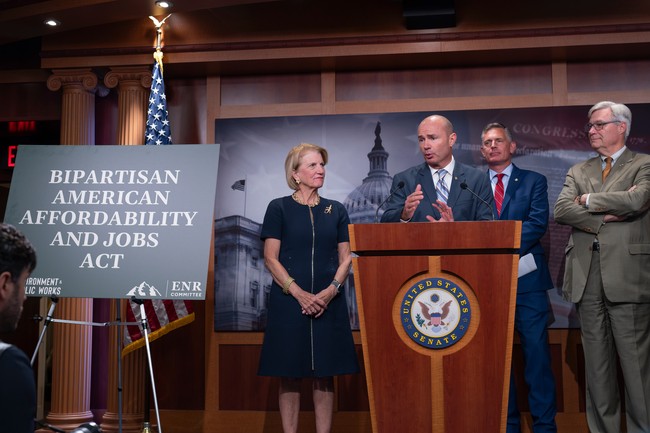
One of the most comprehensive permitting-reform bills to date, the Bipartisan American Affordability and Jobs Act (BAAJA), has passed the Senate and is on its way to the House of Representatives. While Congress must work to meet today’s rising energy demand and streamline project approvals to boost American innovation, permitting reform shouldn’t come at the expense of states' rights, which is what this bill does.
Sponsored by Sen. Shelley Moore Capito (R-WV), BAAJA modifies federal permitting processes, including environmental reviews under the National Environmental Policy Act. While it’s probably usually a good idea to limit environmental reviews, it shouldn’t come at the expense of states’ autonomy. BAAJA would shift power away from states to the federal government. Washington shouldn’t be overriding states to decide where power lines go, whose land they cross, and who pays for them.
To pass the strongest permitting reform, Congress must fix the provisions that infringe on states' rights before final passage. Republicans have until Congress adjourns for the year to make those fixes while they still hold the majority.
Republicans have long raised alarms about federal overreach, and BAAJA should put them on high alert. Any power the bill hands to the federal government today could be used by a Democrat administration tomorrow, whether that means approving power lines over a state’s objections or making families in red states pay for power lines that serve blue states, leaving states with no ability to stand their ground.
Farmers and ranchers who depend on their land to make a living deserve a say in whether a power line cuts across it. Many of these families have worked the same fields for generations and hope to pass them down to their children, and a single decision made in Washington can change that land forever. States have long led the way on siting and permitting these projects, because state regulators hold local hearings, know the land, and answer to the ratepayers who pay the price. Decisions about a family’s land belong with the people closest to it, and Republicans who have fought federal overreach for decades should object to handing those decisions to unelected officials in Washington.
BAAJA expands the federal government’s power to approve interstate power lines over a state’s objections. If a state doesn’t act on a project within a year, federal regulators can approve it themselves, and the developer can then use federal eminent domain to take private land and farms. Large out-of-state developers could go straight to federal regulators and bypass local communities and state officials entirely. Proposed amendments from Sen. Josh Hawley (R-MO) would address some of these challenges head-on, giving states more time to weigh projects, returning decision-making power to the states, and ensuring property owners are properly compensated when their land is taken.
The bill also writes a Biden-era power grid rule into law, turning a regulation that a future commission could revisit into permanent statute. The rule aligns with ineffective Green New Deal policies, and its regional plans could shift costs to farmers and landowners in neighboring states who won't reap the benefits. North Dakota has challenged one such plan, which could cost its customers $5 a month for decades for renewable energy lines in neighboring states. The bill says costs must track benefits, but regional grid operators calculate those benefits with their own models, and those estimates are easy to inflate. Families in red states could be stuck paying for power lines in blue states that will never deliver electricity to their homes, a deal that no family should be willing to take.
Emerging technologies and innovation will require a bigger and faster grid, but those aspirations shouldn’t steamroll states’ ability to oversee what happens within their borders. As it stands, speeding up projects has the unintended consequence of ceding that power to Washington. Fortunately, the fixes are narrow: keep states in charge of what gets built within their borders, protect landowners from federal eminent domain, and make sure customers pay only for projects that benefit them.
Republicans have long championed states’ rights and stood against federal overreach, and they should insist on these fixes while they still can, before Congress adjourns for the year and Democrats take control in January. They will have no qualms about trampling states' rights at all.
Jared Whitley is a longtime D.C. politico, having worked in the U.S. Senate, White House, and the defense industry. He has an MBA from Hult Business School in Dubai. This year, the Society of Professional Journalists named him among the best columnists in the Intermountain West.