





After long and difficult negotiations, an agreement was recently concluded in Vienna between Iran and six Western powers, including the United States, to curb that nation’s nuclear weapons program.
The discussions highlight two stark facts: First, that however difficult the negotiations, implementing the terms of the agreement will be equally if not more challenging. And second, that atomic weapons are relatively easy to manufacture by nations with sufficient scientific and technological expertise.
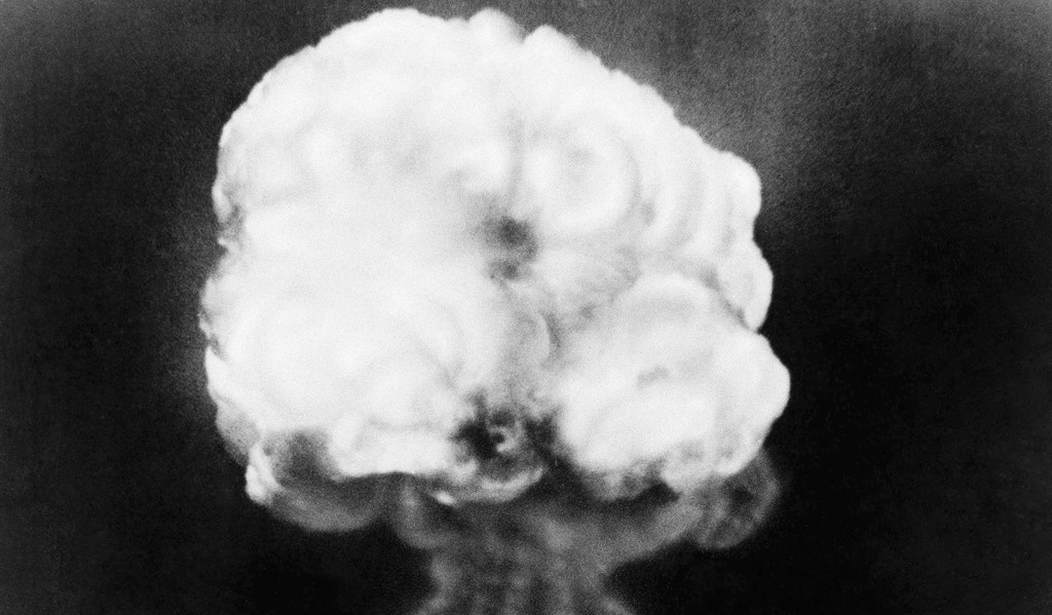
On this last point, it is worthwhile remembering the events of 70 years ago in order to better understand the issues of today. On August 6 and 9, 1945, the United States dropped atomic bombs on the Japanese cities of Hiroshima and Nagasaki. The Second World War with all of its horrors and brutalities was at last brought to an end. Those early weapons, produced in secret during the war and at great expense, were the products of one of the greatest scientific and technological enterprises of all time. We know it today by its popular name, the Manhattan Project, and it was driven by an Army general named Leslie R. Groves and under him, the development of the bomb by his scientific director, J. Robert Oppenheimer. This unusual and unexpected partnership made possible not only the comparatively simple atomic bombs of World War II, but subsequent generations of increasingly powerful thermonuclear weapons.
We should also note that just over seven decades ago, the United States was fighting a war on multiple fronts and with private industry converted to meeting the needs of a massive war effort by producing everything from uniforms to bombers, artillery shells to tanks. Despite this all-out effort, the nation also spent two billion dollars employing thousands of talented scientists and engineers and hundreds of thousands of civilian workers, and building a network of production plants solely for an enterprise that had no sure guarantee of working: the creation of a new and destructive weapon based on the power of splitting atoms. And yet, that is exactly what America did when it created the Manhattan Engineer District in 1942, and over the next two and a half years, constructed, among other installations, a colossal plant to process uranium in Oak Ridge, Tennessee; giant reactors in Hanford, Washington, to generate plutonium; and an isolated laboratory high in the Jemez Mountains of New Mexico to design and build the bombs themselves.
By good fortune, the man running the Manhattan Project was General Groves, an Army engineer who before the war oversaw construction of the new Pentagon building in record time and under budget. Smart, ambitious, and a gifted administrator, he ran the project with indefatigable energy. Also fortunate was his choice of the scientist to lead the design and development of the new bomb at the laboratory in New Mexico, the brilliant theoretical physicist, Robert Oppenheimer. Although he lacked administrative experience, Oppenheimer made up for this with an unusual intellectual versatility and ability to inspire.
Named after the mesa top it occupied, the Los Alamos Laboratory worked its way through difficult theoretical questions and challenging engineering hurdles over a period of two and a half years. Two versions of an atomic bomb were designed and built and given the nicknames Little Boy and Fat Man. In August 1945 the boy fell on Hiroshima, the man on Nagasaki. Most Americans at the time believed their use ended the war. The atomic bomb undeniably changed the course of history, and one of its legacies is that the principles and techniques developed at Los Alamos for creating a nuclear explosion are still applicable today. That knowledge—the “secret” of the atomic bomb—would not stay secret very long. Even in 1945, Groves and Oppenheimer understood that the genie was out of the bottle.
Today, eight nations are known to possess nuclear weapons: China, France, India, North Korea, Pakistan, Russia, the United Kingdom, and the United States. Other countries no doubt hope to acquire them. The recently completed negotiations in Vienna are only the latest attempt to keep the list at eight, but realistically, the fight to halt the further spread of weapons will no doubt continue far into the future.
This is the legacy of the Manhattan Project and of the partnership between general and physicist.
“The General and the Genius: Groves and Oppenheimer — The Unlikely Partnership that Built the Atom Bomb” is available here.



Join the Conversation
VIP members get the ability to comment on articles.