





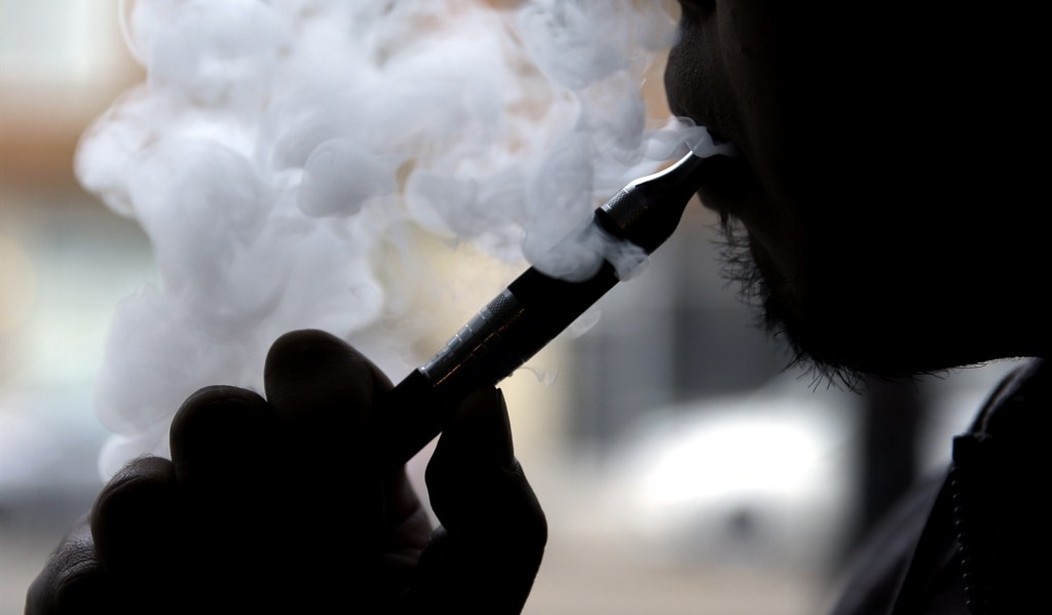
In the stock room at Division Vapor in Portland, Oregon, a sign affixed to a metal rack holding various nicotine solutions reminds employees to "Censor Before (You) Stock!" The sign alludes to state regulations that require merchants to obscure allegedly child-enticing images and words before displaying vaping products to their adult customers.
The law that authorizes those bewildering rules, which in many cases require covering almost the entire label of products sold in stores that do not even admit minors, is at the center of a case that the Oregon Supreme Court considered this week. The case illustrates how concerns about underage vaping have become a pretext for overriding the rights of adult consumers and the businesses that serve them, including the right to communicate and receive information about potentially lifesaving products that offer a harm-reducing alternative to conventional cigarettes.
In 2015, Oregon legislators enacted a law that prohibited the sale of vaping products "packaged in a manner that is attractive to minors." It charged the Oregon Health Authority with explaining what that meant.
The resulting regulations offer a "non-exclusive list" of packaging features that the OHA deemed "likely to appeal to minors," including images of "food or beverages ... such as candy, desserts, soda, (and) food or beverages with sweet flavors including fruit or alcohol." Also forbidden: "terms or descriptive words for flavors that are likely to appeal to minors such as tart, tangy, sweet, cool, fire, ice, lit, spiked, poppin', juicy, candy, desserts, soda, (and) sweet flavors including fruit, or alcohol flavors."
The premise of these rules is that such flavors appeal to teenagers, which is true. But they also demonstrably appeal to adult smokers looking for a less hazardous form of nicotine consumption.
Survey data indicate that adults who switch from smoking to vaping overwhelmingly prefer the flavors that the OHA views as juvenile. That much is also evident from the products offered by businesses like Division Vapor, which cater exclusively to adults.
The OHA's regulations require vape shops to actively conceal information that their customers want. "We spend three or four hours a week -- employees making $13 to $18 an hour -- putting labels over offending material," Division Vapor owner Paul Bates said when he challenged the state's regulations with help from the Goldwater Institute in 2018.
That "nitpicky work," Bates added, is a "waste of money ... when we could be using that money to help people transition from smoking to vaping." The state-ordered censorship also means customers must ask employees for information that ordinarily would be on the label, which is doubly frustrating.
As a result of the state's requirements, according to Bates' lawsuit, "Division Vapor has been forced to cease selling certain product lines because the labels must be completely covered by censorship stickers, rendering sale of these products economically impracticable." That burden, he argues, is not just counterproductive and nonsensical; it violates the Oregon Constitution's free speech guarantee.
Last year, a state appeals court agreed, ruling that the law authorizing the OHA's label censorship is "unconstitutional on its face." The ban on packaging deemed "attractive to minors," it said, "does not regulate the effect of a sale to a minor or a minor's later use of the product"; instead, it restricts "the expressive content of the packaging of products legally sold to consenting adults."
The Goldwater Institute thinks the Oregon Supreme Court, which is now reviewing that decision, should go further. It argues that Oregon's law is unconstitutionally vague and that the OHA's "non-exhaustive list" of prohibited packaging characteristics violates the right to freedom of speech.
"I'm grateful the appellate court struck down the government's attempt to stop me from communicating with my own customers," Bates says. "Shouldn't my customers have access to the truthful, accurate information they need to make wise choices?"
The answer seems obvious. But for politicians and regulators eager to pose as guardians of the nation's youth, virtue signaling trumps civil liberties as well as common sense.
Editor’s Note: The Schumer Shutdown is here. Rather than put the American people first, Chuck Schumer and the radical Democrats forced a government shutdown for healthcare for illegals. They own this.
Help us continue to report the truth about the Schumer Shutdown. Use promo code POTUS47 to get 74% off your VIP membership.



Join the Conversation
VIP members get the ability to comment on articles.