





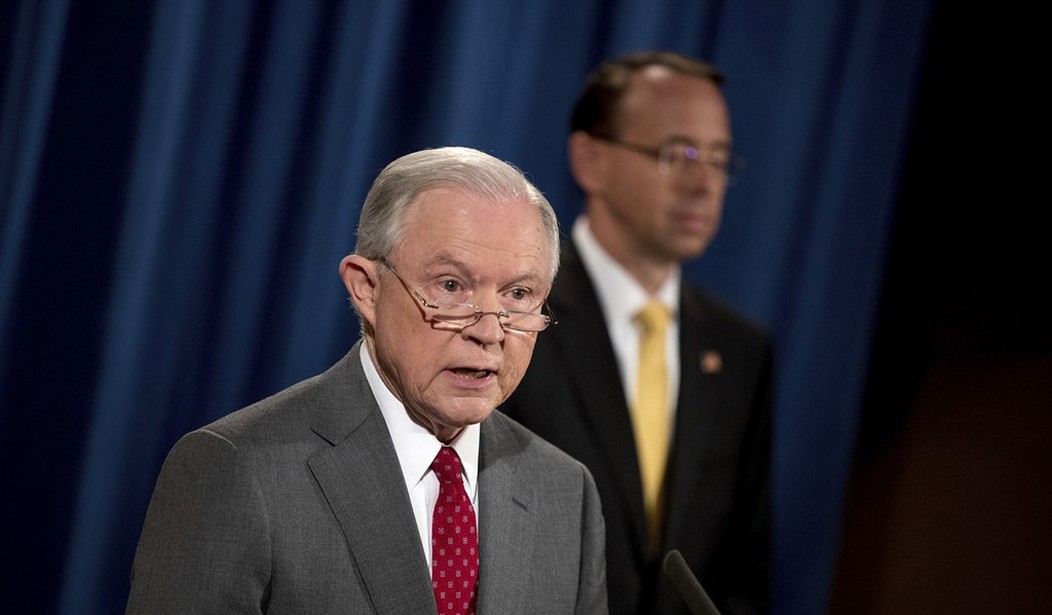
Attorney General Jeff Sessions has moved swiftly to encourage the use of mandatory minimum sentences and civil asset forfeiture, two major weapons of a war on drugs he seems bent on escalating. But six months after taking office, Sessions, despite his well-known anti-pot prejudices, has not challenged the legalization of marijuana in any serious way, and it is starting to look like he may never do so.
Last week the Associated Press reported that an advisory panel Sessions charged with studying the issue "has come up with no new policy recommendations to advance the attorney general's aggressively anti-marijuana views." While that may seem surprising, there are sound practical and political reasons for Sessions to think twice before trying to shut down the state-licensed marijuana businesses that blatantly violate federal law every day.
Sessions has made no secret of his displeasure at the ongoing collapse of marijuana prohibition. But so far his concerns have not resulted in any prosecutions, forfeitures, or even threatening letters. Nor has he tried to challenge state marijuana laws in federal court.
Instead Sessions has been waiting for advice from the Justice Department's Task Force on Crime Reduction and Public Safety. According to the A.P., which obtained parts of the task force's unpublished interim report, that advice is "vague" and "tepid," recommending a wait-and-see approach little different from the Obama administration's.
The report does say the Justice Department "should evaluate whether to maintain, revise or rescind" the 2013 memo from Deputy Attorney General James Cole that established a policy of prosecutorial restraint regarding state-legal cannabusinesses. But the task force does not advocate any of those options, and Sessions does not seem inclined to scrap the Cole memo, which he has called "truly valuable in evaluating cases."
The memo leaves lots of leeway for more vigorous enforcement of the federal ban on marijuana. It lists eight "enforcement priorities" that could justify federal action against state-licensed marijuana producers and distributors, several of which are so ambitious (e.g., preventing marijuana from crossing state lines) or so broad (e.g., preventing "adverse public health consequences") that they could always be used as a pretext for prosecution.
Sessions, who as a senator complained that the Obama administration was not taking the memo's conditions seriously enough, recently sent Washington Gov. Jay Inslee and Attorney General Bob Ferguson a letter asking how they plan to address several concerns related to the enforcement priorities, including interstate smuggling, stoned driving, and underage consumption. If he is not satisfied by their response, Sessions theoretically could take matters into his own hands, but a cannabis crackdown would not necessarily deliver results he likes.
Since all but one of the eight states that have legalized marijuana for recreational use allow home cultivation, shutting down state-licensed cannabusinesses would undermine federal enforcement priorities by making production and distribution less visible and harder to monitor. So would a lawsuit that successfully challenged state licensing and regulation of marijuana merchants as contrary to the Controlled Substances Act.
Sessions also may be reluctant to further irk a boss who has been publicly castigating him for weeks over his handling of the investigation into Russian meddling in the presidential election. While running for president, Donald Trump repeatedly said he favors allowing medical use of marijuana, as 29 states now do. Trump was less keen on legalizing recreational use but said the decision should be left to the states.
Abandoning that commitment to marijuana federalism would be politically risky. According to a Quinnipiac University poll completed last week, 61 percent of Americans support marijuana legalization, which makes that policy considerably more popular than Trump. An even larger majority, 75 percent, opposes federal interference with state marijuana laws.
Sessions can't stop marijuana legalization, but he could slow it down. The fact that he has not tried suggests that even an old-fashioned pot prohibitionist who thinks "good people don't smoke marijuana" can see the disadvantages of pursuing a policy that is unpopular as well as ineffective.

Join the Conversation
VIP members get the ability to comment on articles.