





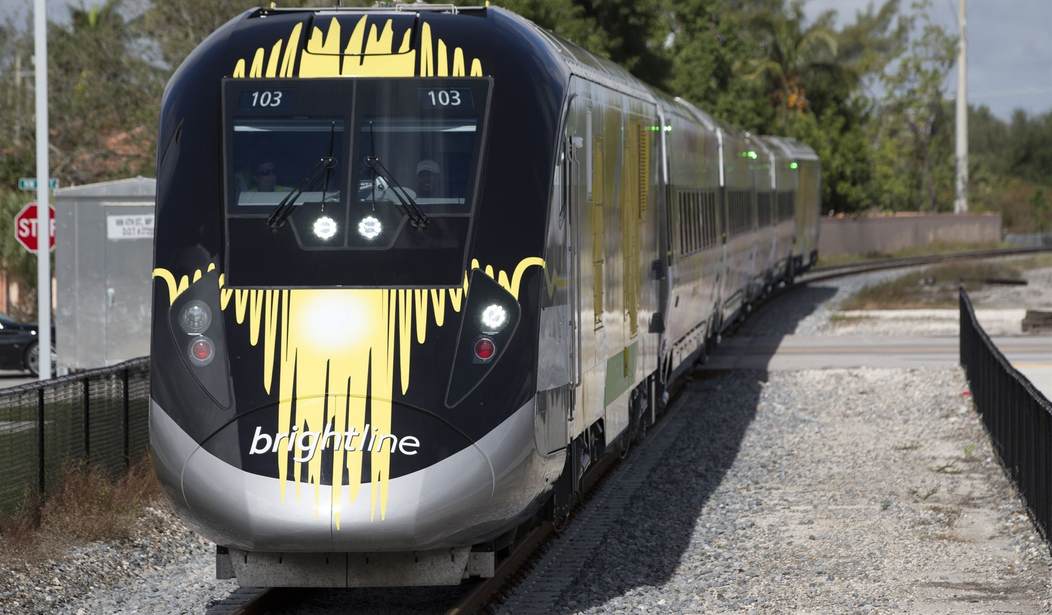
When Brightline launched its Florida service in 2018, it promised to slash traffic and offer a genuine alternative to driving. Eight years and billions of dollars later, that promise has turned into a financial train wreck. Instead of focusing on a busy corridor, Brightline poured money into a route with too few passengers to ever turn a profit—and now it’s back, hat in hand, asking for another $6 billion.
The numbers don't lie—Brightline is a sinking ship. Despite assuring Congress in 2017 that it would need no subsidies, Brightline has already received over $486 million from four different Department of Transportation (DOT) programs:
- The Consolidated Rail Infrastructure and Safety Improvements (CRISI) Program,
- The Restoration and Enhancement Grant Program,
- The National Railroad Partnership Program, and
- The Corridor Identification and Development Program.
Taxpayers funded stations in Miami, Aventura, and Boca Raton. They're also paying to add cars to trains that run half-empty. Furthermore, they're covering the cost of a new bridge over the St. Lucie River. Finally, they have paid for studies to add new routes even though the existing route isn't working.
Despite the subsidies, Brightline lost $233.1 million in 2025 and isn’t even paying interest on its debt. Meanwhile, Fitch has downgraded its bonds to junk. The company predicted $633 million in annual revenue, but only earned $214 million. It predicted six million riders, but only carried three million.
Brightline's fundamental problem isn’t the quality of its trains; it’s the route. When Brightline opened its Orlando service in September 2023, it was already doomed to fail. There were too few travelers between Orlando and Miami. For context, in the first quarter of 2023, only 724 air travelers per day flew between those cities. In comparison, there were 28,898 between New York and South Florida during the same period.
Only 37,000 vehicles use Florida’s Turnpike between Orlando and South Florida daily. Of those, 20 percent are trucks carrying freight. Meanwhile, 227,000 vehicles travel I-95 within South Florida each day. There are also 100,000 vehicles per day using I-95 in the Northeast Corridor. The passenger base simply isn’t between Orlando and Miami.
Brightline is also the deadliest passenger railroad in the United States. As of July 3, 2026, 221 people have died in accidents involving Brightline trains. Even after a $45 million safety effort, its death rate remains the highest in the nation. By 2024, 24.55 people had died per million train- miles traveled. The second-worst, Coaster in Southern California, had 16.6.
Worse, Brightline and its supporters have often blamed the victims. A deaf man who never heard the train. A woman who tripped and fell in the dark. On Instagram accounts tracking Brightline deaths, the comments are cruel.
One commenter noted, “The Darwinism Express doing the Universe’s work.”
Another stated, “If you get hit by a train, you deserve it.”
Brightline is not only a failing business, but it’s a safety hazard wrapped in arrogance.
Despite all this, the Biden administration gave Brightline a $3 billion loan to build a new route. The new route, dubbed Brightline West, would connect Las Vegas and Rancho Cucamonga. The problem is, its construction costs have ballooned from $8 billion to $21.5 billion. As a result, Brightline is begging for another $6 billion loan to finish the job.
Why should the DOT hand over another $6 billion to a company that can’t repay its existing loans? Since the planned route ends in Rancho Cucamonga, it is very unlikely to succeed. Passengers from Los Angeles would have to travel 42 miles to reach the station. It's also worth noting that the population of Los Angeles is in decline. Population decline reduces the passenger base, further diminishing the chance of success.
Given these factors, there is no realistic way for Brightline West to be profitable. The company will probably lose even more money on this route than it currently does in Florida.
Brightline’s failure doesn't mean that passenger trains can't be profitable elsewhere. In Australia, the Ghan is profitable without subsidies. Canada’s Rocky Mountaineer offers stunning trips through the Rockies—also without subsidies. The difference is that they chose routes that people actually want to ride.
Brightline's supporters often point to Amtrak's record ridership last year as a reason to subsidize Brightline. However, these figures are misleading.
For instance, ridership on Amtrak's high-speed Acela trains actually fell by 12 percent. It fell from 3.58 million passengers in FY2019 to 3.15 million in FY2025. Meanwhile, the slower Northeast Regional trains saw a 34 percent increase. It grew from 8.94 million passengers in FY2019 to 12.02 million by FY2025.
Without the growth of the Northeast Regional, Amtrak would not have set a ridership record. Ultimately, since Brightline does not operate in the Northeast, Amtrak's ridership growth is irrelevant to Brightline's prospects.
The bottom line is, Brightline does not deserve another red cent of taxpayer money. Instead of throwing good money after bad, Secretary Duffy should reject Brightline's $6 billion loan application. The DOT should not reward a company that has failed riders, taxpayers, and safety. Brightline’s Florida route is a loss-ridden boondoggle. Its Las Vegas dream will only add another construction-cost nightmare.
If Brightline cannot get its own house in order, then it should die on the tracks it was built on—not on the backs of American taxpayers.



Join the Conversation
VIP members get the ability to comment on articles.