







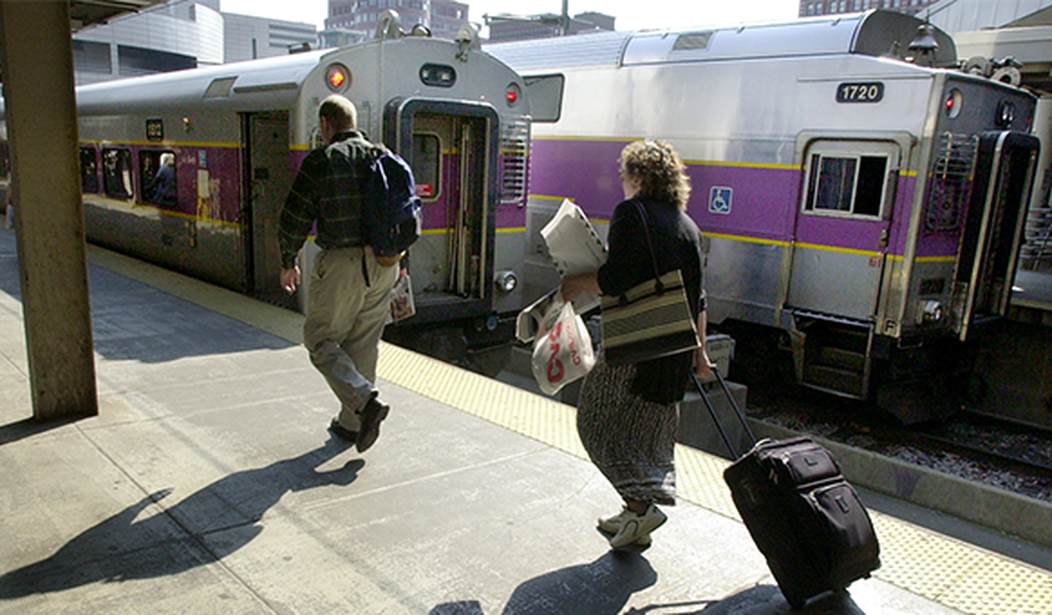
As the Department of Government Efficiency (DOGE) seeks to end wasteful subsidies, it is crucial to focus on Amtrak. Founded in 1971, Amtrak began as an "experiment" to see if passenger trains could make money. Yet, with routes drawn for political gain rather than public need, it has lost money ever since. Instead of throwing good money after bad, DOGE and Congress should cut Amtrak's subsidies to $0 in 180 days.
To put things in perspective, Amtrak's long-haul routes lost $635.1 million in FY2024. Short-haul, state-supported routes didn’t fare any better, losing another $565.6 million. Even the busy Northeast Corridor loses money with depreciation factored in. This financial drain isn't new; America's passenger trains have lost money for 79 years.
While Amtrak announced a "ridership record" for FY2024, this figure is misleading. In reality, Amtrak only transported 6.5 billion passenger-miles in FY2024. This is a decrease of 3.4% since FY2013.
Amtrak's advocates often cite highway "subsidies" to explain its financial struggles. Yet, Amtrak guzzles about 39 times more subsidies per passenger-mile than highways do. In 2022, highways received $90.5 billion in subsidies. This facilitated 5 trillion highway passenger-miles. In contrast, Amtrak received $3.5 billion in subsidies. Yet, this accounted for only 4.9 billion passenger-miles.
Despite experiencing huge losses, Amtrak awarded $5 million in bonuses in FY2023 with fourteen of its top leaders receiving over $200,000 each.
In stark contrast, America’s privately-owned freight railroads are thriving. In fact, America’s freight trains remain solvent even when competing with trucking. Unlike trucks, which use public roads, freight railroads maintain their own tracks. Yet, they do not receive government subsidies. Why should Amtrak?
Amtrak's advocates often label its unprofitable routes as “essential services.” Yet, the reality is that Amtrak accounts for a minuscule 0.001% of passenger-miles. For every small town served by Amtrak, there are at least 40 others without any train service. If Amtrak were to vanish, travelers would still have many options. On many routes, it would cost less to buy each passenger a free airline ticket than to subsidize Amtrak. To illustrate, the average airfare in 2024 was around $0.23 per passenger-mile. This is much lower than Amtrak’s FY2024 subsidies of $0.91 per passenger-mile.
Amtrak also invested $181.2 million in the Point Defiance Bypass, which opened in 2017. This new route reduced travel time between Seattle and Portland by a mere 10 minutes. Yet, the inaugural train derailed, resulting in three fatalities and injuring 65 others. A federal investigation revealed that speeding was the cause of the derailment.
Amtrak's website once touted the environmental advantages of train travel. Yet, that doesn’t justify its subsidies either, as Amtrak removed this webpage in January 2025. This action suggests that Amtrak exaggerated its claims about environmental benefits. Amtrak's most popular routes, such as the Auto Train, could thrive without subsidies. Beyond them, cars, buses, or airplanes could be more efficient than Amtrak’s services.
The way passenger trains have operated for the last 79 years is obsolete. Yet, ending Amtrak’s subsidies wouldn’t spell the end for passenger trains. Rather, it would end an outdated policy that has squandered taxpayer money since 1971.
Today’s travelers often seek scenic an enjoyable train experiences over ordinary transportation. Successful models such as Australia’s Ghan and Indian Pacific operate without subsidies. With subsidies ended, some American passenger trains could find profitability too.
It has happened before. The 1980 Staggers Act ended heavy government regulation of freight railroads. This change rescued the industry from the brink of bankruptcy, paving the way for a host of benefits. Operational efficiencies soared, prices dropped, and routing improved. This resulted in an estimated $20 billion in annual benefits for American consumers. In a similar way, reducing Amtrak's subsidies to $0 within 180 days is the solution.
Congress has already exhausted ways to limit the growth of Amtrak's subsidies. Over the past 54 years, none of its efforts at reform have yielded meaningful results. The only way to free up resources for more efficient train services is to end the subsidies. It's time for DOGE and Congress to stop issuing blank checks and cut Amtrak's subsidies.


Join the Conversation
VIP members get the ability to comment on articles.