





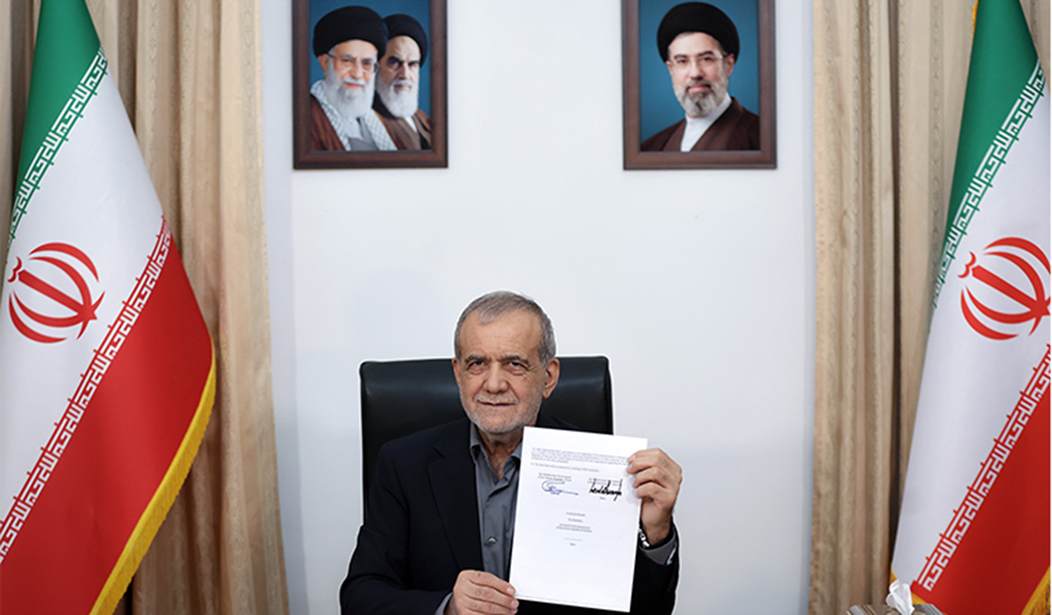
In contemporary warfare, victory is increasingly determined by influencing key decision-makers and molding public opinion outside the combat theater.
Nowhere is this more apparent than in Iran's strategic posturing.
For decades, Tehran cultivated sympathizers, promoted favorable narratives, amplified divisions within Western societies, and sought legitimacy through seemingly independent intermediaries while pursuing its hostile agenda.
Now, American policymakers must understand how these tactics may be employed during the next phase of the war.
With Operation Epic Fury over, the U.S. and Iran are negotiating. Washingt
Some argue that America’s expenditure of blood and treasure yielded little. Others assert that the campaign degraded Tehran’s offensive capabilities, despite its belligerent rhetoric.
Irrespective, Iran claims victory in withstanding a withering onslaught from the world’s most powerful nation and is likely to change its information strategy, with consequences extending far beyond the Middle East.
Tehran’s statecraft has long focused on resistance, portraying a besieged state confronting superior adversaries, enduring despite the Big and Little Satan, with justice on its side. The suffering of its population, weaponized against the West, was used effectively to rally the faithful and generate support.
But winning is more attractive than surviving, and given Tehran’s weaknesses, the ayatollahs are strategic in declaring themselves victors. Each conce
Future framing is likely to fo
Artificial intelligence offers unprecedented opportunities for narrative warfare. Since February 2026, Iran has dominated the information front with slick AI-generated Lego videos, pop-culture memes, and an onslaught of cognitive warfare operations, catching the Israelis and Americans flat-footed.
To be clear, Iranian information ope
Eldar Mamedov, a Brussels-based foreign policy specialist serving as a non-resident fellow at the Quincy Institute for Responsible Statecraft – co-founded by Chairman Emeritus Andrew Bacevich, a retired Army colonel and Professor Emeritus of International Relations and History at Boston University, and Executive Vice President Trita Parsi – illustrates how these ecosystems function.
Quincy launched in 2019 with money from the left-leaning, Soros-funded Open Society Foundations and the libertarian/conservative Charles Koch Foundation, united by a commitment to shift U.S. foreign policy away from perceived mil
Consistent with this, Quincy advocated engagement and accommodation with Iran, while Parsi, Mamedov, and others criticized analysts and political figures favoring a more hawkish posture.
Prior to joining Quincy, Parsi founded the National Iranian American Council (NIAC), which itself became the subject of criticism among circles opposed to the Iranian regime, including some in the divided Iranian expatriate community, as being too accommodating toward Tehran. In 2009, a Washington Times article alleged Parsi was in communication with Iran’s UN ambassador, and NIAC was acting as an undeclared lobby for Tehran. Parsi was never investigated over the allegati
More recently, The Free Press disclosed that Parsi, a green card holder reported to have Iranian and Swedish passports, is under investigation by the State Department “in a case that revives long-running questions over Tehran’s influence in Washington.” While the State Department went on record indicating that it will not deport him now, it maintained that it can “unapologetically terminate the legal status of any foreign national who participates in activities that undermine America’s national security.”
Mamedov, for his part, has experience in European institutions and worked on issues involving Iran, the Caucasus, and the Middle East. A former Latvian diplomat, he remains active in international dialogue networks, such as Pugwash Council, but was suspended from his advisory position in the EU Parliament in 2022 in an internal investigation into an influence-buying scandal. His affiliation with Quincy, however, continued.
Because influence campaigns succeed through narrative control rather than overt propaganda, Tehran intentional
While less powerful states utilize asymme
Fake social media accounts, manipulated videos, anonymous websites, and coordinated hashtags remain a concern. But the most effective campaigns operate by shaping narratives and elite assumptions.
The battle over the final outcome of the Iran war is underway, and legitimacy, prestige, and perception are the coin of the realm. Tehran seeks to convince global audiences that it remains a fixture of the Middle East landscape and resistance is futile, or at least not cost-effective, while accommodation is prudent.
With combat operations winding down, cognitive warfare will determine what happens next.
Ivan Sascha Sheehan is the interim dean of the College of Public Affairs at the University of Baltimore where he is a professor of public and international affairs. The views expressed are the author’s own. Follow him on X@ProfSheehan
Editor’s Note: Do you enjoy Townhall’s conservative reporting that takes on the radical Left and woke media? Support our work so that we can continue to bring you the truth.
Join Townhall VIP and use promo code FIGHT to receive 60% off your membership.

Join the Conversation
VIP members get the ability to comment on articles.