
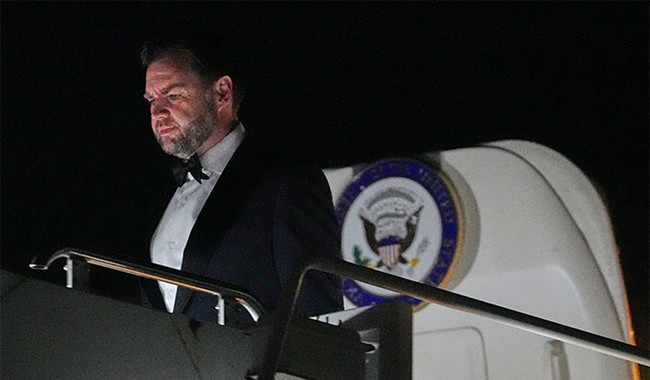
On Wednesday morning, JD Vance was supposed to open Andrew Ross Sorkin's conference in New York. Thirty minutes before he was due on stage, Sorkin was told the vice president would not be coming because he had to stay in Washington. Within the hour, a "senior administration official" was briefing reporters on background about the string of outages that had taken down websites, bank portals, and back-end systems across the country. The vice president of the United States, given the chance to reassure the nation on stage and on camera, chose to do it on background.
The day before, Marco Rubio had already done it on the record. The secretary of state and national security adviser was in Asia with President Donald Trump. After 24 to 48 hours of Americans asking where the administration was, Rubio held an impromptu press conference, acknowledged that people were nervous, told them what the government knew, and said the government had "a duty to report that to the American people." It was the sort of thing Reagan, Bush, Clinton, and Obama used to do themselves.
The New York Times reports the president is frustrated with Vance for trying to put distance between himself and the president on Iran. The day after the midterms, Vance declared that the reason Republicans lost was the war. The president has since pulled him off the Iran talks and retasked him to focus on fraud.
The reassignment is interesting because Vance negotiated the memorandum of understanding with Iran. It was his deal. He led the American negotiating team, sat at the table and came home with the terms. Asked on Fox News this week whether there was any daylight between him and the president, Vance insisted there was none. He is overselling how like-minded the two men are on Iran, just as he oversold the memorandum of understanding.
His most devoted supporters have noticed the problem. A notable phenomenon has taken hold on social media, where Vance's fans insist the memorandum of understanding belongs to the president and was never really negotiated by the vice president. They are rewriting the story to protect the vice president from the fallout of the deal he negotiated.
Multiple Republican senators have told me the same thing. Support for the memorandum of understanding and for how the administration handled Iran was high at first with Republicans. Then those same Republicans found out what was actually in the memorandum. Once they did, even their support for the war turned decisively against the deal. That collapse came after the vice president negotiated the deal, and it came because of what he negotiated.
Consider where that leaves the administration.
The president is aggravated with his vice president. The vice president no longer wants ownership of a memorandum of understanding with a terrorist nation — a memorandum he negotiated himself. The secretary of state, jet-lagged and juggling China, Russia, and Iran, has become the face of the administration and the president cannot stop praising him. "How hot is Marco, right?" the president asked at the ASEAN summit in Manila.
Politicians have always run from their failures, but it is rarer to watch a vice president run from his own signature. Vance wants to inherit the president's coalition in 2028. A man who wants to lead the party, however, cannot negotiate the most consequential foreign policy agreement of the term and then pretend he had nothing to do with it.
Scripture tells us to let our yes be yes, and our no be no. A man who says yes at the negotiating table should not say no on social media when the deal turns unpopular, and he should not hide behind a background briefing when the country wants to hear from its leaders.
The 2028 conversations are already happening, with donors fielding calls and would-be candidates surveying their lanes. Republican primary voters are going to remember who stood in front of the cameras when Americans needed reassurance and who briefed reporters as a nameless official. Unfortunately for the vice president, they are also going to remember whose signature is on the deal with Iran that dragged out a war instead of ending it.