





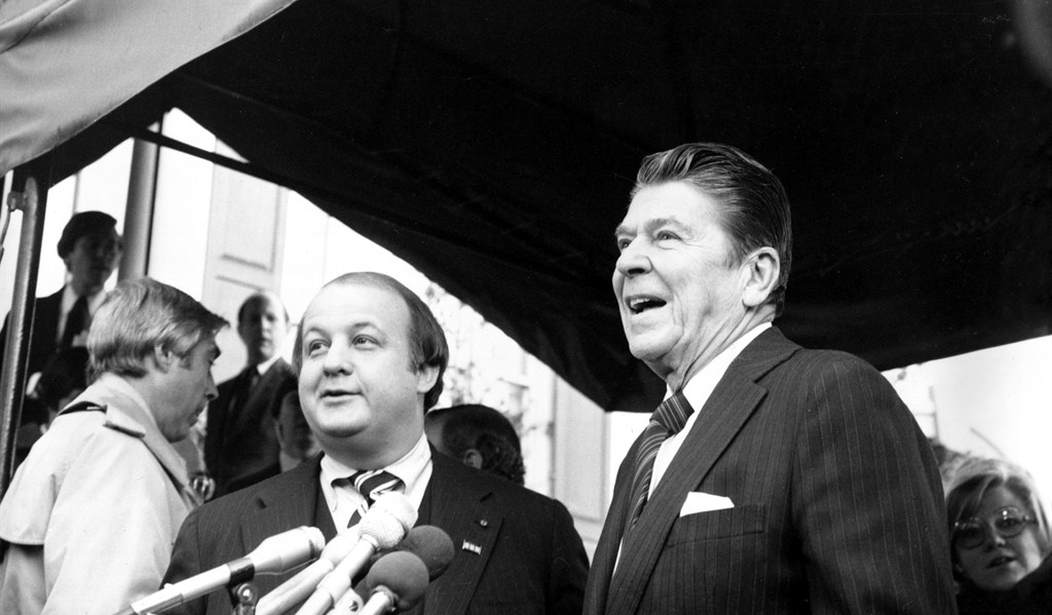
President Reagan had a gift for proving his critics wrong. Almost none of the leading economists of the late 1970s thought that his supply-side tax-cutting agenda, along with stable monetary policy and deregulation, could revive the U.S. economy.
But the prosperity of the 1980s, with growth rates higher than 6 percent, proved the Gipper correct. An economics major from Eureka College understood our free-market system better than the so-called experts at Harvard, Yale and MIT.
As the 2016 presidential campaigns gear up, Reagan’s policies are under assault again, this time even from some on the right. This new group, called “reformicons,” says that supply-siders are obsessed with cutting tax rates for the richest Americans at a time when middle-class tax cuts and tax credits should take precedence.
Reagan’s legacy has gotten tangled in this debate. As Henry Olsen of the Ethics and Public Policy Center recently wrote:
“Many claim [Reagan] today as the political father of supply-side tax policy, but his words and deeds show that it was not quite so. . . . By indexing standard deductions and tax brackets for inflation, he steered hundreds of millions of dollars to middle- and working-class families, money that theoretically could have been used to cut top rates even more. And his 1981 tax cut allowed all workers to contribute to tax-deductible IRAs, exactly the sort of middle-class tax cut that today’s supply-siders deride.”
This is partly true. Reagan’s 1981 Economic Recovery Tax Act was an across-the-board 25 percent reduction in tax rates. Everyone got tax relief. Almost all supply-siders supported indexing tax rates for inflation to end “bracket creep” and to prevent the government from profiting from inflation. And deductions for tax-free IRAs are supported by most supply-siders as a way to encourage saving by ending its double taxation.
The Tax Reform Act of 1986 was quintessential Reagan. He knew closing loopholes and lowering rates would create efficiency gains. No one thought it could be done. But the legislation passed, reducing the number of tax brackets to two, 15 percent for the middle class and 28 percent for the wealthy. As a result, the highest income-tax rate fell from 70 percent to 28 percent — one of the biggest rate reductions in American history.
Reagan was a supply-sider -- period. He understood that high tax rates discourage work, investment and growth. He used to tell the story of making only a certain number of movies a year, because once he got pushed into the highest tax rates of 70 percent or more, there was no rational justification for continuing to work. The Reagan tax-rate reductions increased tax revenues from $500 billion to $1 trillion by the end of the 1980s.
A study by economist Larry Lindsey found that the rate cuts for the highest income brackets paid for themselves by encouraging work and investment. Supply-side economics was a success. As the Gipper noted with his customary wit, “I knew my ideas were working when the media stopped calling it Reaganomics.”
Would Reagan have supported a flat tax that got rates down to 17 or 18 percent for all, with a generous deduction for families with children? All we can say for sure is that the idea is consistent with his work to simplify the tax system and promote growth.
Just tinkering with the tax code, though, may not be a political or economic winner. The system needs to be rebuilt -- made simple and pro-growth. Market research shows that what Americans want most from the tax system is “fairness,” so shaping the popular definition of that term will be key to winning the policy debate.
A fair tax system isn’t one that takes from the rich and gives to the poor. It’s one that requires everyone to play by the same set of rules. Reagan understood that. Do we?


Join the Conversation
VIP members get the ability to comment on articles.