





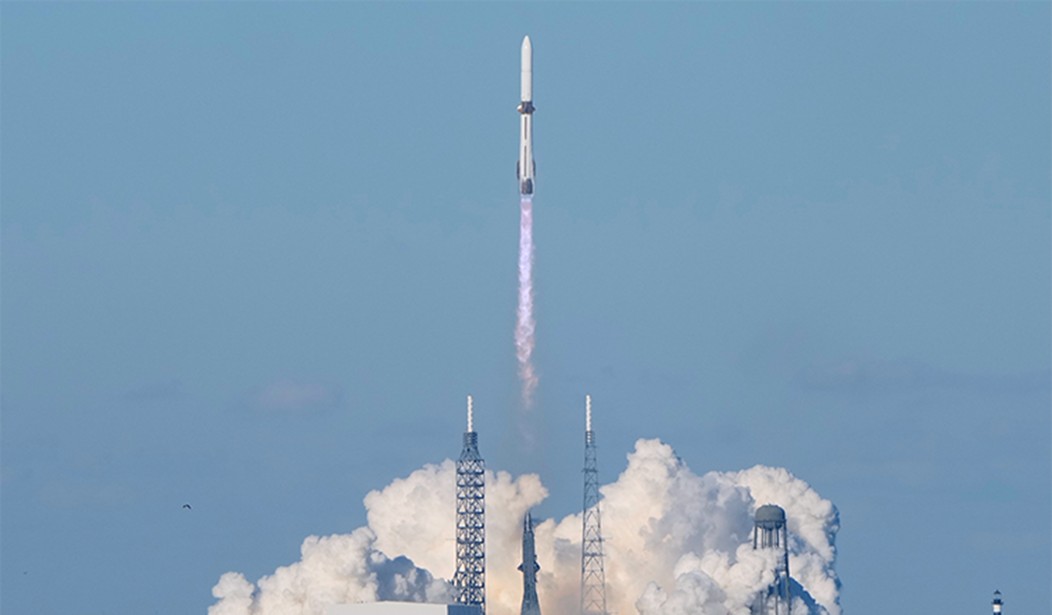
Last month, two starkly contrasting views on the American experiment were put on full display. In November, Blue Origin, the Jeff Bezos-owned spaceflight company, became the second company to land an orbital-class first-stage booster, a reusable rocket stage that powers its initial ascent. On the same day, the anti-capitalist chorus was posting online about “billionaire tears.” Taking to X.com, Sen. Elizabeth Warren (D-MA), posing with mayor-elect Zohran Mamdani and his transition team co-chair and former FTC head Lina Khan, said, “Tax the rich. Billionaire tears not pictured.”
This contrast of builders vs. central planners manifests the stark difference in their worldviews. The builders are driven by optimism, recognizing the unprecedented prosperity brought about by American capitalism, a system fully tapping into the human spirit. They understand the endless value-creating potential economic freedom continues to offer. The central planners are driven by envy. Government cannot create and innovate in the way a free, robust private sector empowers individuals to do, and those who build must be punished for not doing with their money what central planners think is best.
What Blue Origin accomplished is nothing short of remarkable. Not only is it the second company to land an orbital-class first-stage booster, but the second institution on Earth ever to do so — a feat no national space agency or government has ever demonstrated. SpaceX became the first in 2015.
The increasing ability to land boosters offers exceptionally consequential benefits to humanity. Unlike the Space Shuttle, which required astronauts aboard and meaningfully reused only its crew-carrying orbiter, the ability to recover this type of booster, and to do so without people on board, is a fundamentally different approach. Because the booster is the most expensive part of the launch stack, reusing it dramatically cuts costs. Furthermore, the ability to launch without humans on board means these launches don’t need to meet stringent human-rating requirements. This makes satellite, deep-space, and other scientific missions far more efficient — a game changer.
The central planners fundamentally misunderstand money, viewing it as a zero-sum game. Entrepreneurs investing their fortunes into space innovation expands the pie rather than slice it thinner. They are creating value for everyday people.
Low-Earth-orbit (LEO) satellite internet, already connecting millions, can extend high-quality broadband to rural America swiftly and on the cheap compared to traditional infrastructure. Modern weather forecasting, dependent on LEO sensors, means earlier tornado warnings, better hurricane tracking, and more precise rainfall predictions. And deep-space missions, now a fraction of the cost to launch, bolster research, expand our ability to study solar storms, detect near-Earth asteroids, and understand the broader universe. None of this happens at scale without reusable boosters: reuse makes LEO broadband economically viable, weather data collection more frequent and accurate, and deep-space science drastically lower in cost.
And space innovation is just one of many examples. As government-imposed lockdowns kept us at home during the pandemic, Amazon’s logistical network, employing more than 1.5 million workers, became essential infrastructure, enabling millions of Americans to receive groceries, medications, and other basic goods in two days or less as the virus surged.
Yet instead of recognizing the obvious public benefit, many on the Left complained about how much Bezos’ wealth increased amid Amazon’s surging sales. Amy Goodman of Democracy Now! asserted, “Billionaires like Elon Musk and Jeff Bezos and Mark Zuckerberg all saw their bank accounts swell amidst the global crisis.” Rep. Rashida Tlaib called his pandemic-era wealth increase “immoral.”
If the “billionaires shouldn’t exist” crowd has its way, the technologies that rely on affordable access to space, the jobs created by companies like Amazon, and the logistical lifelines that softened the pandemic’s bite would not exist. Musk and Bezos pay billions in taxes, and the revenue from taxing them out of billionaire status would be far less beneficial to society writ large than allowing it to be privately and continually invested.
Not only is the private sector far better and more efficient at driving human flourishing than government, but this level of wealth confiscation wouldn’t be enough to pay even a fraction of most of the Left’s projects. The Cato Institute reported in 2023 that “If Congress confiscated every dollar earned by individuals and businesses past their first $500,000, it would still be about $200 billion short of covering the cost of next year’s projected $1.7 trillion deficit.”
The examples of market-driven innovation creating value for society are endless, and profit shouldn’t be a dirty word. The American story of unprecedented prosperity is one driven by pioneers, inventors, and entrepreneurs willing to take risks, not by envy, central planning, and redistributionism. To turn our backs on economic freedom — something that rewards risk-takers rather than punishing them — would leave us all far less free, less dynamic, and less prosperous.
Ed Tarnowski is a Senior Young Voices Contributor and a Policy and Advocacy Director at EdChoice, where he hosts the State of Choice podcast. His work has been published in National Review, Reason Magazine, RealClearPolitics, Fox News, Education Next, and others. A graduate of the University of Rhode Island, he can be found on X @edtarnowski. The opinions expressed are strictly his own and do not reflect the views of his employer.
Editor’s Note: Do you enjoy Townhall’s conservative reporting and opinion? Support our work by joining Townhall VIP! Use the promo code FIGHT to get 60% off your VIP membership!



Join the Conversation
VIP members get the ability to comment on articles.