





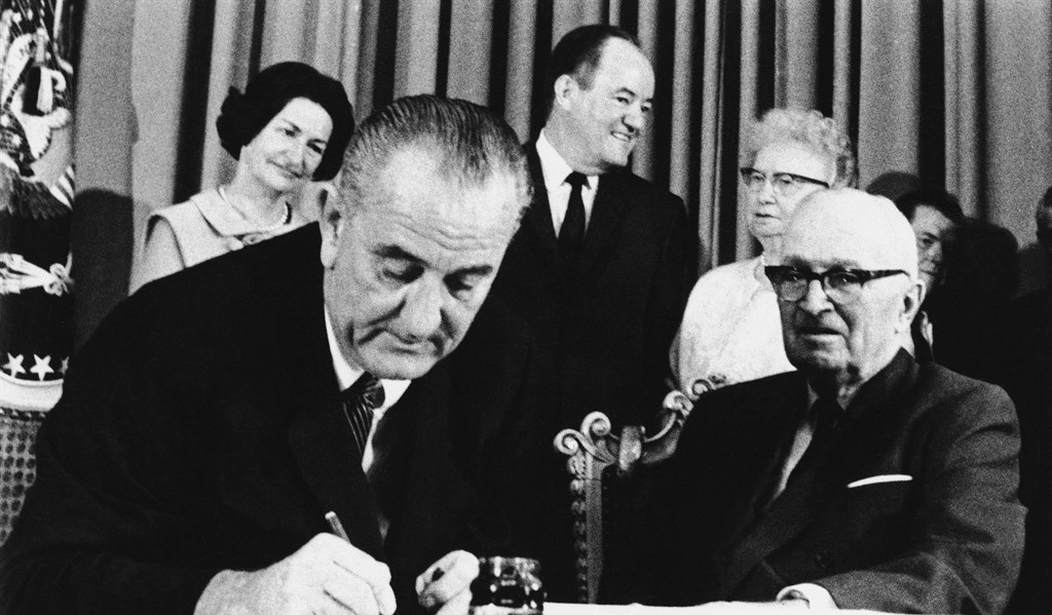
When President Johnson signed Medicare into law on July 30, 1965, nobody realized the program would grow to its current size. Last year alone, Medicare spent $613 billion on nearly 54 million beneficiaries. Seniors qualify for Medicare when they turn age 65. Back in 1965 when Medicare was created, many Americans died before reaching that age. Only Americans born in 1900 and before would have been eligible Medicare benefits at its inception. But the life expectancy for men and women born in 1900 was under 50 years of age.
Life expectancy has increased dramatically over the past 115 years. Americans reaching Medicare eligibility today were born in 1950 — about 70 percent of whom are still alive. Furthermore, men born in 1950 and enrolling in Medicare can expect to live another 17 years, while women can expect another 20 years of life. By the next century, scientists may even extend longevity by decades with new treatments and advances in anti-aging drugs.
The Medicare program has undoubtedly grown well beyond what Congress imagined in 1965. However, Medicare’s outlandish expenditure is not solely due to the increased number of Americans reaching the Medicare eligibility age. Neither is it solely due to the number of years they remain on Medicare. Per capita spending on Medicare beneficiaries has also skyrocketed due to perverse incentives that drive up costs and new treatments unavailable when Medicare was created. In 1970 — five years after the program began — annual per capita Medicare spending was only $385. Today it is $12,430; and it is projected to reach nearly $19,000 a decade from now. [See Figure I.]
Last week, the Medicare trustees released their 2015 report on the financial solvency of the federal health care program in 2014. The news was welcomed as positive; per beneficiary spending was only two percent higher than last year. The report claimed Medicare is expected to remain solvent until 2030 — unchanged from last year. Additionally, Medicare spending growth is projected to slow by mid-century.
Yet, upon closer inspection the report isn’t very reassuring. Medicare spending as a percentage of GDP has been rising sharply. It was 1.3 percent in 1980, 2.2 percent in 2000 and about 3.5 percent of GDP today. Medicare spending is expected to surpass four percent of GDP by 2022 and reach five percent in about 15 years. The “good” news is that Medicare spending is projected to stabilize between five and six percent of GDP for a period of about 60 years — from 2029 until 2089. [See Figure II.]
The problem is: this projection assumes conditions under “current law”. For instance, current law assumes the Independent Payment Advisory Board will retain the power to arbitrarily cut Medicare spending if a growth rate threshold is surpassed. Current law assumes current changes to Medicare physician fees remain in place, as will other Medicare fee reductions. Moreover, current law also assumes these provisions will be enforced, which is unlikely. In their Illustrative Alternative scenario, Medicare’s actuaries also looked at spending under conditions they believe are more likely to occur. Under this set of assumptions, Medicare spending could reach 9.1 percent of GPD in 2089 — about 50 percent higher than current law projections.
Rising drug costs are another reasons to worry about Medicare’s financial future. In 2014 Medicare spending on drugs was .48 percent of GDP. This proportion will rise as specialty drugs supplant spending on cheap generics. Specialty drugs describe the new generation of costly treatments and biological agents, which can cost $15,000 per year or more (some cost $1,000 per pill!). While only about 10 specialty drugs were available 20 years ago, today there are more than 300. Despite comprising only one percent of drugs prescribed, specialty drugs accounted for one-third of drug spending in 2014. By the end of the decade half of drug spending will be on specialty drugs.
In the coming decades the amount of general revenue necessary to fund Medicare will rise substantially. In 1970, premiums and payroll taxes funded all costs of the Medicare program. Today, general revenue funds are needed to pay about 43 percent of Medicare’s spending — equal to about 1.5 percent of GDP. That’s scary enough but taxpayers will be on the hook for Medicare spending equal to 3.2 percent of GDP about 20 years from now. Of course, that assumes the provisions under current law are actually followed. Under the Illustrative Alternative scenario, Medicare expenditures could nearly triple from what it is today — reaching 9.1 percent of GDP in 75 years. Under this more likely scenario, taxpayers could find their share of unfunded Medicare spending quadrupling from its current level of 1.5 percent of GDP to 6.1 percent of GPD.
One final thought. The Trust Fund itself is a fiction; it’s little more than a filing cabinet full of IOUs that are claims on future taxpayers. There is no trust fund in the sense of one that holds assets than can be sold to alleviate burden on taxpayers.


![See Figure I.]](http://www.ncpa.org/images/Medicare50_Fig1.JPG)

Join the Conversation
VIP members get the ability to comment on articles.