





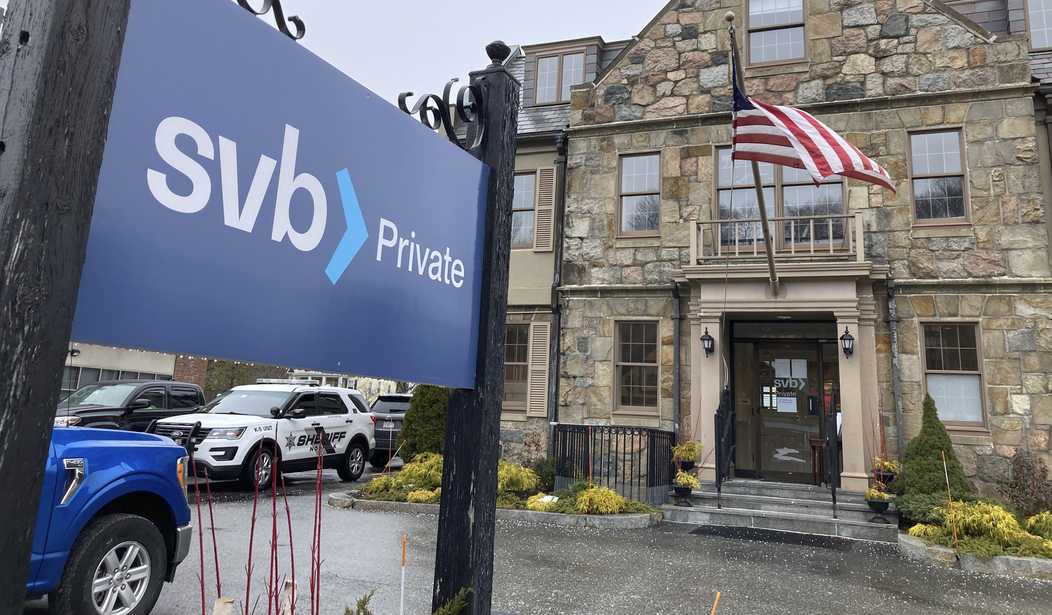
The primary concern of the people who ran the Silicon Valley Bank (SVB) -- the bank that just went bust -- was not banking. Nor was it making money for the bank's shareholders or safeguarding the funds of its depositors.
Their primary concern was social activism -- LGBTQIA+, DEI (Diversity, Equity, Inclusion), ESG (Environmental, Social, and Governance), and climate change.
In fact, for nine months -- from April 2022 until only eight weeks ago -- SVB in America didn't even have a chief risk officer (CRO). It did have a CRO for Europe, Africa, and the Middle East, but the woman entrusted with that role, Jay Ersapah, was apparently considerably more interested in left-wing activism than in risk assessment.
The Daily Mail reported that Ersapah -- who identifies herself as a "queer person of color" -- "organized a host of LGBTQ initiatives including a month-long Pride campaign and implemented 'safe space' catch-ups for staff. In a corporate video published just nine months ago, she said she 'could not be prouder' to work for SVB serving 'underrepresented minorities.'"
"Professional network Outstanding listed Ersapah as a top 100 LGTBQ Future Leader.
"Jay is a leading figure for the bank's awareness activities, including being a panelist at the SVB's Global Pride townhall to share her experiences as a lesbian of color, moderating SVB's EMEA (Europe, Middle East, Africa) Pride townhall and was instrumental in ... supporting employees in sharing their experiences of coming out," her bio on the Outstanding website states.
"It adds that she ... had authored numerous articles to promote LGBTQ awareness. These included 'Lesbian Visibility Day' and 'Trans Awareness Week.'"
How is one to explain SVB's -- and for that matter, virtually every major bank's -- woke activism?
There are a number of possible reasons, but here is one that explains the left-wing activism of almost every profession.
Beginning in the second half of the 20th century, people in nearly every white-collar profession ceased finding their work inherently meaningful. So, they sought to use their profession to change the world.
Take journalism. For most of American history, reporters understood that their primary job was to report news. And for the most part, reporters believed that was important work. In the second half of the 20th century, more and more of them found reporting the news unexciting and meaningless. So, they sought to use journalism to change the world.
Sports writers are one such example. There is no group more woke, or more sheeplike in its behavior than sports writers. They decided that merely writing about sports was not particularly significant work. So, they decided to use their profession to change the world. It was sports writers who led the idiotic campaign to drop the name "Redskins" from the Washington NFL team -- even though the name was adopted as an honorific (no one names their team for an insult) and even though the vast majority of Native Americans, according to the Washington Post itself, could not care less about the issue.
But the hysteria they whipped up over the name "Redskins" gave the lives of these sports writers much more meaning than merely reporting on football games. They were now making the world a better place.
The same holds true for actors. Until about the mid-20th century, few actors spoke out on political issues, let alone devoted their off-screen lives to social activism. Most actors actually found meaning in their profession -- as indeed they should. Bringing plays and films to life, making people laugh and cry, distracting people from their troubles for a couple of hours -- these things render acting a very meaningful profession. But, again, beginning in the second half of the 20th century, Hollywood stars thought they had to "make a difference" by changing the world. One obvious result has been the decimation of the Academy Awards, which have morphed into joyless celebrations not of acting, but of left-wing anger.
The same holds true for academia. If you're an English professor, why merely teach English literature when you can change the world? Doesn't that make you feel much more important? And, if that's true for a college professor, how much more so is it true for an elementary school teacher? What makes you feel more important -- teaching third graders how to read and write or fighting racism?
There are two related reasons for these developments.
One is the ascent of leftism, an ideology that regards literally every aspect of life as political. For the left, there are no non-political spheres. Whether you are a kindergarten teacher, a sports writer or an oboist with the Philadelphia Orchestra, you are to bring political activism into your work.
The other reason is the loss of meaning in our secular society. Whereas in the past people derived meaning in life from their religion -- their religious community, their house of worship, from Bible study -- religious sources of meaning have begun to disappear from our secular society. And secularism is rapidly leading to the collapse of the other great source of meaning in people's lives: marriage and family, as we witness the lowest number of marriages and children in American history.
Therefore, one has had to look elsewhere for meaning.
And where do people look? To career and political activism -- and ideally, the merger of the two. Whereas in the past, one's work was primarily regarded as a means to an end -- namely, a way to provide for one's family -- today, work is an end in itself.
That's why the people running the Silicon Valley Bank were more interested in LGBTQ activism than in making money for its investors and protecting the money of its depositors. The former is way more meaningful.

Join the Conversation
VIP members get the ability to comment on articles.