
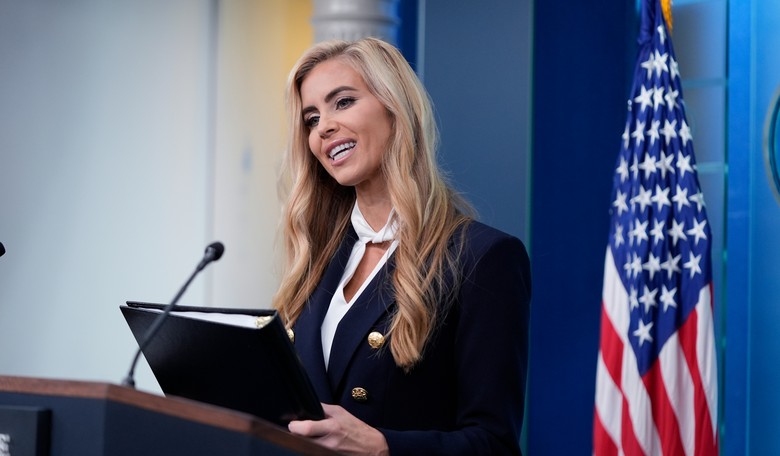
The brief tenure of White House Press Secretary Katie Zacharia offers a timely reminder that we should be careful about confusing a difficult beginning with a definitive verdict. Our human nature provides a remarkable ability to turn a brief stumble into a defining moment. Combined with an administration where every word is scrutinized, every misstep becomes a headline, and every decision is treated as a referendum on the president, the rush to judgment can be relentless.
There is no question that the White House press secretary has one of the toughest communications jobs in America. The position requires a rare combination of preparation, composure, political instincts, command of the facts, and the ability to think on one’s feet while facing a room full of journalists whose job is to ask difficult questions. The cameras are rolling, the stakes are high, and mistakes are rarely forgotten.
Zacharia had a rocky introduction. She stumbled over a line, faced intense scrutiny, and found herself at the center of a controversy that could have been handled far better.
In a hyperpartisan environment, objectivity is nearly impossible to find. For some, anything associated with Donald Trump is automatically wrong, suspect, or deserving of ridicule. For others, the administration can do no wrong. Both camps have their preferred conclusions before the facts have even finished coming in.
The result is that honest assessments become harder to find. Criticism is too often mistaken for disloyalty, while praise is dismissed as sycophancy. Yet it is entirely possible to support an administration’s policies, recognize its accomplishments, and still acknowledge its mistakes. It is equally possible to oppose a president’s policies without treating every personnel decision as proof of incompetence.
We do not have to be Trump loyalists to believe Zacharia may have been judged too harshly, too quickly.
Consider Karoline Leavitt, whose performance as White House press secretary demonstrated how effective a confident, disciplined, and politically savvy communicator can be in a demanding role. Her ability to handle aggressive questioning, defend the administration’s positions, and command the briefing room made her a formidable presence. She set a high bar.
No one should assume that Zacharia would necessarily have become the next Leavitt. But neither should anyone pretend to know that she could not have developed into an equally effective communicator with experience, coaching, and time to find her footing. Potential is not always apparent in a first performance, particularly when the circumstances are unforgiving.
White House communications require preparation, discipline, and accountability. When an explanation falls short or a controversy is mishandled, the appropriate response is to learn from it and improve. A supportive administration can demand better without concluding that a promising career should end before it has properly begun.
Perhaps the most troubling aspect of this episode is how quickly the conversation moved from evaluating a performance to passing judgment on a person. In the age of social media, five difficult days can generate enough commentary to create the illusion that a comprehensive assessment has taken place. Late-night comedians and social media reels will have their material. But while Zacharia is no longer at the podium, her story is far from over.
The more interesting story is not the stumble; it will be what happens next. Recovering from a public setback requires humility, resilience, preparation, and a willingness to learn. Those qualities matter in politics, but they also matter in life. A supportive family and the opportunity to regroup can make a difference when the spotlight becomes uncomfortable. A difficult beginning does not have to become a permanent ending.
For Zacharia, the next five months may not be any easier than the last five days. But a comeback built on preparation, better judgment, and demonstrated competence would be far more interesting than another round of partisan mockery.
We may never know what Zacharia could have accomplished in the briefing room, but we do know that one of the most rewarding things to witness is someone who refuses to let a difficult beginning define the rest of their story.
Washington has no shortage of people eager to celebrate a downfall and kick someone when they are down. However, watching someone earn a second chance, rebuild confidence, and prove the doubters wrong will be a far more enjoyable story. Zacharia's next chapter has yet to be written, and if it becomes the comeback story it has the potential to be, it will be a joy to see.
Dan Rene is a strategic communications counselor and founder of Dan Rene Communications.