





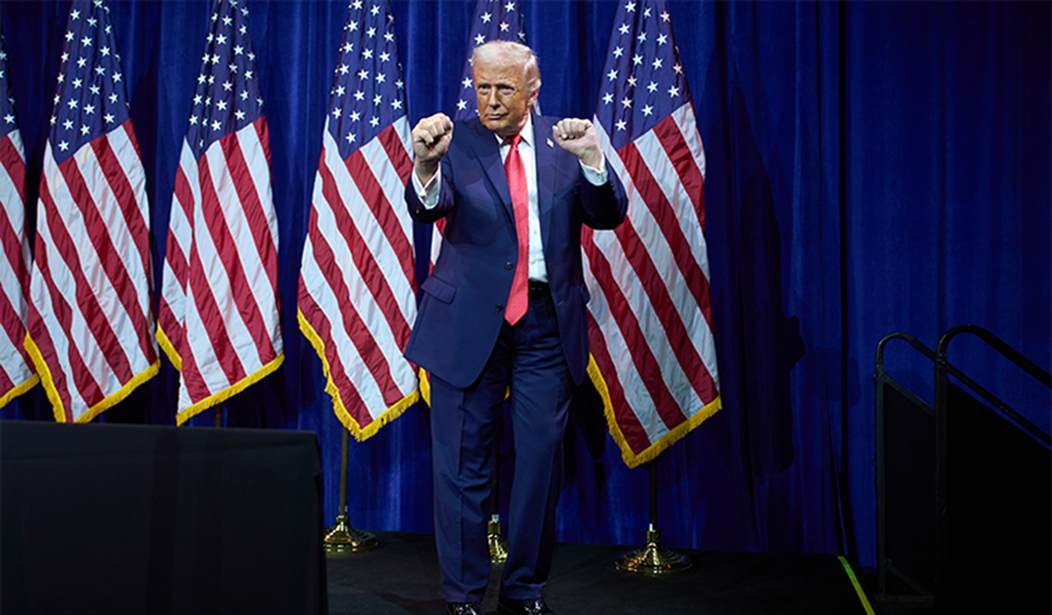
Every serious presidency reveals a doctrine, named or not. President Trump's second term reveals one: a coherent fusion of timeless American instincts—America First, peace through strength, and the recognition that prosperity and security are inseparable.
Call it the Donroe Doctrine—Trump's vigorous update to Monroe's 1823 warning against foreign meddling in the Western Hemisphere. As Trump declared after the Venezuela operation, "We've superseded it by a lot—they now call it the Donroe Doctrine."
At its heart is a simple truth: free societies endure only when power defends commerce. Trade fosters alignment. Alignment demands security. Security requires power. And power left unused does not remain neutral—it gets replaced. The Donroe Doctrine treats domestic growth, trade enforcement, and military strength as one continuous system, not separate policies.
Critics dismiss Trump as "transactional," as if that were a flaw. It isn't. Transactions keep relationships honest. Charity is voluntary; trade is essential. And trade only works when rules are enforced and lanes remain open.
That logic starts at home.
After years of drift, the American economy is again treated as a strategic asset. Low taxes reward risk and productivity. Deregulation unleashes capital, innovation, and growth. A nation that cannot grow cannot deter.
Energy dominance drives the point home. Abundant U.S. production slashes inflation, stabilizes allies, and denies adversaries leverage. Oil is embedded in everything—shipping, food, manufacturing, defense. When hostile regimes control supply, inflation becomes a geopolitical weapon. American scale ends that scarcity. Lower energy prices stabilize markets, ease household budgets, and strip geopolitical panic from domestic politics.
Tariffs complete the picture. Used under Article II authority, they are not walls but leverage—pressure points that enforce reciprocity against predatory trade. Unenforced trade isn't free; it's tribute.
Domestic strength, in other words, is foreign policy. It funds military readiness, secures supply chains, and sustains deterrence over time.
Look south.
The original Monroe Doctrine aimed to prevent hostile powers from turning geographic proximity into strategic pressure. Decades of neglect undermined that vision, allowing Venezuela to collapse into a narco-state that exported drugs, mass migration, and chaos while serving as a welcoming host for Russian arms, Chinese debt traps, and Iranian proxies.
This instability did not remain contained. It spilled northward—distorting global energy markets, overwhelming U.S. borders, and supercharging cartel violence at home.
The Donroe Doctrine brought clarity where denial had failed. Failed states don't stay local—they metastasize, creating instability that attracts adversaries and spills across borders. Venezuela had become exactly that: a hostile foothold threatening U.S. security and commerce.
Trump responded with decisive but restrained force: surgical strikes, disruption of criminal networks, and removal of the regime's leadership—no endless wars, no occupation, no nation-building illusions.
The goal wasn't conquest. It was restoration—reasserting boundaries, eliminating foreign proxies, and giving the hemisphere room to breathe.
The results speak for themselves: steadier energy markets, reduced migration pressure, and the elimination of adversarial staging grounds. Commerce thrives when partners are truly sovereign, not puppets of Russia, China, or Iran.
The same logic that reclaimed our hemisphere now turns northward.
The Arctic has awakened. Retreating sea ice is transforming the region: unlocking shorter shipping lanes like the Northern Sea Route with record traffic in 2025, including expanded Chinese container voyages, exposing vast rare-earth mineral deposits in Greenland advancing toward production amid Western efforts to counter China's dominance, and revealing critical military corridors for missile trajectories, surveillance, and power projection.
Russia continues remilitarizing Soviet-era bases despite Ukraine strains, while China aggressively advances its Polar Silk Road—deploying icebreakers, research vessels, and infrastructure partnerships to secure economic and strategic footholds.
Vacuums here won't stay empty; great-power competition is intensifying over routes, resources, and dominance in this emerging global pivot.
America already relies on Greenland for irreplaceable missile warning and surveillance. The only unresolved question is whether political language will catch up to strategic reality.
Donroe answers it by formalizing responsibility—deeper integration to secure open navigation, Western norms, and critical resources against authoritarian chokeholds. Formal integration isn't empire—it's the mature acknowledgment that responsibility already exists in practice.
The Donroe Doctrine seeks no grandeur—only stability. American leadership is not moral vanity; it is obligation: to lead economically, to lead militarily, and to do so before rivals fill the void.
Denying responsibility doesn't make it vanish. It simply cedes the field to Russia, China, or whoever acts first.
Editor’s Note: Do you enjoy Townhall’s conservative reporting and opinion? Support our work by joining Townhall VIP! Use the promo code FIGHT to get 60% off your VIP membership!


Join the Conversation
VIP members get the ability to comment on articles.