





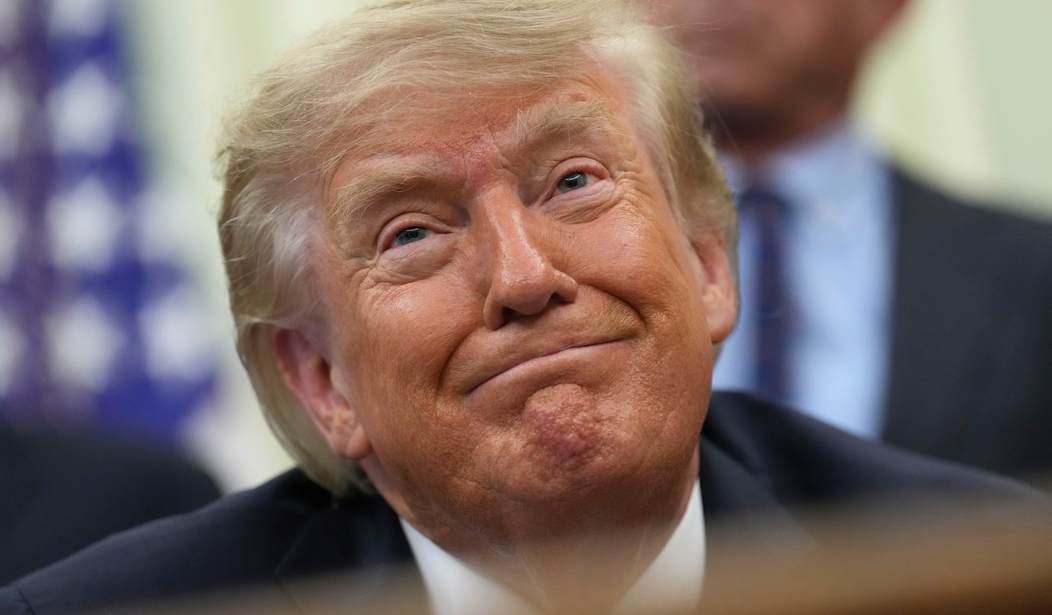
A new analysis in the Wall Street Journal offers striking evidence that, for all his problems, President Donald Trump has delivered economic benefits to the voters whose support was the foundation of his victory in 2024.
The Wall Street Journal's headline and story synopsis read: "Americans Without College Degrees Are Having One of the Best Job Markets in Years; Unemployment among younger workers who didn't go to college has rarely been lower in recent decades. It is the opposite story for college grads."
The article was based on work done by a think tank called the Burning Glass Institute. Analysts found that "the unemployment rate for workers ages 22 to 34 who never graduated from college" is at one of its lowest points in the last 20 years. Meanwhile, workers with a bachelor's degree or higher are experiencing greater and greater difficulty getting a good job. "Just as job hunters without degrees are having one of their best runs, those with college educations are having one of their worst," the article said.
In the past, analysts noted, the trends for the two groups, degreed and non-degreed, tended to move in the same direction at the same time. Now, they have diverged, with the non-degreed improving and the degreed encountering problems.
It's not that those with college degrees are suddenly at a huge disadvantage compared to those without. A degree still means something. The Wall Street Journal notes that for those workers between ages 25 and 54 who have a college degree, the unemployment rate averaged 2.7 percent in the last year. For those with some college but no degree, it was 3.6 percent, and for those with no college at all, it was 4.7 percent. So the story is not that having no degree is better than having a degree. The story is that the economic circumstances of non-college-degree workers are improving faster than those with degrees.
Now the politics. A key part of Trump's rise and hold on power has been the support of voters who do not have a college degree. Trump's success has prompted hundreds of stories on the "educational divide" in politics — how educational status increasingly determines one's politics. The bottom line of all those stories is that voters without degrees support Trump, and voters with degrees support Trump's opponents.
Look at the exit polls from the 2024 election. Among those who never attended college, Trump won with 62 percent of the vote. Among those who had some college but no degree, Trump won with 51 percent. Among those who had an associate's degree, Trump won with 57 percent. Put them all together, and Trump won those without a bachelor's degree with 56 percent of the vote. And remember — those without a bachelor's degree made up well over half of the total electorate.
On the other side, then-Vice President Kamala Harris won those with a bachelor's degree with 53 percent of the vote. Among those who had an advanced degree, Harris won with 59 percent of the vote.
With Trump, it was a phenomenon that was apparent from the very start of his political career, beginning with the Iowa caucuses in January 2016. "Trump overwhelmingly leads rivals in support from less educated Americans," a headline from PBS reads.
Now, years later, in a second presidential term, the essential storyline is this: Candidate appeals to a group. Candidate wins with that group's support. In office, candidate looks after that group. The cornpone version of it is the phrase, "You got to dance with them what brung you." In this case, Trump got elected on the strength of people without college degrees, and people without college degrees are doing better under his administration.
Of course, it's not that simple. Behind the numbers, there is profound economic and social dislocation. Among the biggest problems is the state of the nation's colleges and universities, many of which offer a product so insanely expensive that it has set off widespread debate on whether a college education is worth it. Still, the belief in college is so ingrained in the American psyche that schools are turning out more graduates than ever, even as AI replaces some of the work they do.
On the other side, people without college degrees, with lower wages, are struggling to pay the same high prices for groceries, gas and other necessities as those with degrees. That has led to Trump's approval rating falling into negative territory with the non-college voters who elected him.
Looking at the details inside a Fox News poll from the summer, the president was underwater with voters who might be expected to be with him. With white voters who do not have a college degree, Trump was at 43 percent approval, 57 percent disapproval. That is essentially the opposite result of the 2024 exit polls.
It will also probably mean defeat for Republicans trying to keep control of the House in November's midterm elections. Nevertheless, on one of the most basic measures of economic health — having a job — the prospects of those without a college degree are improving under the president they supported. And that has likely created a stable core of support for Trump in what could be a very bumpy second half of his term.
This content originally appeared on the Washington Examiner at www.washingtonexaminer.com/daily-memo/4717301/trump-2024-voters-economic-outlook/.
Byron York is chief political correspondent for The Washington Examiner. Email him at byork@washingtonexaminer.com. For a deeper dive into many of the topics Byron covers, listen to his podcast, The Byron York Show, available on the Ricochet Audio Network at ricochet.com/series/byron-york-show and everywhere else podcasts are found.
Editor's Note: Do you enjoy Townhall's conservative reporting exposing the radical left and woke media? Support our work so we can keep bringing you the truth.
Join Townhall VIP and use promo code FIGHT to receive 60% off your membership.

Join the Conversation
VIP members get the ability to comment on articles.