





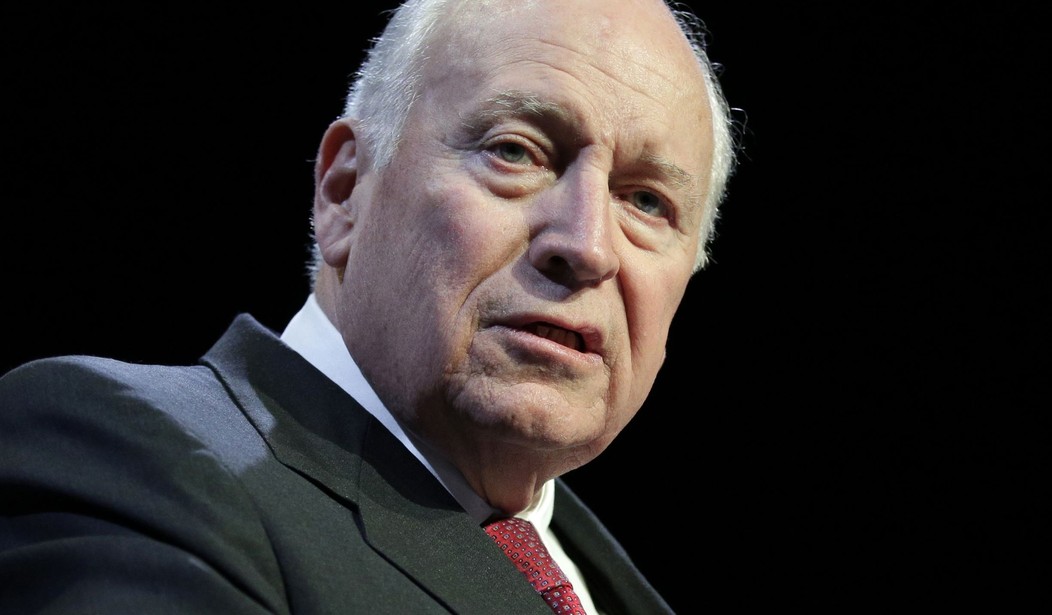
When George W. Bush ran for president in 2000, he faced a widespread public perception that he was callow and inexperienced, even though he was 54 years old and the governor of Texas. That's not an unheard-of situation in presidential politics; the solution is for the less-experienced candidate to pick an older and more experienced running mate to give the ticket some gravitas. That is what Bush did.
It's fair to say that Bush's choice, Dick Cheney, fit the bill, and more. Cheney, who died Monday at age 84, probably knew more about the workings of the U.S. government than any man active in politics at the time. He had been the youngest White House chief of staff ever, for President Gerald Ford. Then he served 10 years in the House, representing his home state of Wyoming. Then he was tapped by President George H.W. Bush to serve as secretary of defense. Cheney later became CEO of a major oil services corporation, Halliburton. That's quite a resume.
So Cheney added weight to the GOP ticket. Maybe just enough weight -- Bush-Cheney lost the 2000 popular vote but won the presidency on the strength of 537 votes in the Florida recount.
In the next few months, the team enacted much of its campaign agenda, passing the Bush tax cuts and making substantial progress on the president's education initiative, the No Child Left Behind Act. At that point, just eight months into the term, the Bush-Cheney administration seemed oddly without direction, with little else to do.
Then came September 11, 2001, and Bush, Cheney, and the nation had an urgent new direction for the future. Cheney was at the White House when it happened; Bush was in Florida on a trip to promote children's reading. From that moment on, Cheney took a leading role in formulating what became known as GWOT -- the Global War on Terror.
It would take too long to recount all the details. But first, the U.S. attacked Afghanistan, aiming to find and kill every person who planned, executed, financed, or otherwise aided or abetted 9/11. That is what Bush and Cheney began, but after making initial progress, the mission went on and on, became bogged down in nation building, and, in more than seven years, failed to find and kill the one man most responsible for the attack -- Osama bin Laden.
Meanwhile, around the White House, there was talk suggesting that Iraqi dictator Saddam Hussein had some connection to 9/11 and that there was some link between Saddam and al Qaeda. Then the White House argued that Saddam had weapons of mass destruction, which, in a mad dictator's hands, created an intolerably dangerous situation for the United States. Cheney became the administration's most aggressive promoter of invading Iraq, toppling Saddam and neutralizing the WMD.
Everyone knows what happened next. The intelligence was wrong, there were no WMD, and the war in Iraq turned into a disaster. That was not because of any failure by the U.S. military -- they performed beautifully. But Bush and Cheney had been dreadfully wrong about the premise for invading.
After a huge loss in the 2006 midterms, Bush and Cheney tried to salvage the situation in Iraq with a "surge" of U.S. troops. But the war ended in a massive failure. And then, as fate would have it, as the Bush-Cheney administration entered its final stretch, the economy nearly collapsed. Disaster upon disaster. By the time of the 2008 election, Bush had a job approval of 24.6%, according to the RealClearPolitics average of polls.
In the case of Cheney, here was a man with broad and deep knowledge of how the world and the U.S. government worked, who dedicated himself to protecting the United States in the aftermath of the worst terrorist attack in history, who meant well -- and who made terrible mistakes that ensured his time in office would be seen as a failure.
Cheney's time in office also changed Republican politics. It is impossible to imagine the 2016 GOP primary race going the way it did absent the legacy of the Bush-Cheney administration. The Bush-Cheney team was in the field in 2016 in the person of Jeb Bush. Candidate Donald Trump took great delight in bashing Jeb, and he was remarkably effective at it.
Trump called the Iraq war "a big, fat mistake," and Republican crowds applauded. He called the entire Bush-Cheney administration a "disaster." He dumped all over the Bush-Cheney legacy and went on to win the Republican nomination. Things had changed.
Still, Cheney actually supported Trump as the Republican nominee in 2016. Only after the Jan. 6, 2021, Capitol riot did Cheney declare Trump a "coward" and a "threat to our republic." Cheney ended up casting his last vote for president for Kamala Harris in 2024.
By then, Cheney's brand of Republican politics, whatever you might think of it, had receded far into the past. The man who was Gerald Ford's chief of staff half a century earlier could find no place in today's GOP politics. The bitter irony was that Cheney, with the misadventure in Iraq and the calamitous end of the Bush-Cheney administration, had himself contributed to creating Trump's Republican Party.
This content originally appeared on the Washington Examiner at washingtonexaminer.com/daily-memo/3874889/dick-cheneys-complicated-legacy/.
Byron York is chief political correspondent for The Washington Examiner. Email him at byork@washingtonexaminer.com. For a deeper dive into many of the topics Byron covers, listen to his podcast, The Byron York Show, available on the Ricochet Audio Network at ricochet.com/series/byron-york-show and everywhere else podcasts are found.
Editor’s Note: The Schumer Shutdown is here. Rather than put the American people first, Chuck Schumer and the radical Democrats forced a government shutdown for healthcare for illegals. They own this.
Help us continue to report the truth about the Schumer Shutdown. Use promo code POTUS47 to get 74% off your VIP membership.

Join the Conversation
VIP members get the ability to comment on articles.