





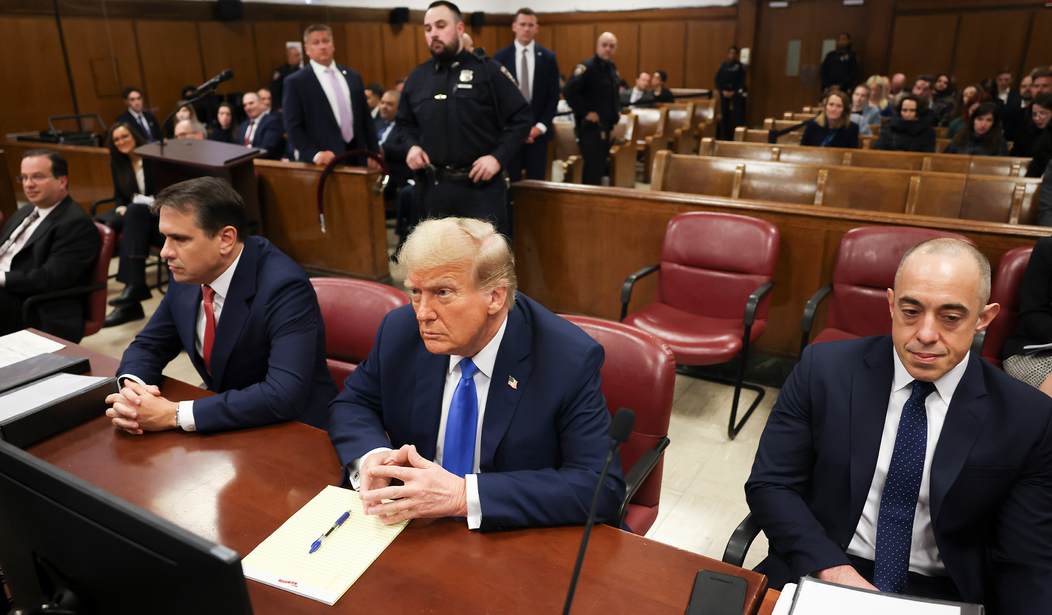
An adage learned early in the career of a trial attorney is, “if the law is not on your side, argue the facts, and if the facts are not on your side, argue the law, but if neither the facts nor the law are on your side, make sure you get your fee up front and in cash,” because you are almost certain to lose your case.
Manhattan District Attorney Alvin Bragg is paid by Big Apple taxpayers regardless of whether he wins or loses a case, but he deserves to lose the so-called “hush money” case against former President Donald Trump because neither the law nor the facts justify this prosecution.
Although the trial in the case, styled “THE PEOPLE OF THE STATE OF NEW YORK against DONALD J. TRUMP, Defendant,” is in its early stages, any reasonably objective analysis of the applicable facts and the law leaves one with far more doubt than could be considered “reasonable” that the 45th President of the United States committed even a single one of the 34 criminal acts alleged by Mr. Bragg.
Media attention focuses on virtually every real or perceived aspect of what happens inside the courtroom of Judge Juan Merchan, down to and including the thermostat setting and Trump’s posture; such irrelevancies are fodder for media pundits on both sides of today’s ever-present partisan political divide.
It is, of course, not surprising that conservative media outlets believe Trump to be absolutely and unquestionably innocent, while their liberal counterparts can hardly contain their glee at the former President’s predicament and wish him a speedy trip to Riker’s Island. Much of the ongoing news coverage of the trial reflects this divide, while offering little in terms of meaningful legal analysis.
Taking the time to sift through the Red vs. Blue media coverage, however, rewards one with an occasional piece that is educative. The best of these I have found is a New York Times Guest Essay by Boston University law professor Jed Handelsman Shugerman – “I Thought the Bragg Case Against Trump Was a Legal Embarrassment. Now I Think It’s a Historic Mistake”. If the reader only scans the title, they very well might conclude the essay is just another in a long line of superficial analyses of the hush money trial by a supporter of the former President, and skip over it. This would be a mistake.
Shugerman’s piece is anything but superficial, and I have no idea whether he is Republican or Democrat, a Trump hater or MAGA true believer. I could care less. What I do care about is the lucidity with which the professor analyzes the theory or theories on which Bragg’s case appears founded and the manner by which it is being presented to the judge and the jury.
The overarching thesis at the heart of Shugerman’s argument that Bragg is on the wrong prosecutorial track, lies in what appears clearly to be a misguided effort (“crusade” could be a more apt term) by the prosecutor to fit what might at best be seen as a series of falsely characterized business records into a broad “election fraud” scheme through which Trump intended to unlawfully interfere in the 2016 presidential election.
The proverbial effort to fit a square peg into a round hole.
The fact that the 2016 election is a federal matter and not a New York state matter, and therefore outside the prosecutorial jurisdiction of a local New York state prosecutor, appears to have been a technicality beyond Bragg’s ken. It nonetheless is a serious defect in the case. Notwithstanding this jurisdictional roadblock, Bragg and his assistant prosecutor Matthew Colangelo employ the “[federal]election interference” theory as a trampoline from which to jump onto the election fraud bandwagon that has fixated so many Republicans and even Democrats for eight years.
Calling a case of nothing more than a series of misdemeanor false business filings felonious “election fraud” does not make it so. Even Colangelo’s opening statement, which good litigators use as a roadmap laying out the case for the jury with the clarity and simplicity that wins jurors to their side was, again as appropriately noted by Shugerman, short on specifics and long on vagueness – indicative of a dangerously, if not fatally weak case.
Bob Barr represented Georgia’s Seventh District in the U.S. House of Representatives from 1995 to 2003. He served as the United States Attorney in Atlanta from 1986 to 1990 and was an official with the CIA in the 1970s. He now practices law in Atlanta, Georgia and serves as head of Liberty Guard.
Join the Conversation
VIP members get the ability to comment on articles.