







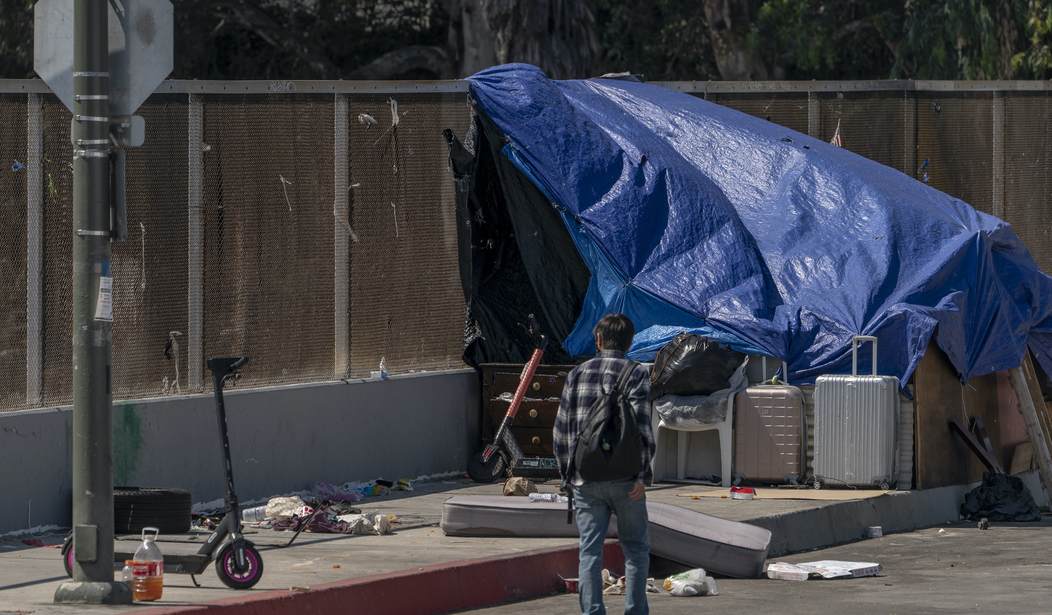
Whether you live in a city or a small town, you're a winner because of the U.S. Supreme Court's decision in City of Grants Pass v. Johnson, announced on Friday. The Supremes ruled 6-3 that municipalities can ban homeless encampments from sidewalks, parks and other public areas. Sleeping in the rough is not a constitutionally guaranteed right, said the court.
It's likely no other Supreme Court ruling this year will positively impact more people. In cities plagued by street living, parents walking their children to school have to navigate around discarded needles and human waste. Store owners opening up in the morning have to deal with entrances blocked by cardboard shelters. People risk getting mugged walking by the encampments on their way to work.
The small town of Grants Pass, Oregon, banned sleeping under cardboard boxes, tents and blankets in public places. Homelessness advocates sued, citing a 2018 9th Circuit Court of Appeals ruling -- Martin v. City of Boise. It said that fining or jailing people for sleeping in the rough was "cruel and unusual punishment," a violation of the U.S. Constitution.
Lawyers for Grants Pass asked the Supreme Court to overturn Martin, citing the incidence of "crime, fires, the reemergence of medieval diseases," and "record levels of drug overdoses and deaths on public streets" wherever sleeping rough is tolerated.
In every one of the nine states affected by the Martin ruling -- Alaska, Arizona, California, Hawaii, Idaho, Montana, Nevada, Oregon and Washington -- street living has soared since 2018, up 51% in Alaska, 46% in Idaho, and 46% in Oregon, according to the Department of Housing and Urban Development's annual homeless survey. Legalizing living rough encourages it.
Had the Supreme Court ruled against Grants Pass, all 50 states likely would be facing a surge in street living.
Stunningly, the three justices who dissented in Grants Pass -- Sonia Sotomayor, Elena Kagan and Ketanji Brown Jackson -- showed no interest in how homeless encampments harm quality of life for other residents. Sotomayor, who penned the dissent, sneered at the majority for framing the problem "as one involving drugs, diseases, and fires instead of one involving people trying to keep warm outside with a blanket."
Sotomayor, Kagan and Jackson want to legitimate sleeping rough, arguing that there are "myriad legitimate reasons people may lack or decline shelter."
New York City's far left City Council has the same misguided idea. It passed a "Homeless Bill of Rights" making street living a right. The average lifespan of someone living on the street is 48 years, compared with 78 for most people. Losing three decades of life is not a right. It's a terrible wrong.
Justice Neil Gorsuch, writing for the majority, cited data from many cities showing that most homeless are living on the street by choice, refusing offers of shelter in favor of easy access to illegal drugs and no shelter rules.
San Francisco attested to the court that it has "seen over half of its offers of shelter and services rejected by unhoused individuals who often cite" the Martin order "as their justification to permanently occupy and block public sidewalks."
Finally, Gorsuch said judges should not be homelessness czars, dictating policy. It's up to local lawmakers to decide how the homeless are cared for and how public resources are spent. The Grants Pass ruling is a bold denunciation of judges making decisions that should be left to locally elected leaders.
Are you listening, Mayor Eric Adams? New York City is a victim of this judicial activism.
For over four decades, New York City residents have been forced to foot an enormous bill -- billions of dollars a year -- because of a consent decree and subsequent court rulings that dictate the city's homeless policies, down to details like meals served and square footage per person. The big winner is the homeless-advocacy-industrial complex that runs shelters, files lawsuits and profits off the exorbitant spending.
New York City is the only place compelled by the courts to guarantee shelter for all comers.
It will bankrupt New York. Tell Adams it's time to challenge the consent decree and wrest control of homeless policy from judges. If little Grants Pass can do it, the Big Apple can too.


Join the Conversation
VIP members get the ability to comment on articles.