





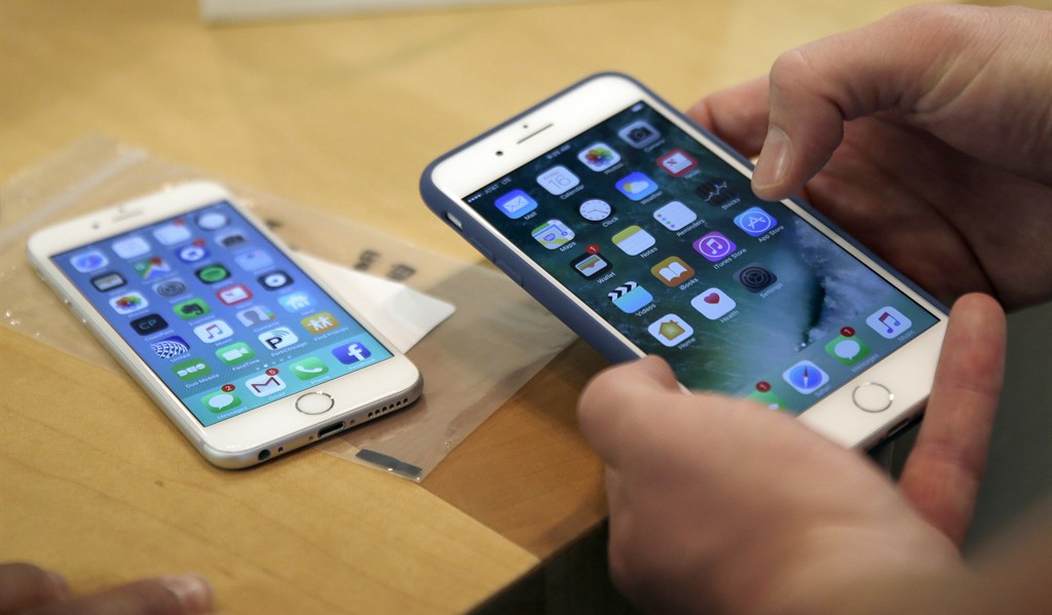
Next time you set out to commit armed robbery, leave your cellphone at home. Timothy Carpenter was convicted of robbing a string of T-Mobile and Radio Shack stores, stealing smartphones. But he wasn't too smart himself. He used his cellphone to call 15 getaway drivers. The calls were his undoing. The FBI used the records from his wireless carrier to confirm his proximity to every robbed store when it was hit.
Now Carpenter and the American Civil Liberties Union are challenging the conviction, and the Supreme Court just agreed to hear the case. Activists determined to guarantee total privacy to criminal suspects, no matter what the cost to society, are thrilled. They're predicting Carpenter v. United States could be a landmark victory for privacy. How foolish. A victory for Carpenter would tip the scales of justice in favor of criminals and against law enforcement's ability to keep us safe.
The ACLU claims using wireless companies' records to pinpoint suspects' locations violates the Fourth Amendment's privacy protections. Don't fall for it.
The Supreme Court has already ruled the actual content of cellphones cannot be searched without a court-issued warrant, because the Fourth Amendment bars "unreasonable" searches by government. But in Carpenter, the ACLU is stretching the notion of privacy, trying to block police from identifying a cellphone's location. Not its content, just its location.
Carpenter v. United States is part of the ACLU's campaign to hobble police and shield wrongdoers -- both terrorists and common criminals -- from the latest technologies available to law enforcement.
In the Carpenter case, the ACLU insists the FBI overreached by looking at many months of Carpenter's phone records, revealing where he prayed, slept and shopped. But how else could agents find out whether he was near the robbed stores? Carpenter's spree went on for months.
Lawyers defending the FBI say phone records are vital for "promptly apprehending criminals and exonerating innocent suspects as early as possible."
They also argue Carpenter had no reason to expect his phone records would be private. Anyone who signs up for a cellphone knows the phone company -- a third party -- will have call records. They're not private.
Not so fast, said Justice Sonia Sotomayor in a previous case. Sotomayor suggested that "it may be necessary to reconsider the premise" that there is no privacy right once someone gives information to a third party -- like the phone company. If other justices agree with Sotomayor, the Court could ultimately bar the use of cellphone records without a warrant.
Privacy purists across the political spectrum -- including the libertarian Cato Institute -- are lining up against law enforcement. They argue that the Fourth Amendment guarantees Americans must be "secure in their persons, houses, papers and effects" from unreasonable searches. That's a precious right.
But as the store owners robbed by Carpenter will tell you, there's also a need to be secure from criminals.
Not to mention terrorists.
The Carpenter case involves records of calls made in the past. What about a new technology police departments are using to track cellphone locations in real time? It can track fugitives, find abducted children, even foil terrorist attacks.
It's a suitcase-size device called a Stingray, and it mimics cell towers. When it's moved to an area, cellphones send signals to it, mistaking it for a tower. Stingrays fool cellphones into becoming tracking devices. It was developed by the military, and some object to its use to catch common criminals.
The ACLU is urging dozens of cities, including New York, to clamp down on use of Stingrays and is going to court in some cities to stop it. That's "very misguided," says New York City Deputy Police Commissioner Larry Byrne.
Who's helped when wrongdoers have better technology than cops? That's one of the questions the Justices will weigh in Carpenter -- and in future cases as new technologies test the meaning of the Fourth Amendment.

Join the Conversation
VIP members get the ability to comment on articles.