





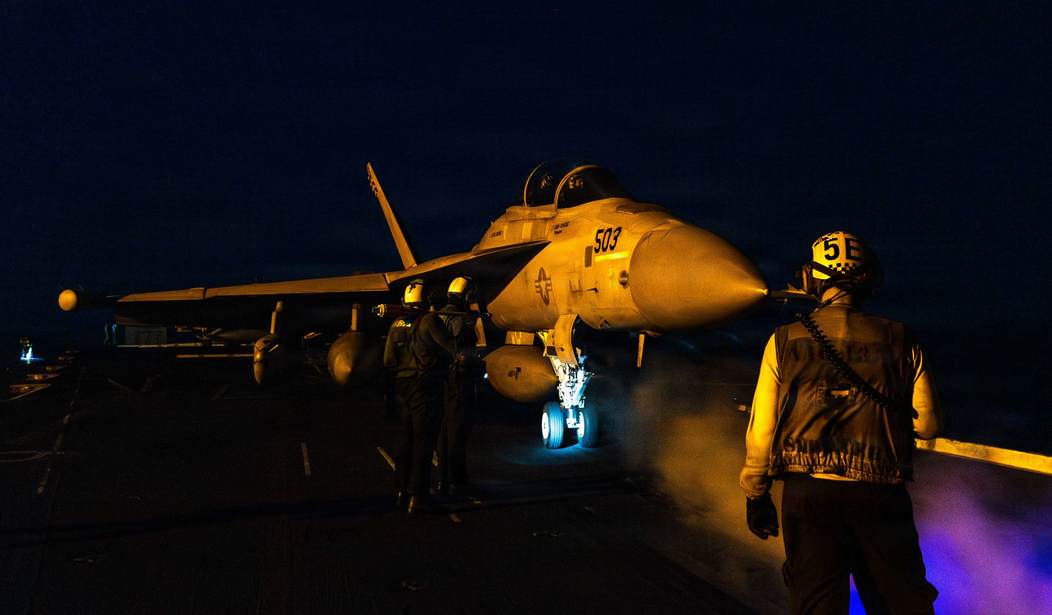
The United States is winning.
Anyone telling you otherwise is either mistaken — or rooting for a different outcome.
That may sound blunt. But it happens to be true.
The Iranian regime's best remaining strategy is not military. It is political. Tehran is not counting on its air defenses, which are being shredded. It is not counting on its ballistic missile program, which has been systematically dismantled. It is not counting on its nuclear infrastructure, which is being methodically degraded.
It is counting on Americans.
More specifically, it is counting on a strange and uncomfortable coalition inside the United States: a segment of the Left that reflexively opposes anything undertaken by President Donald Trump, and a faction on the populist Right that insists American power is inherently corrupt and that any projection of it must be illegitimate. That coalition — unlikely as it seems — is Iran's last real hope.
Because on the battlefield, the facts are stubborn.
According to reports, Israeli strikes have targeted senior leadership facilities, including sites tied to succession planning within Iran's governing structure. The United States, meanwhile, has struck Islamic Revolutionary Guard Corps facilities and ballistic missile sites across the country. Iran's capacity to threaten its neighbors — and eventually the West — is being reduced in real time.
And at a cost that, while never trivial in war, underscores the scale of American military superiority.
In the 1991 Gulf War, the United States lost 294 servicemembers. In Afghanistan, roughly 2,300. In Iraq, more than 4,500. Operation Inherent Resolve, the campaign against ISIS, cost 124 American lives.
In the current operation — Operation Epic Fury — six American servicemembers have been killed.
Every death is a tragedy. No serious person minimizes that. But it is also true that American military capability has evolved dramatically. This is not 1968. It is not a Vietnam-style quagmire with thousands of casualties mounting toward strategic stalemate. It is a display of overwhelming technological, intelligence and operational dominance.
The Israeli Air Force reportedly flew roughly 1,200 sorties in three days without a single combat loss. The United States has conducted extensive operations in theater without losing aircraft over Iran. That is not what losing looks like.
Which brings us back to Tehran's messaging strategy.
Iranian Foreign Minister Abbas Araghchi has taken to posting in English, directing his appeals squarely at American audiences. His argument rests on three pillars: that Iran was never a threat, that negotiations were proceeding in good faith, and that the United States was manipulated into war on Israel's behalf.
Each claim collapses under scrutiny.
First, the notion that Iran posed no threat ignores both its missile development and its nuclear progress. U.S. envoy Steve Witkoff recently detailed the scale of Iran's enriched uranium stockpiles —including material enriched to 60 percent purity, alarmingly close to weapons grade. That is not theoretical capability. That is a short breakout timeline.
Second, the claim of good-faith negotiations falters when one examines the reported American offer: a decade of zero enrichment, with the United States supplying fuel. That proposal was rejected. If the objective was purely civilian nuclear energy, the offer would have been attractive. Its dismissal suggests other priorities.
Third, the argument that America was somehow cucked by Israeli Prime Minister Benjamin Netanyahu is not serious analysis. It is internet theater. Secretary of State Marco Rubio put the strategic case plainly: Within a year to 18 months, Iran could have crossed what he described as a "line of immunity," accumulating sufficient short-range missiles and drones to deter effective counteraction.
The window was closing.
That reality explains the timing more convincingly than conspiracy theories do.
History offers a cautionary note. Adversarial regimes have long attempted to fracture American domestic support during wartime. During World War II, Axis propagandists beamed radio broadcasts at Allied populations. During Vietnam, North Vietnamese leadership understood that battlefield setbacks could be offset by political erosion in the United States. The strategy is familiar: If you cannot win militarily, try to win psychologically.
Tehran is attempting the same maneuver.
It is firing drones toward regional targets in symbolic displays of defiance. But its most consequential salvos are rhetorical, aimed at American social media feeds rather than American aircraft carriers.
The uncomfortable truth for Iran is that its military options are narrowing. Its air defenses have proven porous. Its infrastructure is vulnerable. Its deterrent credibility has been badly shaken.
That does not mean the conflict is risk-free. War always contains uncertainty. Escalation is always possible. Skepticism is not disloyalty; demanding clear objectives and accountability from leaders is a civic duty.
But analysis should begin with reality.
And the reality is, the United States and its allies currently possess escalation dominance, operational superiority and strategic momentum. The Iranian regime's primary remaining lever is the hope that Americans will convince themselves they are losing -- even as evidence suggests otherwise.
The United States is winning.
And Tehran knows it.
Ben Shapiro is a graduate of UCLA and Harvard Law School, host of "The Ben Shapiro Show," and co-founder of Daily Wire+. He is a three-time New York Times bestselling author.
Editor's Note: For decades, former presidents have been all talk and no action. Now, Donald Trump is eliminating the threat from Iran once and for all.
Help us report the truth about the Trump administration’s decisive actions to keep Americans safe and bring peace to the world. Join Townhall VIP and use promo code FIGHT to get 60% off your VIP membership.

Join the Conversation
VIP members get the ability to comment on articles.