





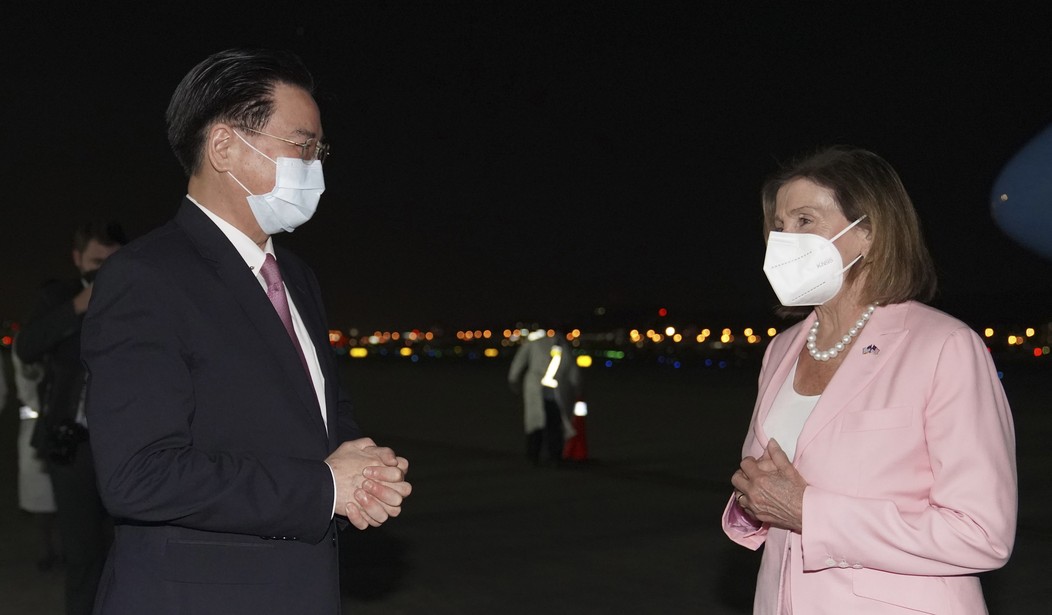
This week, House Speaker Nancy Pelosi went to Taiwan, determined to make a statement about American support for the democratic country under constant threat from its tyrannical Chinese neighbor. That trip prompted spasms of apoplexy from the Chinese government, which vowed serious consequences; China, in the end, engaged mainly in some military posturing.
There is no question that Pelosi is correct about the need for the West to support Taiwan, nor is there any question that China is an aggressive dictatorship. But Pelosi's trip represents the latest in a long line of American foreign policy moves that seem like bluster rather than strength. It's one thing for John F. Kennedy to fly to Berlin in the midst of a Cold War blockade of the city to show solidarity with Germans in the face of Soviet aggression, declaring that the United States would indeed defend West Berlin in case of invasion. It's another for Pelosi to fly to Taiwan in provocative defiance of Chinese caterwauling without any firm deliverable: no statement of American intention to defend Taiwan in case of invasion (President Joe Biden actually stated that America would do so, before his State Department then walked it back); no major increase in military aid to the island; no increase to the projective power of the United States Navy, which will purchase nine ships this year while losing 24.
Pelosi's visit, therefore, sounds a lot like the virtue signaling in which American politicians of both parties have engaged for decades. These politicians say they will protect democratic allies, then abandon them when the going gets tough; they explain that their foreign policy priorities range from free elections to gay rights, then hobnob with the world's worst dictators. They speak loudly and carry a wet noodle. Their addiction to high-flown rhetoric and vacillating commitment undercuts both their credibility and their capacity for moral suasion.
Biden represents a paradigmatic example of this sort of politician: in February 2002, for example, he stated that "history will judge us harshly if we allow the hope of a liberated Afghanistan to evaporate because we failed to stay the course"; by 2021, Biden was pulling the plug on Afghanistan, handing the country over to the tender mercies of the very same people who presided over the planning of Sept. 11. Biden spent all of 2020 describing Saudi Arabia as a pariah over its human rights violations; by 2022, he was fist-bumping Crown Prince Mohammed Bin Salman.
The answer to a foreign policy based on buzzwords is a foreign policy based on forwarding American interests, which over the long run will indeed forward America's values. Instead of suggesting that America will defend Ukraine because of Ukraine's commitment to democracy, for example -- a commitment that is undermined internally by rabid corruption -- our leaders should simply tell the truth: We ought to defend Ukraine from Russia because it is in our interest to counter Russian predations in Europe, which threaten the integrity of our allies in NATO and foster more aggression from our geopolitical opponents including China. At least such a clear position would prevent the misunderstandings that arise when Western nations bluster about defending democracy, then repeatedly do nothing to do so, as the West did during Russia's invasions of Georgia and Crimea.
Such a foreign policy would be nothing new; it would be perfectly in line with the famous words of John Quincy Adams, who stated that America "goes not abroad, in search of monsters to destroy. She is the well-wisher to the freedom and independence of all. She is the champion and vindicator only of her own." America ought to know her own interests. And America ought to protect her own interests. At least then our allies and our enemies will know where we stand, rather than speculating that our rhetoric is empty.

Join the Conversation
VIP members get the ability to comment on articles.