


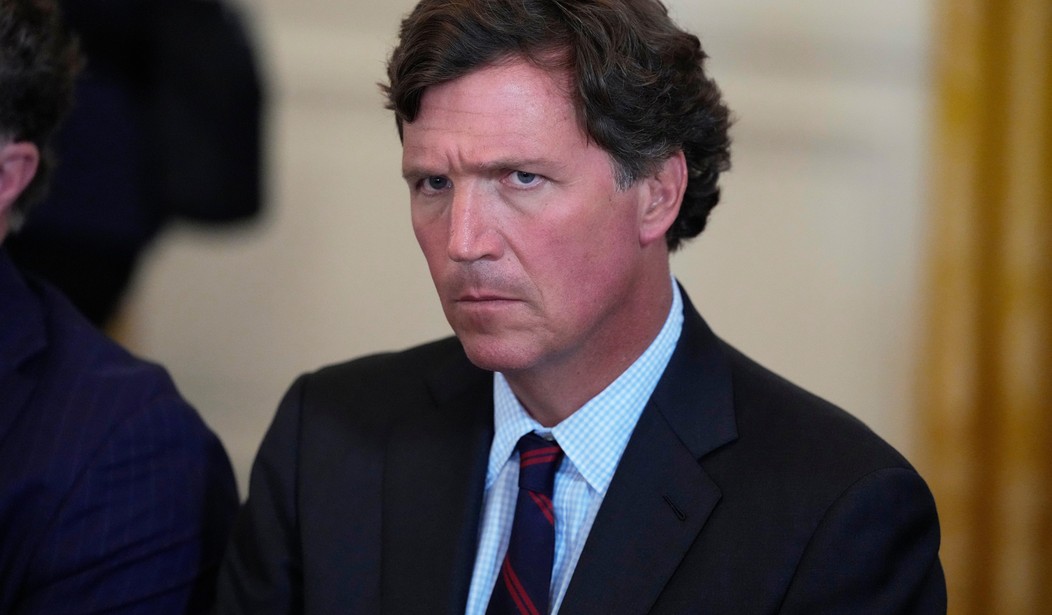
On October 2, 2026, Tucker Carlson released his hostile interview with former U.K. Conservative MP Jacob Rees-Mogg. That was a bad move for the fired Fox News host.
A wide array of opinions has celebrated Mogg for holding his own against the abusive detours, the unwelcome interventions, and unjustified non sequiturs that Tucker Carlson has become famous for throwing out.
Views tired of Tucker’s pro-Islam, anti-Zionist schtick have praised Mogg for keeping his cool and turning the tables on the former MSNBC-CNN host throughout the entire.
The wide bevy of commentators declared that Carlson finally met his match. Most of the public should have expected as much. The posh UK conservative was one of the few who expertly rebuffed Sasha Baron Cohen’s obnoxious alter ego Ali G nearly 30 years ago. He mocked the liberal comedian without batting an eyelash or breaking a sweat. Remarking on the mockery, Mogg undermined Cohen’s subversive credibility by sharing that he enjoyed the interview. Calm, cool, and collected is the approach, and Mogg took the time to develop clarity of speech under duress.
His excellent takedown of a fake news propagandist masquerading as a journalist is not a first, either, but he capitalized on prior wins to deflate the most obnoxious of the bunch.
Canadian psychologist and intellectual Jordan Peterson’s revealed (and reveled in) his own masterclass on dealing with hostile interviews when he took down Cathy Newman of Channel 4 News in 2018. She repeatedly tried to put words in Peterson’s mouth (as Tucker did with Mogg), but he would gently correct her and set the record straight. At one point, he even laughed at her silly questions.
Elon Musk has also shut down arrogant liberals pushing their agenda under the guise of journalism. At X's San Francisco headquarters on April 11, 2023, Musk slammed a BBC reporter outright for lying about a supposed increase in hate speech or racist commentary on Twitter (now X) shortly after Musk took over. On July 23, 2026, in Musk’s long and contentious interview with the Economist, he rebuked the reporter’s suggestion that people loathe him for taking on more conservative political views. He retorted (correctly) that more people loathe corporate media talking heads like herself for mischaracterizing people and not reporting the truth. He also pushed back on the empty smear that he was supporting “extreme right” or “far right” policies when he provided a solid list of Democrat politicians in America who had supported secure borders, protection of children, and a rejection of amnesty for illegal immigrants.
It’s worth building on Musk and Peterson to appreciate Mogg’s approach to biased interviewers who insist on putting words in their guests’ mouths all while contorting their remarks and undermining their arguments.
These aggressive, liberal interviewers want to enrage their guests, cause them to lose their cool, then take advantage of their flustered state as if to say: “See! You’re wrong about your stance! You are getting angry with me because all I’m doing is just asking questions.”
As if!
Like Peterson and Musk, Jacob Rees-Mogg was prepared, and the audience recognizes that he was comfortable with his views and his answers because he had pondered them for a long time. He spoke cogently, responded calmly without sudden alarm, and he had no problem correcting Tucker’s misunderstanding — or disregard — of history.
How have the pundits responded, and what are they missing?
Triggernometry podcaster Konstantin Kisin rebuffed these celebrations, lamenting that Tucker’s take was not particularly dark or disconcerting. He found Tucker to be unintelligent, and the whole discussion disappointing.
I could not disagree more.
Mogg’s masterful class on mogging (urban slang meaning to outshine, outclass, or dominate someone else — most commonly in physical appearance, physique, height, or presence, making them look inferior or smaller by comparison, cf. Merriam-Webster) Tucker and his insufferable post-liberal arrogance is a clinic for dealing with these fake news propagandists masquerading as journalists.
British conservative Peter Hitchens remarked that Tucker shouldn’t be treated seriously. He faulted Tucker’s lack of knowledge of history, his broad folly about Russia’s GDP vs. the UK, but he didn’t go after Trump’s deprecating self-contradictions. More conservatives need to point out this disturbing habit, then rest on that point to dismiss further discussions with him.
Andrew Klavan sounded off on Mogg mogging Tucker, too. He pointed out that war is justified when an aggressive power attacks, murders, and slaughters innocent civilians. He dismissed their influence because they may have many followers and views, but so what?
Klavan focuses on Tucker’s repartee that the UK should not have entered World War II. He slams the litany of falsehoods that flooded out of Tucker’s mouth. He criticizes the notion that WWII caused the decline of the UK. Klavan correctly points out that European allied nations are collapsing because they have lost the will and the interest in keeping their culture alive.
I would go one step further, though. This analysis is still missing from the Carlson-Mogg reactions. Why has the West stopped fighting for its values? Because Christian faith has fallen into decline as universities have embraced secular leftist and globalist ideas. I also welcome his attack on the false dichotomy of having to choose between Nazi rule and Islamic rule. He put Nazi and Islam together vs. Western glory based on Judeo-Christian values, Greek reason, and Roman courage.
Klavan also jumped on Tucker’s naïve argument that the UK is arresting more people for speech than Russia. Mogg mocked Tucker’s brazen ignorance (his confident dumbness), reminding Tucker that Putin routinely jails dissidents, or they suddenly find themselves falling from windows or getting poisoned.
I would add that since the collapse of the Soviet Union, Russian citizens have never enjoyed a culture of robust freedom of speech. While that natural right is under attack in the United Kingdom because of a hostile Labour government and local bureaucrats, Russian citizens have learned to keep their mouths shut, knowing all too well the consequences if they speak out and criticize the regime.
Furthermore, Russia does not respect freedom of religion either. The general public is unaware of this, but as far back as 2016, Russia has heavily restricted proselytizing. Individuals cannot share their faith publicly, yet not a whimper from the pro-Putin crowd. Mogg should have capitalized on that.
Last of all, many of the chatterati have ignored one of the best parts of the Tucker-Mogg moggery, which occurred when Mogg intimated that Tucker was defending Hitler, and the former MP advised his interviewer that he probably didn’t want to give that impression. Most people commenting on the exchange are not giving Rees-Mogg enough credit: he didn’t resort to direct character assassination, but slyly suggested it, just as Tucker makes snide assumptions about his guests under the guise of “just asking questions.”
Trying to defend himself, Tucker said, "Yeah, I guess I'm just a secret Nazi. I'm actually not a secret Nazi..."”
From Mogg’s reflection on his debate/discussion to the latest comments on the exchange, it’s frustrating that no one has seized on this grating, fundamental problem with Tucker, especially in connection with that Nazi-Not a Nazi remark: Tucker says unserious things, then disavows saying them. If he doesn’t take his own words seriously, why should anyone else?
Editor’s Note: Do you enjoy Townhall’s conservative reporting that takes on the radical Left and woke media? Support our work so that we can continue to bring you the truth.
Join Townhall VIP and use promo code FIGHT to receive 60% off your membership.

Join the Conversation
VIP members get the ability to comment on articles.