





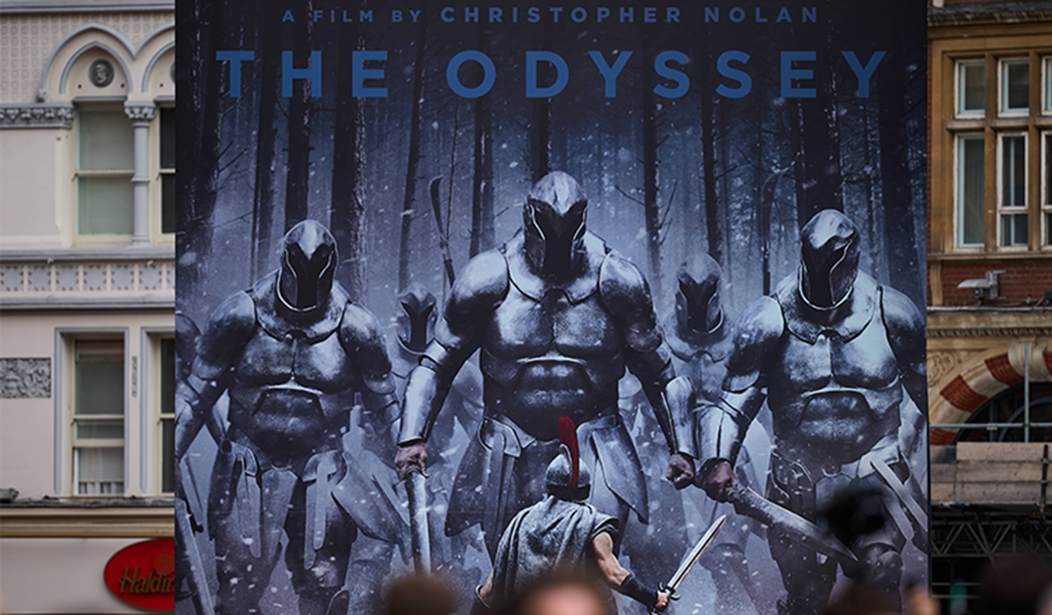
With all the bravado, complaining, and politicking over the movie, I decided to watch for myself.
The Odyssey is a foundational epic of the West, exploring themes of courage, overcoming hardship, dealing with moral failures, recognizing danger near and far, and understanding the consequences of one’s actions, even if you never learn from them.
It’s about the journey, not the destination.
Your identity must resound beyond your surroundings, your challenges, or even your accomplishments.
It’s no surprise that The Odyssey founds the Western Tradition, enough so that daring, visionary director Christopher Nolan insisted on composing his own adaptation of the epic.
And he doesn’t disappoint.
That’s not to say that I don’t have criticisms. Even the poem has detractors (“I get angry when good Homer nods off,” Roman satirist Horace slyly pointed out), but Nolan provides a fresh retelling, albeit with some dubious departures from the seminal text, somewhat like the protagonist of many turns in the epic poem.
First, let’s dispense with the woke criticisms.
I was not one bit disappointed by Ellen “Elliot” Page’s part. If an actor delivers a riveting performance, it matters that we recognize the truth of the actor— he or she deserves respect for a job well done. Page gets it done.
Let’s not forget that female character actress Linda Hunt played a male Vietnamese photographer in The Year of Living Dangerously, and she won a well-deserved Supporting Actress Oscar.
Page, as minor character Sinon, plays a powerful role in the whole work. The politics of her moral and biological confusion off-screen didn’t matter to me.
If Homer can detour, so can I—For the record, conservative readers, if you insist on basing all entertainment choices on the moral standing of the artist, you will find life to be quite boring: Janis Joplin featured in Rush Limbaugh’s daily radio programs, even though she was a drug addict and a single mother. His musical preferences never represented his politics, nor should they have cast a condemning shadow. Elton John is a great musician, even if I oppose his private life choices (and their public consequences). Leonardo DiCaprio and Robert De Niro are fine actors, even if I don’t care about climate change or I find De Niro’s anti-Trump rants petty and pathetic.
Now let’s talk about the African version of Helen of Troy. The sleek black-skinned actress who played Helen of Troy AND her twin sister (not too many spoilers, although everyone should know the Odyssey from middle school or high school English, so there’s that) commanded every scene: tough, nimble, and capable in her capturing the character she portrays. When you watch black Helen, there are no “Black Lives Matter” vibes shoved in your face. Helen of Troy is beautiful, no matter her melanin count.
In fact, throughout the movie, Odysseus’ crew is composed of men from all backgrounds. There are Southeast Asian, Indian, and even Hispanic actors playing the parts. Guess what? I didn’t care. They played their parts well, and once again—not once did I feel that Nolan was engaging in diversity lottery-lecture scolding to score woke points with Hollywood.
Think about it, folks: we have seen black men play Hamlet, white men play Othello, and women play the main characters in Twelve Angry Men (they just tweak the title to Twelve Angry Jurors). We don’t need to get hung up over skin color or ethnicity or sex when actors and directors are telling (or retelling) excellent, fantastic stories. In fact, the superficial diversity enhances the eternal dynamics of the legends! Works of art stand the test of time, and they can be reproduced by men of any background!
Now, to the movie itself.
Nolan does not disappoint with his innovative filmmaking. Instead of pallid statues of Pallas, carved mosaics, ancient obsidian pottery, or flat, clean classical storytelling, Nolan gives us a raw, earthy, epic retelling.
He literally brings the many tales of the epic to life before us.
The scene with the Cyclops Polyphemus is gruesome, chilling, intense, all rolled into one. When I read Homer’s passages in middle school, then studied them in high school and college, the suspense, the danger, and the intense drama never burst out on me. With Nolan’s direction and the superb acting of Matt Damon as Odysseus, I endured the pain and terror of the misguided Greek mariners. How would you feel, what would you think, what would you do if you were trapped in a cave, about to be beaten by a vile behemoth? The disgusting brute of a cyclops frightens and enthralls viewers all at once. The incredible imagination of Nolan in his depiction of this ravenous brute not only revives Homer’s epic, but I would add that he brought life to the epic which centuries of academics and literary critics have failed to restore.
Circe transforming Odysseus’ remaining crew into pigs; the sacking of Troy—and the repeated flashbacks depicting destruction of the city after 10 years of military standoff; even the terrifying account of Odysseus’ skeleton crew avoiding Charybdis, only to witness in horror as Scylla scoops up and devours six of his crew: all of it staggers our imagination, enhancing the great work of Western literature.
Nolan’s most incredible re-adaptation occurs when Odysseus travels to Hades to speak with the blind prophet Tiresias. I will not relate this scene in detail in order to avoid spoiling the rich, dark, gothic clarity of Nolan’s invigorating retelling. It is chilling, amazing, and overpowering all at once, and provides the final scene for Ellen “Sinon” Page, which serves as a unifying element of the story.
The imaginative realness that Nolan and team thrust into this epic stands out in many forms.
We behold only the imposing figure of Menelaus in black armor and his curly hair. We marvel at the ingenious Trojan Horse and the immense challenges of Odysseus and his men hiding in that equine trap. Far from degrading or detracting from the source material, Nolan’s Odyssey enhances the work—and makes you want to check it out for yourself.
The initial criticisms I had of the movie, the sense that it took massive departures from the original text, I found to be incorrect on my part. There were integral parts of the epic poem which students never cover in school, but Nolan includes them—and accurately—including the touching sub-plot of Prince Telemachus searching for his father, refusing to give him up or give up on him.
And who can forget Anne Hathaway as the wise, cunning, and beautiful wife Penelope in an Oscar-worthy portrayal? She invests her role with Hollywood emotion as well as Ancient Greek pathos; we admire this strong woman for her fidelity and courage, while also recognizing her inevitable frailty.
I disliked one considerable detour from the poem’s main themes. Odysseus as written has a pride problem and gets humbled. Odysseus on screen is wracked with guilt and struggles to overcome the trauma. That’s a departure I would not have chosen, but my detraction should not discourage you from watching it.
The Odyssey movie brings out the epic in the poem, and you should see it. You won’t nod off. I promise.
Editor’s Note: Do you enjoy Townhall’s conservative reporting that takes on the radical Left and woke media? Support our work so that we can continue to bring you the truth.
Join Townhall VIP and use promo code FIGHT to receive 60% off your membership.



Join the Conversation
VIP members get the ability to comment on articles.