
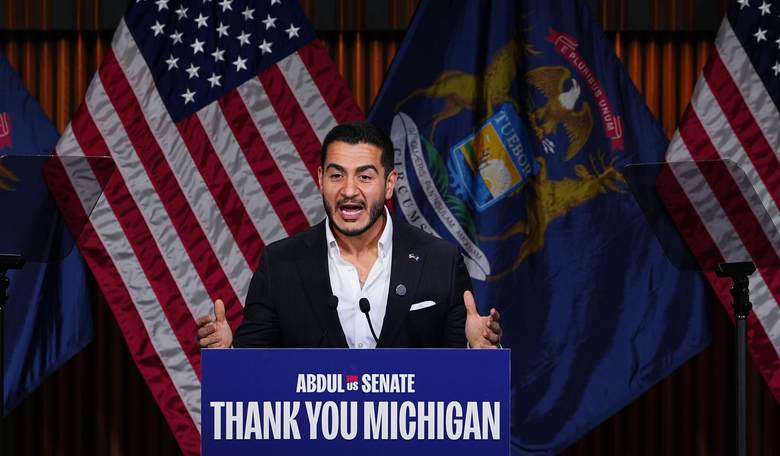
Abdul El-Sayed's election to the U.S. Senate is consequential. It is also a moment that calls for clear-eyed scrutiny, not panic nor complacency.
The most troubling part of El-Sayed's victory is not his Muslim faith. A candidate's religion is not proof of disloyalty, extremism or hostility to America. Nor should political opponents casually brand him a terrorist sympathizer without evidence. Those attacks weaken serious criticism and risk turning legitimate debate into suspicion of an entire religious community.
The serious questions arise from El-Sayed's own statements about Israel. In his "60 Minutes" interview, he affirmed that Israel has a right to exist, but he immediately added a qualification, saying he would support either a two-state solution or "one state shared in a different way" if Israelis and Palestinians chose it. He also called for an arms embargo on Israel and accused the country of genocide. After his election, he again called for ending U.S. arms sales to Israel.
Those positions deserve more than slogans from either side. The one-state idea is not automatically a call to destroy Israel; El-Sayed says the outcome should be chosen by both peoples. But the practical question remains: What would protect the Jewish people's right to national self-determination in a single state? What constitutional arrangements would ensure security, equal citizenship and political power for both peoples? How would the state prevent one community from ruling the other? El-Sayed has raised the possibility of one state without giving voters a detailed answer to those questions.
That uncertainty matters. Israel is not simply a government whose policies can be criticized or changed. For Jews, it is also a national homeland shaped by centuries of persecution and the catastrophe of the Holocaust. A proposal that could fundamentally change Israel's character must explain how Jewish self-determination would survive that change. Voters are entitled to ask whether El-Sayed has a workable answer.
His style adds to the concern. In his victory speech, he taunted Vice President JD Vance and described his win as a "delicious irony." One can understand the impulse to answer a campaign that attacked his name and faith. But the speech also projected a confidence that could read as smugness and self-congratulation. In Washington, the challenge will be whether that combative posture gives way to the patience and seriousness required to represent a state as divided as Michigan.
The election itself does not prove that Michigan endorsed every position El-Sayed holds. Voters choose among candidates with different records, personalities and priorities. His campaign also emphasized lowering costs, healthcare, corporate power and the future of work. A survey of 482 Jewish early voters found that 57 percent supported El-Sayed, compared with more than 78 percent for Democratic gubernatorial nominee Jocelyn Benson. The survey was limited to people who had already voted early and should not be treated as a definitive measure of every Jewish voter's choice. It did, however, suggest that El-Sayed underperformed other Democrats among those respondents.
Jewish voters do not share one political view, and no one should presume to tell them how to vote. The appropriate response is to take their political agency seriously while asking all voters to scrutinize a candidate's record and proposals. El-Sayed's victory is not evidence that Jewish Americans have voted against their own survival. It is evidence that a coalition of Michigan voters chose him for a range of reasons and that many others had serious reservations about his approach to Israel.
The next test is accountability. As a senator, El-Sayed should explain what he means by a shared state, how he would protect Israel's security and what limits he would place on U.S. policy. He should be pressed on the distinction between criticizing an Israeli government and denying the Jewish people's right to a secure homeland. He should also be judged by the same standard as every senator: whether his actions serve his constituents and the constitutional responsibilities of his office.
There is no need to claim that El-Sayed intends to infiltrate the political system or secretly subvert America. Such claims go beyond the evidence and distract from the questions that matter. The case against his approach is strongest when it rests on what he has actually said, what his proposals would do, and what he has not yet explained.
This election should sharpen the debate, not silence it. El-Sayed has won the right to represent Michigan. He has not won a blank check. Supporters and critics alike should listen closely, demand specifics and hold him to his words. When the stakes include Israel's future and the safety of Jewish communities, wishful thinking is no substitute for honest scrutiny.
Armstrong Williams is manager/sole owner of Howard Stirk Holdings I & II Broadcast Television Stations and the 2016 Multicultural Media Broadcast owner of the year.