





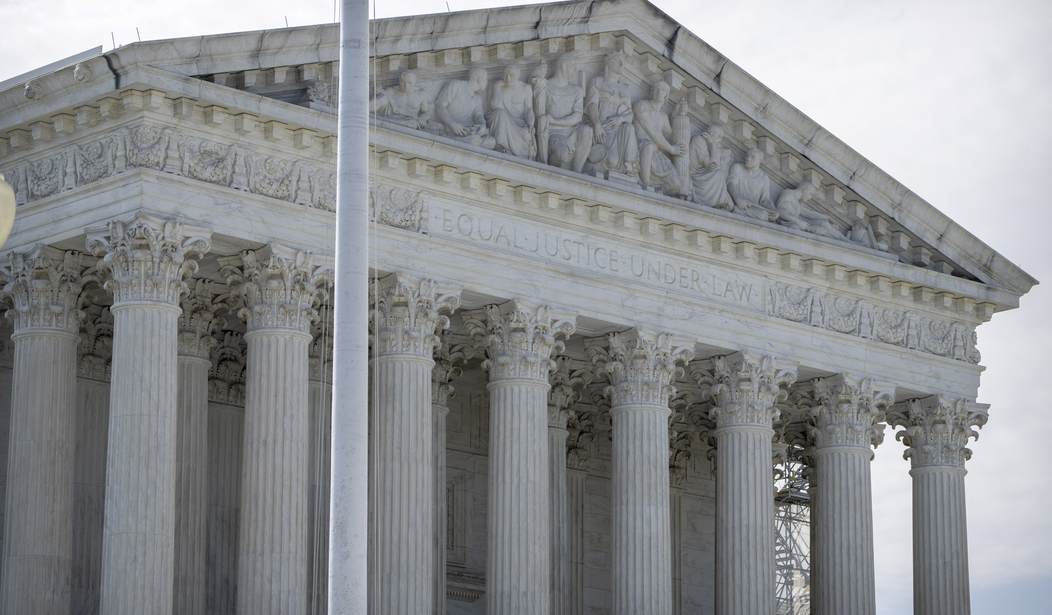
The United States Supreme Court has entered its most consequential season.
From April through June, the justices release rulings that do more than interpret the law -- they shape the direction of the country. Cases argued in the quiet months of winter now emerge into public view, often carrying the full weight of the nation's deepest divisions.
Alexander Hamilton once described the court as the "least dangerous" branch, lacking power over "the sword or the purse." History has not been kind to that prediction. Through judicial review and lifetime appointments, the court has become one of the most influential forces in American life. Alexis de Tocqueville recognized this early, observing that nearly every political question in America eventually becomes a legal one.
He was right.
From Dred Scott v. Sandford to the defining civil rights rulings of the 20th century, the court has not merely followed history; it has redirected it. This term will be no different. Immigration, free speech, religious liberty, executive authority and birthright citizenship all stand before the court, awaiting decisions that will ripple for generations.
The court is not flawless. It misjudges at times. But compared to the raw political instincts driving Congress and the White House, it still reflects something increasingly rare: deliberation, restraint and a commitment, however imperfect, to principle over passion.
That is precisely why its structure has endured. Nine Justices. No more, no less. Since 1869, that number has held firm despite repeated efforts to reshape it for political advantage. Franklin D. Roosevelt famously attempted to expand the court to secure favorable rulings. The public decisively rejected this. Even in moments of overwhelming political power, Americans understood that tampering with the court carries lasting consequences.
Sometimes, it is the smaller moments that reveal the institution's character.
Recently, Sonia Sotomayor apologized to Brett Kavanaugh after making pointed remarks about his perspective in an immigration case. "I made remarks that were inappropriate. I regret my hurtful comments," she said plainly.
In today's political climate, that kind of accountability stands out. Her original comments were sharp but not unusual by modern standards. What was unusual was the apology.
Try to imagine that same moment in the political arena.
It is nearly impossible to picture Donald Trump apologizing to Joe Biden, or vice versa, for the constant stream of personal attacks that define modern political campaigns. In politics today, opponents are not rivals to be debated; they are enemies to be defeated. Compromise has become a casualty.
That shift carries consequences.
Now consider the possibility of Samuel Alito stepping down. A conservative anchor on the court, his departure would immediately trigger a political firestorm. If the Senate were controlled by Democrats at the time, would they move forward with a confirmation? Or would they delay, as Republicans did in 2016 when Mitch McConnell blocked a vote on Merrick Garland, preserving the seat for the next president?
We have seen this playbook before.
And we may see it again.
When the court becomes another battlefield for partisan maneuvering, something deeper begins to erode. Public confidence weakens. The perception of fairness fades. The judiciary meant to stand apart gets pulled into the same gravitational force as the political branches.
We are drifting in that direction.
And unlike past moments, there is little sign either side is willing to pull back.
The Supreme Court may still be the most disciplined institution in American government. But even it is not immune to the forces reshaping the nation.
Springtime at the court is no longer just about decisions.
It is about direction.
And increasingly, it is about the future of the institution itself.
Armstrong Williams is the manager/sole owner of Howard Stirk Holdings I & II Broadcast Television Stations and the 2016 Multicultural Media Broadcast owner of the year.
Editor’s Note: Do you enjoy Townhall’s conservative reporting that takes on the radical Left and woke media? Support our work so that we can continue to bring you the truth.
Join Townhall VIP and use promo code FIGHT to receive 60% off your membership.



Join the Conversation
VIP members get the ability to comment on articles.