





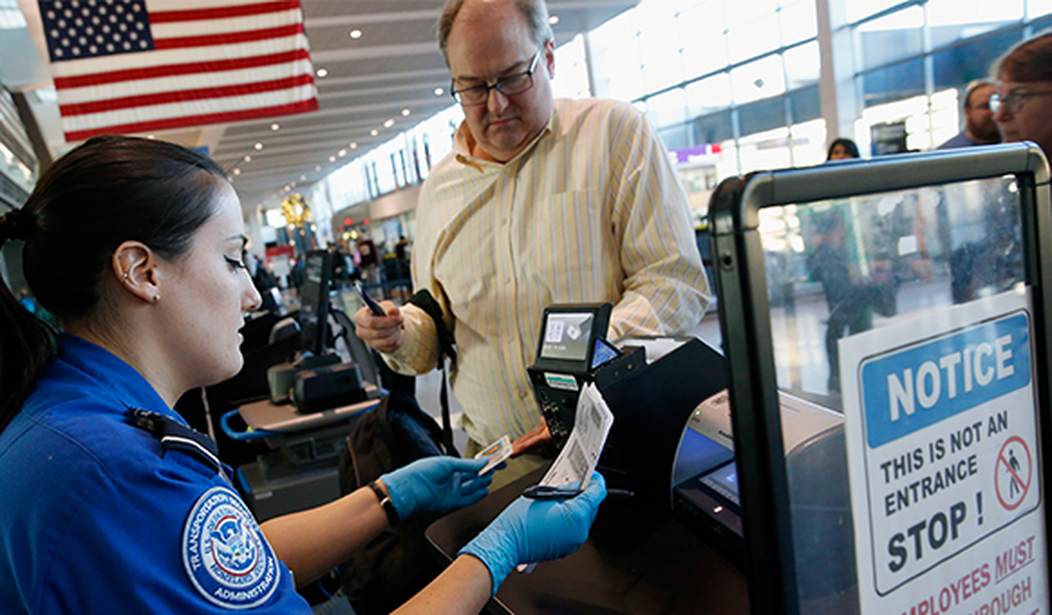
When a Transportation Security Administration official warns that airports could "quite literally shut down," we are no longer talking about inconvenience, delays or political theater. We are talking about vulnerability in one of the most sensitive and critical systems in our country. Aviation security is not just another government function. It is a frontline defense. And when that defense shows signs of strain, every American should pay attention.
Let's speak plainly. When security systems are stretched thin, when agents are overwhelmed, when focus is fractured, the margin for error disappears. And in aviation, there is no such thing as a small mistake. One missed detail, one overlooked bag, one moment of distraction -- those are not minor lapses. They are potential entry points for catastrophe.
We are already hearing deeply troubling reports of prohibited items slipping through screening checkpoints. Whether these incidents are isolated or part of a broader pattern, they should send a chill through this nation. Because our adversaries are not looking for perfection, they are looking for opportunity. And dysfunction, especially in a high-stakes environment like airport security, creates exactly that.
If we continue down this path, we are not just risking delays or travel disruptions. We are risking lives.
History has already taught us this lesson, and it taught it at a devastating cost. We know what happens when vigilance weakens, when warning signs are ignored, when systems designed to protect us begin to falter under pressure. The consequences are not theoretical — they are real, and they are lasting. We cannot afford to relearn what we already know through another tragedy.
Yet here we are, watching a system strained by political standoff and institutional fatigue. A partial shutdown may be framed as a negotiating tactic, but in reality, it is something far more serious. It is a national security liability. When funding is uncertain, when personnel are asked to do more with less, when morale is tested and attention is divided, the system does not hold steady — it weakens.
The people on the front lines of this system — TSA agents, airport personnel, law enforcement — are doing their jobs under increasingly difficult conditions. They show up, they serve, and they carry the responsibility of protecting millions of travelers every day. But even the most dedicated professionals cannot compensate indefinitely for a system under strain. At some point, the cracks begin to show.
And those cracks matter.
Right now, anyone working in or traveling through our major airports is operating in what may be one of the most dangerous threat environments we have seen since the aftermath of the 9/11 attacks. Not because we are unaware of the risks, but because we are allowing conditions that increase them. We are creating an environment where vigilance is harder to maintain, where systems are less resilient, and where the cost of a single failure is immeasurable.
This is not a moment for political brinkmanship. It is not a moment for delay, distraction or deflection. It is a moment that demands seriousness, urgency and responsibility.
We need adults in the room, leaders who understand that safeguarding the American people is not negotiable, not conditional and not something to be leveraged for short-term advantage. National security is not a line item to be debated at the expense of readiness. It is a fundamental obligation.
Because the truth is simple: Our adversaries are watching. They are patient. They are opportunistic. And they do not need us to fail completely. They only need us to falter long enough for them to find a way through.
We cannot give them that opening.
The warning signs are already there. The vulnerabilities are being discussed openly. The risks are no longer hypothetical. And that is what makes this moment so critical.
Fix this. Now.
Not tomorrow. Not after the next round of negotiations. Now.
Because the difference between a system under strain and a system that fails is often just one moment, one oversight, one opportunity taken by someone who means to harm. And if that moment comes, the consequences will not be political. They will be human.
Lives disrupted. Families shattered. A nation once again asking how something preventable was allowed to happen.
We have the knowledge. We have the experience. We know what is at stake.
The only question is whether we have the will to act before it is too late.
Armstrong Williams is the manager/sole owner of Howard Stirk Holdings I & II Broadcast Television Stations and the 2016 Multicultural Media Broadcast owner of the year.
Editor’s Note: Do you enjoy Townhall’s conservative reporting that takes on the radical Left and woke media? Support our work so that we can continue to bring you the truth.
Join Townhall VIP and use promo code FIGHT to receive 60% off your membership.
Join the Conversation
VIP members get the ability to comment on articles.