





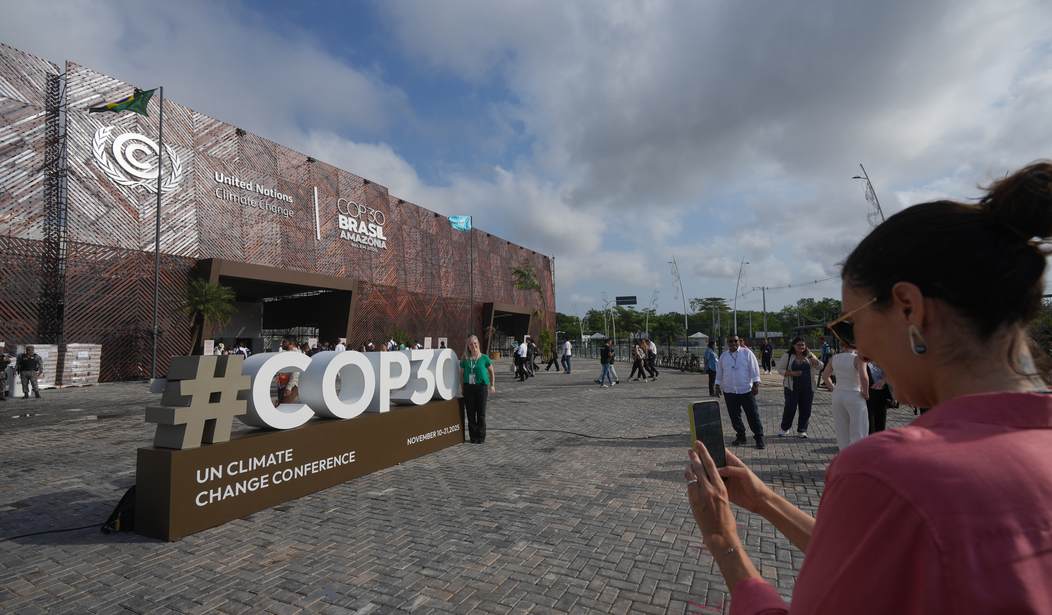
The United Nations climate meetings, aka COP (conference of parties), have always had a flair for hand-wringing bureaucratic drama, but COP30 in Belém delivered something new. This time, instead of another round of carbon pledges, delegates unveiled the Declaration on Information Integrity on Climate Change. It reads less like a scientific document and more like an instruction manual for policing public conversation. The tone alone tells you exactly where this is headed.
The Declaration begins with the standard invocation of urgency. It states that “the urgency of the climate crisis demands not only decisive action by States, but also the broad engagement of all segments of society.” The phrasing sets off alarm bells. The Orwellian document makes it clear that engagement is welcome only when approved by the proper authorities.
Next, the Declaration emphasizes that everyone must have access to “consistent, reliable, accurate and evidence-based information on climate change” in order to build what it calls “public trust in climate policies and actions.” This is telling. Trust, in their framing, is a product of top-down information management rather than transparency or open debate. Real science does not require managed trust. It earns it.
The Declaration frets loudly about “misinformation,” “disinformation,” and the newest catch-all: “denialism.” Once upon a time, these terms described obvious falsehoods. Now, they simply mean “ideas officials dislike.” Under this framework, asking basic scientific questions about climate model biases, data homogeneity issues, policy impacts, or observational uncertainty is transformed from healthy skepticism into heresy. It is the same rhetorical trick used by inquisitions throughout history: declare doubt immoral, then regulate it.
The document repeatedly elevates established institutions as guardians of “truth.” For example, it “recall[s] the importance of the Intergovernmental Panel on Climate Change” in providing “accurate, consistent and evidence-based scientific information.” The IPCC is treated less as a scientific body and more as a final authority whose conclusions must not be challenged.
Once the preamble sets the emotional stage, the Declaration shifts to prescriptions. The first major commitment reads: “Promote the integrity of information related to climate change at the international, national, and local levels, in line with international human rights law, including freedom of expression standards.” This pairing is remarkable. It tries to merge information control with freedom of expression in a way that makes both terms meaningless.
Another section calls on signatories to “reinforce trust in climate science and science-based policies.” Trust is not something reinforced through declarations. It is earned when scientific claims withstand scrutiny. When authorities start instructing society to trust them, it signals a lack of confidence in the underlying evidence.
The Declaration also outlines instructions for the private sector. Businesses are urged to “commit to the integrity of information on climate change” and ensure “transparent, human-rights-responsible advertising practices.” This effectively invites companies to police climate messaging within their own operations and marketing.
Governments receive an even more explicit call to action. The Declaration tells them to “create and implement policies and legal frameworks” that promote information “integrity” while also claiming to respect free expression. It further instructs governments to urge technology companies to examine how their platforms may be “undermining… climate information ecosystem integrity” and to provide researchers with platform data. That is a polite way of saying: regulate platforms until they enforce the preferred narrative.
The text also calls on governments to “promote campaigns on climate change” and support initiatives that ensure the public’s access to “reliable information.” Anyone familiar with past government communication efforts knows exactly what this means: more taxpayer-funded messaging, more one-sided instruction, and less room for dissenting analysis.
Academia and civil society fare no better. They are asked to “integrate information integrity on climate change in their work” and join networks to share “good practices.” In other words, align research and public outreach with the preferred framework or risk being considered part of the information problem.
The final section appeals to funders. It asks them to “donate to the Global Fund for Information Integrity on Climate Change, administered by UNESCO.” This creates a centralized pot of money dedicated to enforcing the very information environment described throughout the Declaration. The arrangement would funnel resources toward debiasing public communication according to standards set by the same institutions that benefit from the resulting narrative control.
The Declaration concludes with a unifying flourish: signatories reaffirm their responsibility to ensure societies are “empowered with the knowledge and information they need to act urgently and decisively.” This is an elegant way of saying the public must be brought into alignment, not through persuasion but through regulation of the information they receive.
When you strip away the diplomatic phrasing, the intent becomes clear. The climate establishment has moved beyond arguing its case. It now seeks to regulate the conversation itself. This is not about protecting the public from misinformation. It is about protecting institutions from questions they no longer wish to answer. The label “information integrity” sounds benign, even noble, but the effect is unmistakable. It centralizes authority over what may be said, by whom, and with what consequences.
This is bureaucratic doublespeak on overdrive, even Orwell might have rejected it as being “too obvious.”
Anthony Watts is a Senior Fellow for Environment and Climate at The Heartland Institute.
Editor’s Note: Do you enjoy Townhall’s conservative reporting that takes on the radical left and woke media? Support our work so that we can continue to bring you the truth.
Join Townhall VIP and use the promo code FIGHT to get 60% off your VIP membership!


Join the Conversation
VIP members get the ability to comment on articles.