





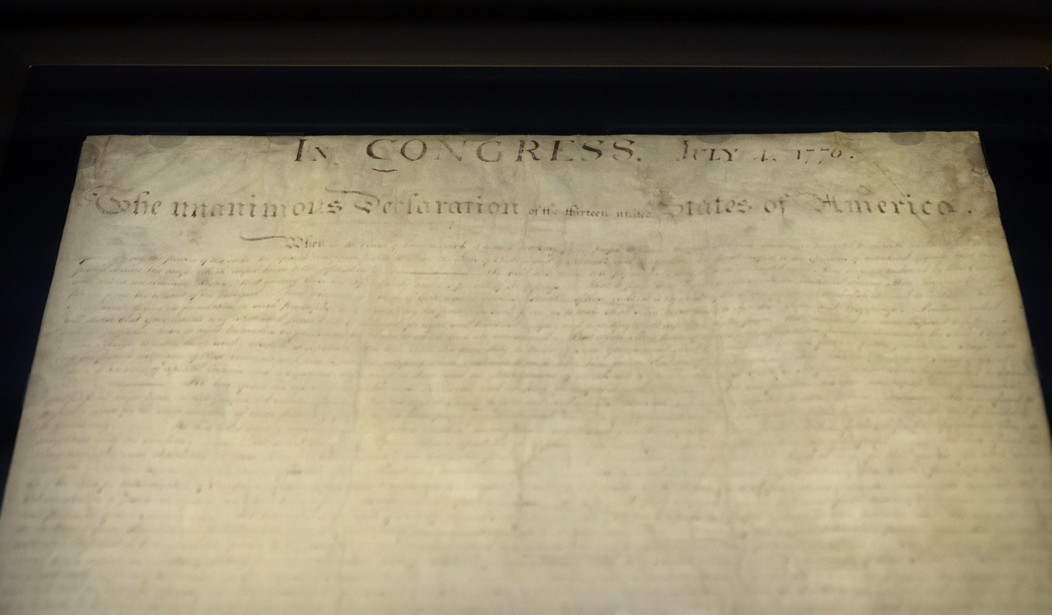
In 1776, Americans rebelled against a tyrant and stood for liberty and self-rule, laying the foundation for a system of limited government.
After years of neglect and abuse by a distant king in London, the colonists chose rebellion over submission.
They launched a bold experiment to create a new nation where the government answered to the people, not the other way around.
The experiment was built on a few core principles — human dignity, the rule of law, freedom, opportunity, civic duty, and limited government.
The Declaration of Independence clearly expresses those principles, laying out the philosophical case for limited government and establishing three key ideas at the core of the American experiment.
Idea 1: Limited Government Policy and the Declaration of Independence
The best explanation of why the colonists rebelled was written by Thomas Jefferson himself. He wrote in the Declaration of Independence:
“We hold these truths to be self-evident, that all men are created equal, that they are endowed by their Creator with certain unalienable Rights, that among these are Life, Liberty, and the pursuit of Happiness.”
These words changed history.
They made a revolutionary claim: Our rights don’t come from kings or governments and can’t be taken away by a petty tyrant.
This idea is the foundation of limited government policy.
It is why the colonists fought. They were not trading one distant tyrant for a closer one. They were fighting for liberty, independence, and self-rule.
Idea 2: The Purpose of Government
The Declaration also explained why government exists in the first place:
“That to secure these rights, Governments are instituted among Men, deriving their just powers from the consent of the governed.”
Jefferson is as right today as he was in 1776. Government exists to protect our natural rights. Its powers are only legitimate when exercised with the consent of the people.
This revolutionary idea is the cornerstone of our belief in the proper role of government.
That’s why we defend a limited government.
Applied today, this principle means when an overbearing government empowers unelected bureaucrats to regulate all aspects of our lives, it strays from the original purpose of government and runs directly against the spirit of the Declaration of Independence.
Idea 3: Defense of Representative Government
The Declaration warned against the concentration of power and abuses of authority — concerns that would later shape America’s system of separated powers. A free society cannot survive when the same people write the laws, enforce them, and decide what is legal.
Jefferson called this out directly. In the Declaration, he condemned the King for abuses such as:
- Dissolving representative houses repeatedly
- Making judges dependent on his will alone
- Imposing taxes without consent
- Creating countless new offices and sending officers to harass the people
They faced heavy taxes, a weakened judiciary, and a growing bureaucracy used to control them. Their government had expanded far beyond its rightful bounds.
America rebelled against unlimited government power — and won.
Defending Liberty at All Times
When our Founding Fathers met in Independence Hall in the summer of 1776, America was at a breaking point.
We were in the middle of a war with the most powerful empire in human history. The odds were certainly not in our favor.
Yet, despite the difficulties, Americans took a bold step forward.
They closed their ranks and fought side by side in the defense of liberty.
Even at the darkest times of the revolution, they never abandoned their belief that government must be restrained and accountable to the people.
Today, as America is nearing its 250th anniversary, we are keeping that same spirit alive.
That’s why AFP launched the One Small Step campaign — to remind Americans that freedom is preserved when citizens stand up, speak out, and take action.
The same ideas that inspired independence in 1776 are the ideas that made America the freest and most prosperous nation in history.
Now it’s your turn.
Take your One Small Step.
Signing the Declaration of Independence is your way of standing for the principles that built this country.
It’s a statement that government exists to serve the people, not control them.
Be part of the movement.
Take your small step. Sign the Declaration of Independence.
Editor’s Note: Do you enjoy Townhall’s conservative reporting and opinion? Support our work by joining Townhall VIP! Use the promo code FIGHT to get 60% off your VIP membership!


Join the Conversation
VIP members get the ability to comment on articles.