
Jews and America.
Yahrzeit is the Yiddish word meaning “time of year.” As applied, it generally refers to the anniversary of the day when a loved one died. And it is by no means solely a Jewish custom to recall the deceased on the day of his or her passing. This past September, many recalled the beloved Charlie Kirk on the first anniversary of his horrific and crushing murder. I have to agree with Victor Davis Hanson that his absence was a very sore loss for the Republicans prior to the recent elections.
Most people feel closest to those whom they know. Sure, you can tell someone that Thursday is the yahrzeit of his great-great-grandfather, but in the end, he never knew him, and as such, it is hard for him to feel much connection to the deceased. On a Yahrzeit, one generally says the mourner’s prayer (“kaddish”) and may dedicate some Torah learning to the relative’s soul. The custom where I pray in the mornings is to make a small “kiddush” of schnapps and some cake. I always have to keep a bottle of whiskey on hand.
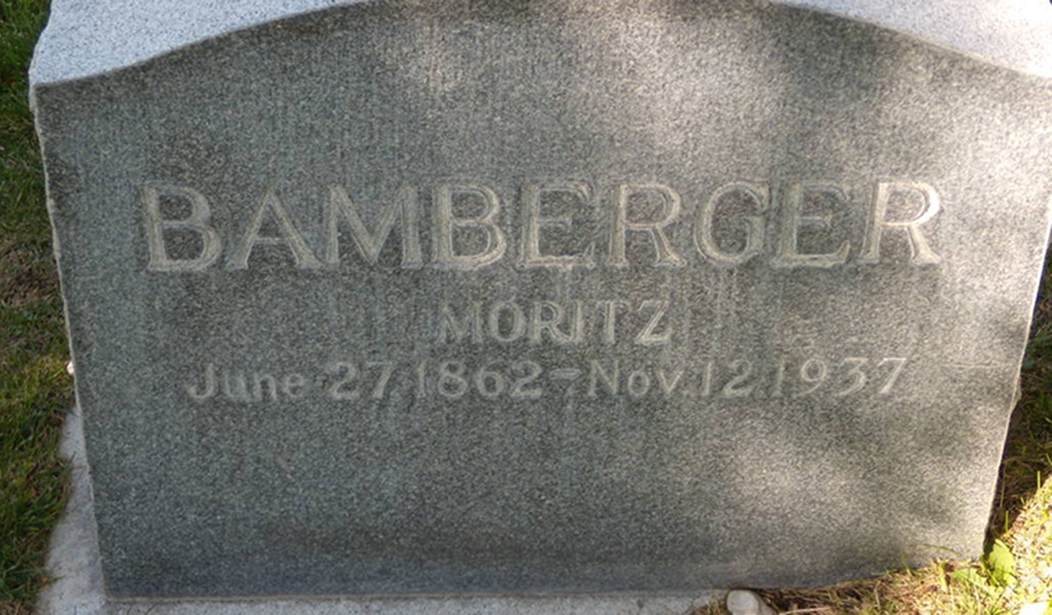
Today (Wednesday) marks the passing of my mother’s uncle. I obviously never knew him, as he passed away many years before I was born. But that does not mean that I am not indebted to him. In a small Jewish section of a Salt Lake City cemetery stands the grave of Moritz Bamberger. He is not to be confused with Utah’s first Jewish governor, Simon Bamberger — apparently of no family connection. I have a picture of Moritz Bamberger’s grave, and the next time we make it back to Utah, I would like to visit. He played no small role in my being part of this world.
When we took things from my parents’ home after their passing, the effort was uneven. I tried to grab any document that might be of familial historical importance. And one thing I brought back to Jerusalem was the last will and testament of Moritz Bamberger. He was born in Wiesenfeld, Germany. He arrived in the U.S. at the turn of the 20th century at age 38. I don’t know his route, but his first known address was in Bonanza City, Custer, Idaho. He was either sent by the family or made his way to make his fortune. His first stop was in a gold-mining town. His next and final home was Salt Lake City, where family lore has it that he did very well in the silver-mining business and ended up owning railroad stocks and other properties. Like with all of my long-gone forefathers, I would have wanted five minutes to ask a dozen questions, but for now all I have is his will.
In it (written in November 1937, immediately prior to his passing), he gives detailed instructions as to the distribution of his wealth. Some is given to charity organizations, both Jewish and more general, like the Neighborhood House. He gave them $200, as well as his clothes and furnishings, to help destitute locals live a better life. The next part of the will has each of 22 recipients receiving 1/40th of the remaining estate after his declared donations, taxes, and expenses. All of those listed were family members in Germany, including my mother and her father (brother of Moritz). He called my mom, his niece, “Elly.” My mother’s name was Ella, and in my life I never heard anyone call her that name. Some of those listed made it out of Germany and arrived in the U.S. Not all did. Another brother, Joseph, was a butcher in Munich. He and his wife were sent to Auschwitz, where they perished. The money set aside by Moritz Bamberger was the financial key to my mother and her parents coming on the S.S. United States at the very end of 1937.
Another document that I have is a sworn statement from Isaac and Frida Heildelberger, who state that they support the arrival of my mother’s family and that the new arrivals should be able to support themselves. But in the event that they could not, they said that they would take financial responsibility (“guarantee to support them as long as it will be found necessary”) for them. This is a far cry from people coming willy-nilly over the border as we had until Donald Trump returned to the White House. One chilling part of their October 1937 letter includes:
“That due to the present conditions in their native country, Germany, they are unable to earn their living there as they are of a Jewish descent.”
One never wants someone to arrive in Israel after substituting U.S., U.K., or France for Nazi Germany referenced in this letter.
The next piece of the puzzle is my grandmother’s naturalization document — with the only picture I have of her — from 1944. In 1954, my grandfather made a will of his own, leaving his bank accounts and belongings to my mother. I never knew either of my maternal grandparents. Again, if I could have five minutes with them…
My mother’s family was like many others that fled Germany and true persecution. Some number of those listed in Moritz Bamberger’s will never made it out. The others arrived and took care of themselves, though they had sponsors who took financial responsibilities so that they would not become wards of the state. If the U.S. stopped giving money at all levels of government to people who are illegally in the country, trillions could be saved. There are only two countries with more than a million Jews: Israel at 7.4 million and the U.S. at 6.3 million. This is no coincidence. These are the two places where Jews feel safest and most comfortable living as accepted citizens free of persecution. Many Jews went through the process described for my family, and a lot of them contributed to the U.S. in every field. Most of the top scientists in the Manhattan Project were refugees from Europe and were grateful for the opportunity to practice their expertise and help the United States win the war. Hyman Rickover said in Congress that his efforts to build the nuclear navy were his way of thanking the U.S. for taking in his immigrant family and granting him admission to the Naval Academy.
Now I’ll save some people time below. Yes, there are Jews whose actions and behavior were not good for the United States. Bernie Madoff, Harvey Weinstein, Jeffrey Epstein are just relatively recent examples. But one can find liars, thieves, criminals, and scoundrels from every religious and ethnic group. That Jews have contributed to virtually every field and area of American life is obvious. Whether it be banking, medicine, science, engineering, and more, one can always find Jews, many being first- or second-generation Americans. When I got into Harvard early, a well-meaning cousin called to implore me that I absolutely had to accept. “You would be the first one in the family to go there!” she intoned. Her parents also fled Germany and actually hosted my father when he did a post-doctoral stint at Columbia. I told her that I was waiting for Princeton. I got in, but the allure of Harvard was too much. When things sucked there during Freshman year, I thought of the quiet, woody campus of Princeton. I got over that when I realized that it was up to me to make the best wherever I was.
Jews have always been grateful for the United States and the freedoms granted. No coincidence that God Bless America was written by none other than Irving Berlin (born Israel Isidore Beilin in Russia). No country is nearly as great, and this Jew is always grateful for the red, white, and blue.