
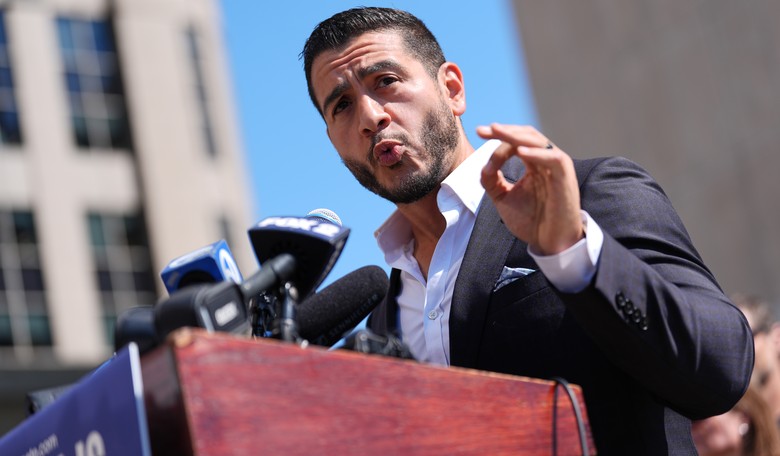
Black people never had access to American capitalism.
That’s the claim Michigan Senate candidate Abdul El-Sayed made earlier this week while pandering to black voters ahead of his contentious Senate race against Mike Rogers. The worst part? It’s almost entirely true, but the blame belongs to politicians like El-Sayed and his fellow progressive Democrats, not capitalism. Far from delivering an indictment of capitalism, his supposedly devastating claim makes the case against his own politics.
“If you’re Black in America, you’ve never actually had access to real capitalism.” That’s Abdul El-Sayed’s latest pandering for the Black vote. Black voters have always been the Achilles heel for many far-left progressives. Bernie Sanders never fixed it. Joe Biden stopped him cold in the 2020 South Carolina primary. El-Sayed has the same problem. He lost Black precincts across Michigan in the primary, and a Washington Post poll found Black voters much more eager for a Democratic Senate than for him. So on a podcast he offers this: Blacks were essentially locked out of capitalism because of Jim Crow and redlining in the 1950s and ’60s. Tell that to Oprah Winfrey, Michael Jordan, and Jay-Z. Tell it to Robert F. Smith and David Steward. None of them inherited it. They built it, in the capitalism he calls fake.
— Gerald Posner (@geraldposner) October 3, 2026
"I gave you the definition of capitalism. I would just argue that America has never actually had a pure form of capitalism. We had closer to purity, but even then, when I talked about the 50s and 60s, that was the exclusion of black folk, you know, by way of Jim Crow and segregation and all the redlining and everything," El-Sayed said. "So, you know, if you're black in America, you've never actually had access to a real capitalism."
It is true that black Americans were denied access to unfettered capitalism in the United States. Enslaved Americans were emancipated between 1862 and 1865, but government-enforced discrimination persisted for another century. Every discriminatory law, originating from government, of course, limited black Americans’ ability to participate in the free market. And yet millions still climbed out of poverty thanks to the shreds of a free market they could reach. By 1965, when landmark civil-rights laws secured greater equality before the law, America had already moved away from free markets, trading them for an increasingly redistributionist economic system.
If anything, that history shows why free markets matter so much. Government repeatedly failed black Americans, from slavery and segregation to discriminatory New Deal policies. When they finally won stronger protections for equal rights, Lyndon B. Johnson was rolling out the Great Society. Those programs promised to end poverty, instead they encouraged dependency and weakened families, while poverty, addiction, broken homes, and inadequate education plagued black neighborhoods.
What is the DSA’s solution? We don’t even need to look that far. What is the average Democrat’s answer to the problems Black Americans face? More government programs, yet another government bureau, and even present discrimination to supposedly remedy past discrimination.
El-Sayed is right that black Americans have been denied access to American capitalism, and that is precisely why he is not the candidate they should vote for. They do not need another politician offering empty promises that government will somehow fulfill this time. They need leaders who will let them participate in free markets and tear down the government barriers that have stood in their way for centuries.