
Two hypothetical college graduates who are married now have a combined annual income of $240,000; they each earn $120,000 per year.
Should an American who graduated from high school but never went to college — and who now works as a delivery truck driver, earning $43,950 per year (the median annual earnings for that job) — be forced to help pay off the federal student loans of these two college graduates who make $240,000?
If former President Joe Biden had gotten his way, that truck driver and other hardworking American taxpayers would indeed have seen their tax dollars help pay off those loans.
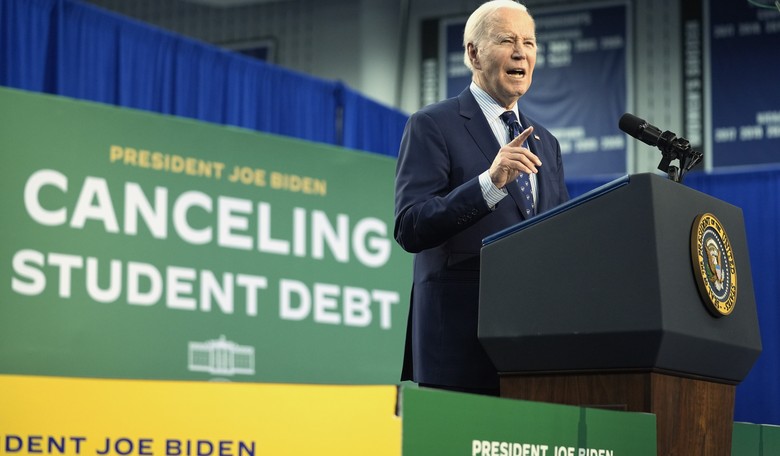
When Biden was running for president in April 2020, he announced his plan for "forgiving student debt."
"I propose to forgive all undergraduate tuition-related federal student debt from two- and four-year public colleges and universities for debt-holders earning up to $125,000," Biden said.
His plan, he said, would also "(i)mmediately cancel a minimum of $10,000 of student debt per person."
After he was elected president, Biden did not get Congress to enact new legislation to implement this plan. Instead, he took unilateral executive action in an attempt to do so — and his administration claimed this action was justified under a law that had been enacted under former President George W. Bush.
In 2003, Bush had signed the Higher Education Relief Opportunities for Students Act, aka the HEROES Act.
This act, said its official summary, "(a)uthorizes the Secretary of Education to waive or modify any requirement or regulation applicable to the student financial assistance programs under title IV of the Higher Education Act of 1965 as deemed necessary with respect to an affected individual who: (1) is serving on active duty during a war or other military operation or national emergency; (2) is performing National Guard duty during a war, operation, or emergency; (3) resides or is employed in an area that is declared a disaster area by any Federal, State, or local official in connection with a national emergency; or (4) suffered direct economic hardship as a direct result of a war or other military operation or national emergency."
As the nation headed into the 2022 midterm elections, Biden announced his student loan forgiveness plan. "On August 24, 2022," explained the Congressional Research Service, "the Biden Administration announced it would invoke the Higher Education Relief Opportunities Act of 2003 (HEROES Act) to carry out a 'one-time student loan debt relief policy' to 'address the financial harms of the [COVID-19] pandemic for low- and middle-income borrowers.' Under the one-time student debt relief policy (HEROES Act policy), ED (Education Department) would have cancelled up to $10,000 in qualifying HEA Title IV federal student loan debt for borrowers with an adjusted gross income (AGI) in 2020 or 2021 of less than $125,000 (for individuals or married borrowers who filed federal income taxes separately) or $250,000 (for married couples filing jointly and certain other individuals)."
So, under Biden's plan, a law that had been designed to help individuals "serving on active duty during a war or other military operation or national emergency" or had "suffered direct economic hardship as a direct result of a war or other military operation or national emergency" could be used to grant general federal student loan forgiveness in the wake of the COVID-19 pandemic.
On September 26, 2022, the Congressional Budget Office sent a letter to Sen. Richard Burr (R-NC) and Rep. Virginia Foxx (NC-05) that estimated the cost of the Biden plan. "As of June 30, 2022, 43 million borrowers held $1.6 trillion in federal student loans," said this letter. "About $430 billion of that debt will be canceled, CBO estimates."
Six states, including Nebraska, sued Biden, arguing that he did not have the legal authority to move forward with this loan forgiveness plan. The Supreme Court agreed with the states, voting 6-3 against Biden's plan.
"The Secretary (of Education) asserts that the HEROES Act grants him the authority to cancel $430 billion of student loan principal. It does not," wrote Chief Justice John Roberts in the majority opinion.
"The new program vests authority in the Department of Education to discharge up to $10,000 for every borrower with income below $125,000 and up to $20,000 for every such borrower who has received a Pell Grant," said the court. "No prior limitation on loan forgiveness is left standing. Instead, every borrower within the specified income cap automatically qualifies for debt cancellation, no matter their circumstances. The Department of Education estimates that the program will cover 98.5% of all borrowers."
"From a few narrowly delineated situations specified by Congress, the Secretary has expanded forgiveness to nearly every borrower in the country," said the court.
"But imagine instead asking the enacting Congress a more pertinent question: 'Can the Secretary use his powers to abolish $430 billion in student loans, completely canceling loan balances for 20 million borrowers, as a pandemic winds down to its end?'" said the court. "We can't believe the answer would be yes. Congress did not unanimously pass the HEROES Act with such power in mind."
Despite this loss in the Supreme Court, Democrats in Congress have not given up on trying to find a way to make federal taxpayers pay for someone else's college costs.
Led by Sen. Alex Padilla (D-CA), a group of nine Democrats in the Senate and 18 in the House is now cosponsoring the Debt-Free College Act. This bill would appropriate $84 billion in fiscal year 2027 alone. It would provide funding to states so that those states could "distribute the grant funds ... in a manner designed to best achieve the partnership's goal of providing debt-free college for all eligible students at in-State public institutions of higher education."
This month, the Census Bureau released its report on income in the United States in 2025. It showed that the median household income of a high school graduate who did not attend college was $60,790 last year. The median household income of those who earned a bachelor's degree or higher was $138,300.
Democrat politicians who would like to make taxpayers subsidize the student loan debt of college graduates are seeking to redistribute wealth to the wealthier.