
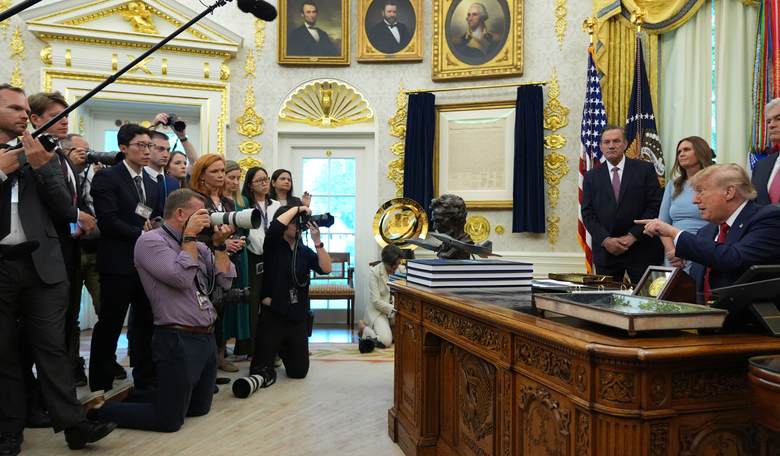
President Trump told Axios this week that he's standing at the fork in the road. "I have a big decision coming up," he said. "Do I want to go in and annihilate them, or do I not? It's a big decision. Anything could happen with me." Tuesday, he meets at UN headquarters with leaders from Saudi Arabia, the UAE, Qatar, Bahrain, Kuwait, and Oman, and whatever direction he takes next will likely follow that room.
There may still be a negotiated road out. Trump himself says there is—he's told reporters Iran wants an agreement but isn't yet ready to accept terms he'd consider acceptable, though Tehran hasn't publicly confirmed his account of any direct contacts. But if that road goes nowhere, the two military choices left in front of him are hard ones, and neither comes without a bill attached.
Option one: end it. Wind the war down, pull back, let Tehran claim whatever victory lap it wants in front of its own state media. In exchange, America gets no boots on the ground, minimal additional loss of American life, and a regime that walks away diminished but intact — a wounded Iran instead of a defeated one. Middle East Institute fellow Nazee Moinian laid out the stakes bluntly this week: Iran is under enough military and economic pressure right now that it either escalates dramatically, tries to ride out the pain, or eventually implodes from within. "Both scenarios are possible at the same time," she said. Choosing to end the war now means betting on the slow implosion rather than forcing the issue — accepting years, maybe decades, of a smaller, angrier, still-dangerous Iran rather than risking what comes next if America pushes further.
Option two: finish it. Go in hard enough to actually break the regime, not just bruise it. Breaking the regime could open the possibility of a fundamentally different Iran — one no longer spending its treasury on centrifuges and proxy militias instead of its own people. But nobody sitting in Washington can promise what replaces it. Regime collapse and political freedom are not synonyms, and history has supplied enough examples to make pretending otherwise irresponsible. What that path plausibly offers is a Gulf no longer living under the daily threat of a nuclear-armed fanatic regime, and the possibility — not the guarantee — of less total American pain over the long run, since a regime actually defeated has a harder time doing what a merely wounded one reliably does: rebuild, rearm, and wait us out for another generation. But that option has a name too, and it's civilian casualties. Real ones. Not an abstraction on a briefing slide — mothers, children, and elderly Iranians who never chose this regime and don't deserve to die for its sins, caught in whatever it actually takes to bring down a government that has spent decades burying its military infrastructure inside civilian neighborhoods specifically to make sure this exact bill comes due.
The stakes aren't abstract. This week, Iran claimed its forces struck the Togo-flagged tanker Trend in the Strait of Hormuz, alleging an unauthorized passage, while the IRGC's navy openly threatened to destroy any vessel it decides crossed the same line. The State Department, meanwhile, approved a potential $24.3 billion sale of 48 F-35s to Saudi Arabia — still subject to congressional approval — arming a key Gulf partner against Iran's Houthi proxies in Yemen. South Korea's president said this week his country may expand naval operations to protect its own shipping, while declining to send forces into the war itself. The Gulf states meeting with Trump on Tuesday have their own stakes in which way he goes, and their read of the room may end up shaping his decision as much as anything happening on the battlefield.
So what should he do?
If diplomacy fails, I don't think there's an obvious cost-free military option waiting behind door three. Anyone telling you there's a costless path through this — a version where Iran's nuclear ambitions get permanently neutralized, the region stabilizes, and nobody innocent pays for it — is selling you something. The honest answer is that both remaining roads carry a moral weight no president should get to carry lightly, and I don't envy the man standing at that fork.
If it were mine to decide, I'd lean toward finishing what's already been started, and I'd lean that way with real reluctance, not bravado. A wounded, unfinished Iran doesn't stay wounded forever. It rebuilds, it rearms, it waits for America's attention to drift elsewhere the way it always eventually does, and future presidents inherit the same decision Trump is facing now, except with fewer options and a regime that's had years to prepare for the next round. Finishing it is the harder, bloodier choice up front. It may also be the only one that doesn't simply defer the reckoning to somebody else's presidency and somebody else's children.
But I say that fully aware of what "finishing it" actually costs, and I won't pretend otherwise for the sake of a tidier column. Trump has to make this call with information most of us will never see, under pressure most of us will never feel, and whichever way he goes, he'll own the consequences of a choice that had no good version waiting on either side of it.
Pray for wisdom. Pray for restraint where restraint is possible, and resolve where it isn't. And pray, above everything else, for the civilians on both sides of this who never got a vote in any of it.