
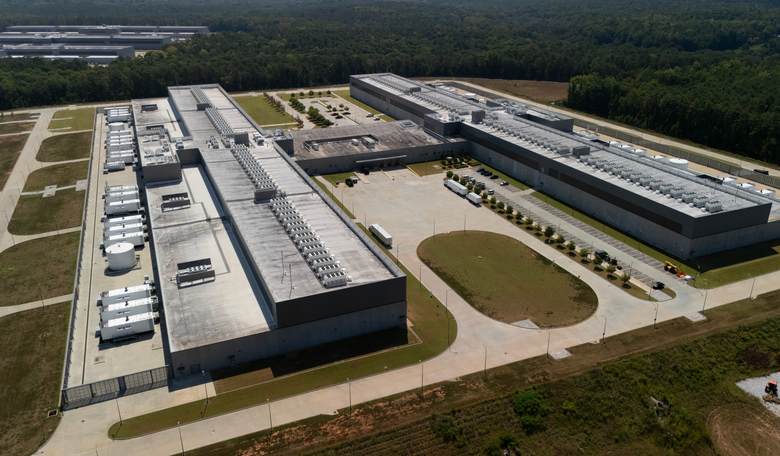
For myriad reasons, nearly all of which are unjustifiable and illogical, a vast majority of Americans “oppose AI data centers in their areas.”
Incredibly, as Gallup notes, “Seven in 10 Americans oppose constructing data centers for artificial intelligence in their local area, including nearly half, 48%, who are strongly opposed. Barely a quarter favor these projects, with 7% strongly in favor.”
“Effects on local resources” is the runaway reason Americans oppose data center development, followed by “quality-of-life concerns.”
The biggest problem is that most Americans mistakenly believe that construction of AI data centers will deplete local water resources and undermine the electric grid, therefore increasing their costs.
The truth is that neither of these boogeyman arguments passes muster after a few minutes of research.
In January, the Florida Water and Pollution Control Operators Association issued a report telling “the full story of data center water usage”
Most notably, the report contains a “breakdown” of “myths vs. reality around data centers and water.”
I bet most Americans have no idea that up to a quarter of data centers are “water-free” because they “do not consume water for cooling.” Instead, they use “air cooling.”
For data centers that do consume water for cooling, technological innovations such as “closed-loop water cooling” “can reduce freshwater use by up to 70% compared to traditional open evaporative methods.”
An even more novel cooling method is called “liquid cooling,” which can “transfer heat very efficiently and can significantly reduce water usage.”
Essentially, these new systems “consume” “far lower” amounts of water because “90–95%” of the water returned are “available for treatment.”
In the outdated open-evaporative systems, “70-80%” of water is lost to “evaporation.”
Innovations in cooling methods have dramatically reduced the water footprint of modern hyperscale data centers. This is a welcome development that should be celebrated.
Another common argument against data centers is that their sheer energy demand will burden the electric grid.
In a static environment, that might be the case. But thankfully, we exist in a dynamic world in which supply can be increased to meet a surge in demand.
In some cases, data centers have taken it upon themselves to provide their own “behind-the-meter” supply.
In the end, data centers are energy customers, like ratepayers. I think the best solution to this looming surge is for policymakers and utility companies to get ahead of the coming spike by going all in on affordable, reliable energy.
The verdict is in. Solar panels and windmills cannot provide affordable and reliable energy.
On the other hand, affordable and reliable sources like natural gas, coal, and nuclear can provide the gargantuan amount of power necessary to keep modernity advancing.
Long story short, data centers are not the primary driver of higher electricity costs. The boneheaded green revolution, which many blue states remain wedded to, deserves nearly all the blame.
Finally, for those fearful that data centers will ruin their quality of life, here are a few things to consider.
With data centers come economic development. With economic development comes job creation. With both come an increase in tax revenue, possible tax cuts, and money for public services like schools.
This summer in Louisiana, Richland Parish School Board teachers received “bonuses of up to $50,935” “after sales-tax receipts surged during construction of Meta’s 4 million-square-foot Hyperion data center.”
Nearly half of all tax revenue generated in Loudoun County, Virginia, comes from the existence of data centers. Consequently, residents pay on average $5,800 less per year in property taxes alone!
Municipalities are drowning in debt exceeding $2.3 trillion. Basic arithmetic alone should compel them to reconsider their data center derangement syndrome.
One last thing all Americans should reconcile with is that we all need and use data centers.
Online shopping, social media, apps, streaming services, and the entire digital world rely upon data centers. When you swipe your debit card, a data center is used to process the seemingly magical system.
Never forget that most modern technology has made life far more connected, convenient, hospitable, and faster. But it cannot run on its own. It needs abundant and reliable energy coupled with a robust, redundant data center infrastructure backbone.
Chris Talgo (ctalgo@heartland.org) is editor at The Heartland Institute.