
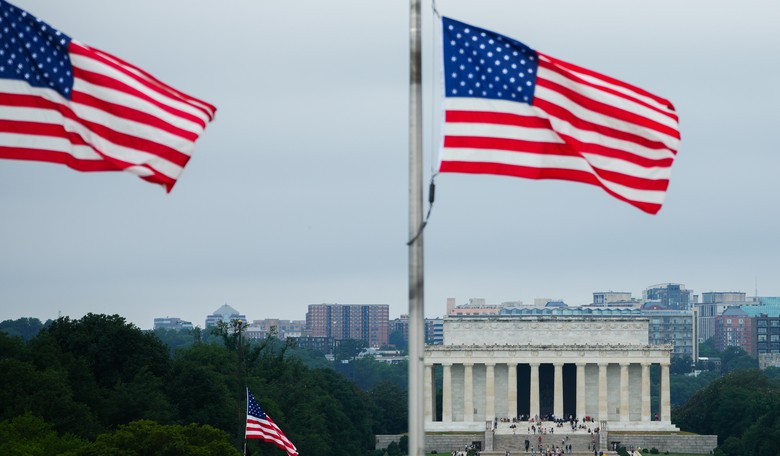
This 25th anniversary of the deadliest terrorist attack ever on American soil may be as good an occasion as any to pay a moment’s attention to the subject of patriotism.
As the moral philosopher Alasdair MacIntyre correctly noted, patriotism, first and foremost, belongs to “a class of loyalty-exhibiting virtues” like “marital fidelity, the love of one’s own family and kin, friendship, and loyalty to such institutions as schools and cricket or baseball clubs.” Patriotism demands partiality toward one’s own. It consists in “loyalty to a particular nation which only those possessing that particular nationality can exhibit.” The patriot’s loyalty, MacIntyre continues, involves “a peculiar regard…for the particular characteristics and merits and achievements” of his country, but precisely because they are the features of his country.
In the 18th century, Edmund Burke eloquently characterized the patriotic disposition as demanding that his fellow British citizens recognize that we “derive all we possess as an inheritance from our forefathers.” Burke explains that in conceiving their constitutional order in terms of an “inheritance,” he and his compatriots “have given to our frame of polity the image of a relation in blood,” which in turn manages to render indissoluble “the Constitution of our country” and “our dearest domestic ties.” This, in turn, has the effect of “adopting our fundamental laws into the bosom of our family affections...”
While neither Burke nor MacIntyre explicitly says this, Burke especially does more than nod in the direction of grasping that patriotism, at least as much as any other disposition, illustrates the morality of embodiment: The fundamental institutions of his country aren’t like pieces of machinery that can be severed from their place of origin and exported to foreign peoples at will. Rather, they belong to traditions that patriots imbibe organically, spontaneously, subconsciously, and in terms of which they conceive their identities as the particular human beings that they are. These traditions, in turn, reside fundamentally within the bodily movements of patriots.
For certain, those who see America as possessing “White Supremacy” in its “DNA,” or as being “systemically racist,” are not, and cannot be, patriots. This is not an ad hominem attack against them. Nor do I intend this verdict as typical political rhetoric. Quite the contrary: It follows from the very logic of patriotism. Of course, one can believe that individuals or specific policies are racist or white supremacist and still be patriotic toward the country as a whole. Patriotism does not preclude criticisms of aspects of or moments in the life of one’s nation. Not at all. It welcomes and depends upon such critical attention. However, once the legitimacy of the historical-cultural project that is one’s nation is undermined in its entirety, as it is by those who insist that America is incorrigibly guilty of what they depict as the most egregious of evils, patriotism gives way to anti-patriotism. A man who felt in his bones that his wife was guilty of the most wicked of deeds and who expressed his contempt for her at every turn could hardly be said to be devoted to her, to possess a love for her, at least none that anyone could see as anything but warped and toxic.
However, it’s also not obvious that patriotism is possible for those who have adopted the moral universalism of classical or Enlightenment liberalism. As David McCabe explicitly states, “liberal morality” is “fundamentally at odds” with patriotism, for the latter “may help tempt people away from the appropriate claims of equal moral treatment and towards something resembling group egoism.”
Paul Gomberg is even more to the point. He writes that “on the most plausible assumptions about our world, patriotism is no better than racism.” After all, “moral universalism implies that actions are to be governed by principles that give equal consideration to all people who might be affected by an action.” But patriotism is “a preference for one’s fellow nationals or for one’s own traditions and institutions over those of others,” and this in turn sounds dangerously like “ethnic and national chauvinism.”
It is not for nothing that America became an independent sovereign state (or union of states) in the 18th century, at the apex of the Enlightenment, a time during which morality became effectively equated with subscription to abstract, universal principles and ideals, i.e., to propositions, supplied by Reason. These principles were predominantly imagined to be natural rights and the ideals tended to be those of Liberty and Equality.
As Allan Bloom, author of "The Closing of the American Mind", wrote, patriotism requires loyalty, yes, but not to the country per se, but to its “form of government and its rational principles,” i.e., to the “Enlightenment” ideal of “liberal democracy.” Human differences dissolve in “the light of natural rights [.]” Irving Kristol spoke of “the equality of natural rights” enshrined in the Declaration of Independence as “the principles of…the universal creed” upon which the nation is based. Bill Bennett alluded to American patriotism as “our steadfast devotion to the ideals of freedom and equality,” and as America being a “new nation conceived in a new way and dedicated to a self-evident truth that all men are created equal.” The American patriot, on this reading, sees his country as one “tied together in loyalty to a principle...”
The principles and ideals that America is said to manifest from this perspective are construed as being basic, universal, abstract, and timeless. This, I submit, is a morality of disembodiment. But if America just happens to be the country that realizes them more fully than any other at the present juncture, then there can be no ultimate reason for why anyone should be devoted to America as such. It is the principles and ideals that command loyalty — not the concrete, particular nation, not past, present, and future generations of the flesh-and-blood people that constitute the country. And if another country, other people, should happen to satisfy the demands of these principles and ideals more so than America, then the American patriot, in this light, should pledge his allegiance to that country.
Patriotism isn’t just a matter of wearing a lapel pin of the American flag, taking a Constitutional oath of citizenship or office, or giving lip service to the Founders. Assuming that my treatment of it is correct and it is a virtue whose object is something concrete and particular, then, like all virtues, it must be cultivated.