
A short history of modern Judaism.
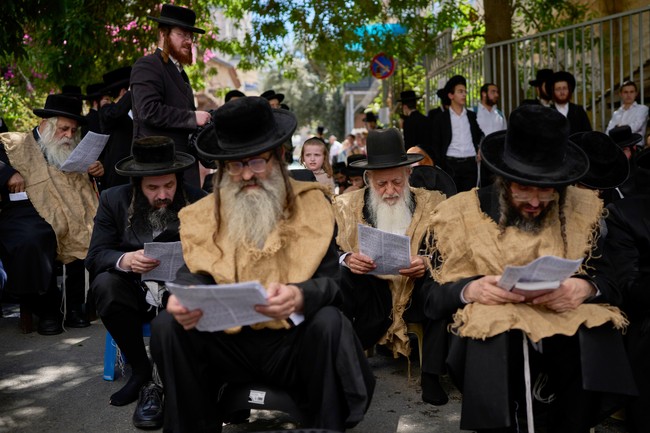
Donald Trump recently met with a group of ultraorthodox rabbis. Before we get to that meeting, let’s do some quick bookkeeping. There are many different movements within Judaism, and Pew studies suggest that “unaffiliated” is one of the largest branches of the faith in the U.S. Reform and Conservative Judaism are movements that came about in the early-middle 19th Century in Germany in response to the Enlightenment that allowed Jews to be active participants in wider society. “Orthodox” tends to refer to Jews who continue to follow Jewish law in the observance of kosher food, the Sabbath, prayers, and all other aspects of their lives. The “ultraorthodox” or “charedim” are Jews who tend to have a different approach to Jewish life and observance than Modern Orthodox communities. Confused yet?
Within the ultraorthodox world, there is a wide range of opinions and approaches. Some younger members of the group go to the Israeli army while most do not. You might notice a doctor or lawyer whose external appearance suggests that he is an ultraorthodox Jew. At the other extreme of political persuasion are groups that do not recognize the state of Israel. Non-Jews often assume that all Jews are pro-Israel. And while for the majority of Jews in the U.S. that probably is true, there are two groups that do not like the Jewish state. One would be the lefties whose political identities trump any religious affiliation. Those are the ones marching with the Muslim Brotherhood crowd in favor of Hamas. The other group is made up of various ultraorthodox groups that reject the state of Israel on religious grounds. One may note that Herzl, Ben-Gurion, Shimon Peres, and many other well-known Zionists were not particularly religiously observant. And while there has always been and remains a strong religious-Zionist movement, the state of Israel came to be under the leadership of many Jews who were either not religious or in some cases anti-religious. The ultraorthodox groups that do not accept the state rely on several religious arguments to support their position. This is not the place to go into the Talmudic minutiae of their views, though I can say that every time there is an election, they put up signs saying that it is absolutely forbidden to vote in Israeli elections. Most ultraorthodox Israelis do vote and rely on the opinions of other rabbis who saw participation in the Knesset as a way of preserving and advancing the needs of the community.
Many of the groups that are opposed to Israel have many members actually living in Israel proper. Their followers do their best to detach themselves from the state. Their schools and institutions do not accept state money, even if it is available. They do their best to avoid any interaction with the state beyond the minimum, such as paying business taxes or getting driver’s licenses. The Mea Sharim neighborhood in Jerusalem is the largest center of anti-Zionist ultraorthodox groups in the country. One fellow living there went over the top and refused to call a “Zionist” ambulance when his son fell ill. The boy died because of the insane extremism of his father. His actions were in direct contravention of Torah law.
One final background point. Nearly 300 years ago, a rabbi by the name of the Baal Shem Tov created the chassidic branch of religious Judaism. At the time, his approach was revolutionary, and as such, there were many who opposed it. Today, chassidic and non-chassidic Jews and rabbis more or less get along, though the ultraorthodox parties in the Knesset still are divided by the chassidic Agudat Yisrael faction and the non-chassidic Degel HaTorah group. It was reported that Vice President JD Vance asked about the differing chassidic garb worn at the president’s meeting. One fellow present suggested that the differences were related to how much money each group had.
I have heard that there is a Jewish liaison fellow in the White House who arranged the meeting of the president and six leading American ultraorthodox leaders. The last such meeting occurred during the days of President Jimmy Carter. I don’t know what criteria were applied in selecting those invited. Five of the six were chassidic, with the addition of the leader of the largest yeshiva, or male seminary in the United States. The chassidic leaders for the most part are associated with the anti-Israel faction of the ultraorthodox world. There is no question as to their leadership positions. The two leaders (and brothers) of the Satmar Chassidic Dynasty have around 150,000 members worldwide and about 24,000 kids in schools in New York alone. Why were these leaders chosen and others not — I don’t know. One of the topics supposedly discussed was the desire of the state of Israel to draft into the IDF large numbers of ultraorthodox yeshiva students. There are tens of thousands of ultraorthodox young men who are of draft age. Some have willingly gone into the army, while others have avoided draft notices. The issue has been a major sore in the country since the High Court threw out understandings between the army and ultraorthodox leaders that had been in place for decades. The somewhat early collapse of the current Netanyahu government is related to the ultraorthodox parties initiating a dissolution of the Knesset that led to elections at the end of next month.
One of those who was present at the White House meeting said that the rabbis came to express their thanks to President Trump for his support of Jews and American values. I have no doubt that such is true as President Trump has been a stalwart in supporting the good and decent family and religious values that have made America successful for 250 years. If they came so as to seek his help on the draft issue, I don’t see how that could work. Foreign leaders, even very generous ones like Donald Trump, tend not to interfere in the internal affairs of other countries. And even if he were to pick up the phone and tell Bibi to leave the young Torah students and scholars alone, it would not help. The Israeli High Court has usurped the Knesset as the final voice on all legislative activity in Israel. Even if the government, IDF, and leading rabbis came to some type of mutually-acceptable agreement on the subject of drafting yeshiva students, the Court could use its position to declare it null and void if it didn’t like it. The High Court sees no value in Torah learning that has supported the continued existence of the Jewish people for over 3,000 years. And as such, they would love to see all ultraorthodox men drafted and the closing of the yeshivas in Israel. And there is nothing Donald Trump can do about the extremist jurists on the High Court. Not even Bibi Netanyahu succeeded in his efforts to rein them in and return them to their original appellate purpose.
I am kind of lost as to the format of the meeting. Why weren’t other orthodox leaders invited? Chabad is one of the most important movements in the Jewish world today. Yeshiva University is the largest orthodox institution of higher education. I would go so far as to suggest inviting leaders of Reform and Conservative Judaism. Many of their members still vote Democrat well after the Democratic Party abandoned Jews and Israel. Meeting with only a small group of ultraorthodox leaders would be like the president meeting the quarterback, star running back, and a few coaches of the Super Bowl champions. It may be that these esteemed rabbis asked for the meeting and were granted the same. I would love to have been present, but like most, I get my information as to what transpired third-hand.