
Foundry School is yet another good idea coming to fruition as part of the Trump Administration’s mission to reindustrialize America in the wake of the COVID pandemic.
This unique pilot, aided by eight major universities and manufacturing leaders from several nations, is the product of a collaborative effort to train a workforce capable of closing gaps in design and manufacturing capacity created after America’s leaders opted to rely on foreign factories.
On September 3, Under Secretary of State for Economic Affairs Jacob Helberg celebrated the opening of the school, a project of the State Department’s Pax Silica initiative, an international economic security partnership connecting governments, industry, and universities to strengthen the critical supply chains and industrial capabilities that underpin the AI economy.
In opening remarks, Helberg repeated Trump’s mantra that a shuttered factory is a betrayal and proclaimed that “America cannot afford not to bring manufacturing back.” Foundry School is employing today’s manufacturing CEOs to teach tomorrow’s manufacturers the tricks of the trade.
The first set of sessions implementing the advanced manufacturing curriculum (developed at Stanford University) will be taught by industry CEOs and others at Stanford and seven other American universities. The seven sessions will cover fundamentals of modern factory design, materials and supply chains, assembly-line engineering, plant economics, regulation and permitting, and workforce development at scale.
Stanford will host the final 10 sessions beginning in January. These will address advanced manufacturing capabilities, including precision tooling, industrial automation, quality systems, new product introduction, digital manufacturing, capital equipment, energy, global site selection, and defense production. The coursework will conclude with a capstone session on lessons from failed manufacturing ventures.
All 17 sessions will be taught by founders and CEOs from advanced manufacturing enterprises drawn from the United States and Pax Silica participating nations, including the Republic of Korea, Japan, Taiwan, and India. The coursework will cover just about everything it takes to build and run a world-class manufacturing enterprise. Enrollees are expected to include engineering, business, and vocational students looking toward a manufacturing career.
At the initial Pax Silica summit last December, charter signatories included the Republic of Korea, Singapore, the Netherlands, the United Kingdom, Israel, the United Arab Emirates, and Australia (plus a few guests).
Today, 24 nations have signed the Pax Silica Declaration, including Argentina, Chile, Costa Rica, El Salvador, Finland, Germany, Greece, India, Italy, Japan, Kazakhstan, Norway, Panama, the Philippines, Qatar, and Sweden. [Taiwan is a non-signatory participant.]
Signatories, according to the Declaration, recognize “that a reliable supply chain is indispensable to our mutual economic security” and “that artificial intelligence (AI) represents a transformative force for our long-term prosperity and that trustworthy systems are essential to safeguarding our mutual security and prosperity.”
Signatories also agreed to promote partnerships on strategic stacks of the global technology supply chain – software applications and platforms, frontier foundation models, information connectivity and network infrastructure, compute and semiconductors, advanced manufacturing, transportation logistics, minerals refining and processing, and energy.
Perhaps most importantly, the 24 nations endorsed “mobilizing the immense creative and financial power of private industry and entrepreneurship to make our citizens more prosperous, our nations stronger, and our supply chains more secure.”
At the launch, Secretary of State Marco Rubio said America made a “terrible mistake” at the end of the Cold War in accepting the premise that the ability to make things no longer mattered. National leaders blithely anticipated a global endorsement of free enterprise democracy. Instead, we got a de-industrialized America increasingly reliant on China and other unfriendly nations.
In 1950, in the aftermath of World War II, the U.S. produced nearly half the world’s manufactured goods. Manufacturing made up 27 percent to 30 percent of U.S. nominal GDP and over 30 percent of total U.S. employment. But by 2007, manufacturing’s share of U.S. GDP had dropped to just 12.1 percent. Today, China leads the world in manufacturing, with a 30 percent share, while the U.S. share is down to 15 percent, representing only 10 percent to 11 percent of GDP and 8 percent of employment.
Rubio said that post-pandemic America woke up to the reality that we were “suddenly as a nation dangerously dependent on other nations for all sorts of things that we need, not simply for our economic vibrancy but in many cases for our national security and our very survival as a prosperous nation-state.”
Rubio pointed out that 21st-century industrial activity is going to involve far more skills than in the past. That means, he added, our workers are going to have to be better educated in what they are doing – and, given the rapidly changing dynamics of the modern world, they may have to be retrained multiple times over their careers.
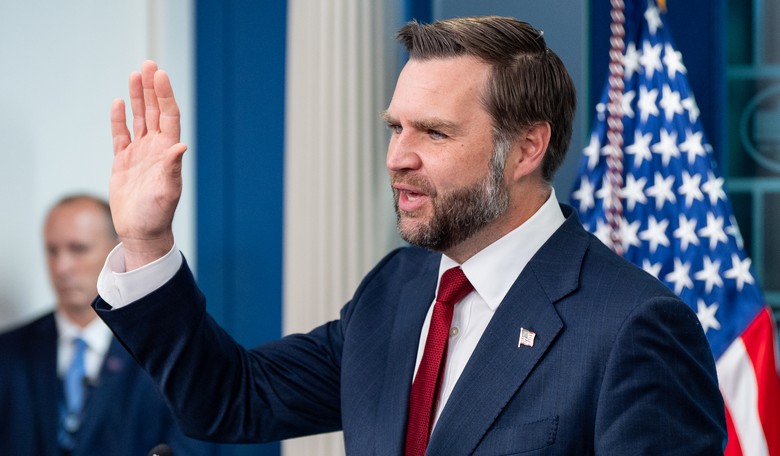
In his remarks, Vice President JD Vance lamented that America’s leaders accepted managing the decline – with Western economies transitioning from manufacturing to an economy based in finance and services. President Trump from day one challenged the Beltway bipartisan consensus — that never existed in the heartland – that we could have an economy without industry.
Vance said that the future of American industry, the future of rebuilding this country, is going to be for our people who use their heads, who use their hearts, who use their hands to build the next generation of American products with American workers doing it. Foundry School is but a small part of the Trump Administration’s work to reverse this decline.
From renegotiating tariffs to encourage reshoring industries to investing in advanced technologies to this initiative and others aimed at training tomorrow’s workforce, Trump has focused on revitalizing American manufacturing. The reopening of American small cities and towns to manufacturing is a godsend to those hungering for jobs that once fed their parents’ and grandparents’ families.