
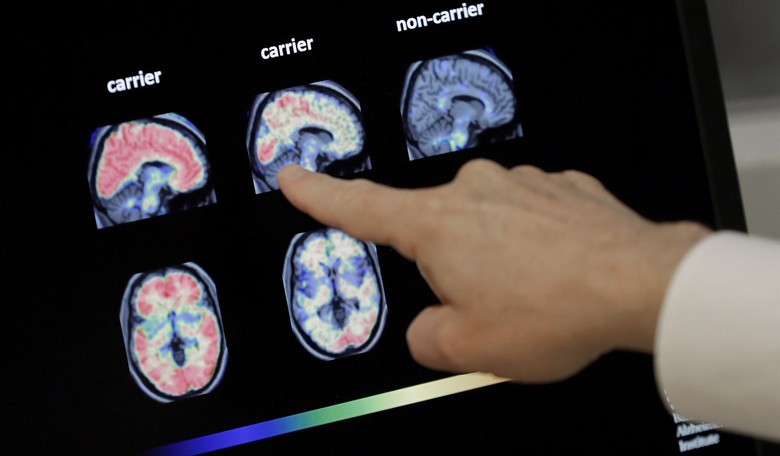
In mid-July, the FDA approved Leqembi, a series of injections that specifically target the plaques that build up in the brains of Alzheimer's patients. Those plaques are what cause the memory loss, behavioral changes, and terminal decline.
That medication was given to Gail Youngsdale. Three years ago, Gail's Alzheimer's disease was progressing. At the time, Leqembi was a trial drug. Doctors gave her injections to target the nine spots of plaque in her brain.
Now? They're gone and Gail has gotten married and gotten most of her memory back.
We're out here reversing Alzheimer's y'all. pic.twitter.com/OuNJCax9Hq
— L (@SomeBitchIIKnow) September 3, 2026
Every single spot of plaque is gone.
After being diagnosed with mild cognitive impairment and later early Alzheimer’s disease, Gail Youngdale feared what the future might hold. She’d seen the devastating effects of the disease on her own mother years ago. Seeking options, she enrolled in a landmark clinical trial for a therapy designed to remove toxic amyloid plaques, a hallmark of Alzheimer’s disease, from the brain.
Her daughter, Teri, served as her clinical trial study partner—attending every appointment, supporting Gail through the process, and learning as much as she could about Alzheimer’s and her own genetic risk of developing the disease.
“After she was diagnosed with Alzheimer’s, I saw the fighter in my mom come out. She inspired me to take my own brain health seriously,” Teri said.
Today, Gail continues treatment with the now FDA-approved medication for early Alzheimer’s disease and has been able to maintain her independence and quality of life. She even found a second chance at love after reconnecting with her high school sweetheart.
This is a miracle.
— L (@SomeBitchIIKnow) September 3, 2026
Alzheimer's is an evil disease.
It's too late for my mom but I'm glad to hear it. It's one of the most screwed up maladies ever. Imagine going to a funeral for the same person again and again over the span of a decade or more. A little piece of them slipping away, gone forever. Memories of parents, siblings,…
— Goban (@GreatGoban) September 3, 2026
This writer lost an aunt to the disease. She developed symptoms in 2007 and died a decade later. It was a very sad thing to watch.
So the plaque theory is vindicated after all? https://t.co/7V0zK5EiQ0
— Dalit Detector (@DalitDetector) September 3, 2026
In this case, it seems it was.
I lost my mom to this disease. I spent 5yrs watching her slowly slip away. The thought that no other daughter has to experience that... https://t.co/UaiLp2C8ib
— TheAlabastard 🏒🏋🏼♀️🐈🤟🏻 (@ThatAlabastard) September 4, 2026
It would be a miracle.
The FDA also approved a subcutaneous injection for home-use, too.
The drug is called Leqembi. Received FDA approval in mid July. https://t.co/Rr07AJuGhq
— L (@SomeBitchIIKnow) September 3, 2026