
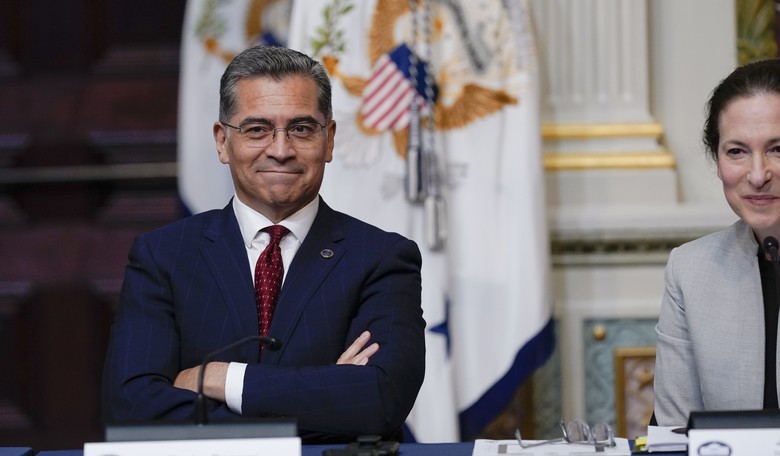
Xavier Becerra and Steve Hilton are headed to a November face-off for governor, after a primary that came down to strategic voting in a crowded top two field. Before anyone fills out a general-election ballot, voters ought to ask the question every hiring manager in America asks before signing off on a candidate: can this man actually run something?
Becerra spent 30 years climbing the ladder in Sacramento and Washington, first as state attorney general, then as Secretary of Health and Human Services for the Biden administration. That résumé comes with two open questions his campaign would rather you not ask. How did roughly a quarter-million dollars walk out of his own campaign account without him noticing? And how did his own department manage to stonewall federal investigators chasing leads on the sponsors taking custody of almost half a million vulnerable migrant children?
Start with the money. Federal prosecutors say Becerra’s chief of staff, Sean McCluskie, conspired with Governor Gavin Newsom’s former chief of staff, Dana Williamson, and Sacramento lobbyist Greg Campbell to drain roughly $225,000 from Becerra’s dormant campaign account between February 2022 and September 2024, running it through Williamson’s consulting firm and disguising it as pay for a no-show job held by McCluskie’s spouse. All three have now pleaded guilty. Prosecutors have said no gubernatorial candidate is implicated in any charging document, and that Becerra’s account was the victim of the scheme, not the vehicle for it.
I’ve spent fifteen years as a fiduciary-duty expert witness, testifying in federal and state courts on what a reasonable principal should have known about the people managing his money. The first question I ask an executive who says “I had no idea what my own people were doing” is simple: what controls did you have in place? McCluskie was the man authorizing payments out of that account. $10,000 a month leaving the door for about 30 straight months isn’t a rounding error a competent principal misses. Somebody either reviewed those statements and missed it, or never looked at all. I have sat across from expert witnesses defending both explanations in federal court, and neither one gets you promoted to chief executive.
The scheme around Becerra’s account was not a one-off lapse in judgment. Prosecutors say Williamson also filed fraudulent tax returns claiming more than $1 million in bogus business deductions for luxury handbags, private jet travel, and a home HVAC system. In 2024, at Williamson’s request, Campbell allegedly had fake retroactive contracts created to respond to a federal subpoena questioning her firm’s eligibility for pandemic-era PPP loans, for which lobbying firms never qualified. This was not a rounding error by one careless aide. It was a small ecosystem of Sacramento operators who treated campaign funds as a personal slush fund, and Becerra’s account was simply the pipe they ran it through.
To be fair, nobody has charged Becerra with anything yet, and prosecutors have called him the victim of his own aide’s greed. I will extend him the same presumption of innocence I would want for myself. There is no evidence he personally pocketed a dime. But “I didn’t know” is a management problem, and a major red flag. Running a state budget north of about $350 billion requires noticing when a quarter of a million dollars leaves an account with your name on it.
The bigger story sits at HHS, where Becerra ran the department from 2021 through January 2025, during the largest wave of unaccompanied migrant children in American history. HHS’s own inspector general reviewed a sample of case files from that surge and found that in 16 percent of files, one or more required sponsor safety checks were never documented as completed. In 19 percent of files, results from FBI fingerprint or state child-abuse-registry checks were never recorded. Mandatory home studies, required by statute for the highest-risk placements, were skipped outright in cases legally required to have them. A separate congressional review found ORR failed to make timely safety and well-being follow-up calls in 22 percent of cases.
Here is the part that should worry every parent in California more than a spreadsheet of percentages. The office of Senator Chuck Grassley (R-IA) referred whistleblower records from a single HHS emergency intake site to federal investigators, who flagged more than 100 sponsors as suspicious enough to warrant investigation for trafficking, smuggling, or exploitation. Homeland Security Investigations issued subpoenas to HHS seeking the records needed to run those leads down. According to Grassley’s own letter to the department, Becerra’s HHS failed to fully comply with two-thirds of them. You do not get to plead ignorance about children in danger when your own agency is sitting on the paperwork federal agents need to find them.
Becerra’s defenders point to the historic surge at the border and argue that no department could have kept pace. Fair enough. The volume was real, but it was his administration that was responsible for it. A crisis is exactly when a leader earns his paycheck. Tightening controls during a surge is the job description. Loosening them or sitting on federal subpoenas while children remain unaccounted for is a failure of leadership, not an act of nature.
Neither story proves Xavier Becerra committed a crime. Both prove the same thing: money and children moved through operations he ran, and when somebody came looking for the paperwork, it was nowhere to be found. Ronald Reagan built an entire foreign policy around “trust but verify.” California voters would do well to apply the same standard to a man asking to run the fifth-largest economy on earth. Before November, somebody at a debate podium ought to ask Xavier Becerra a simple question: if you could not account for a quarter-million dollars in your own campaign account, or answer a federal subpoena about nearly 480,000 vulnerable migrant children on your own watch, why should Californians hand you the keys to Sacramento?
Jay Rogers is a financial professional with more than 30 years of experience in private equity, private credit, hedge funds, and wealth management. He has a BS from Northeastern University and has completed postgraduate studies at UCLA, UPENN, and Harvard. He writes about issues in finance, constitutional law, national security, human nature, and public policy.