
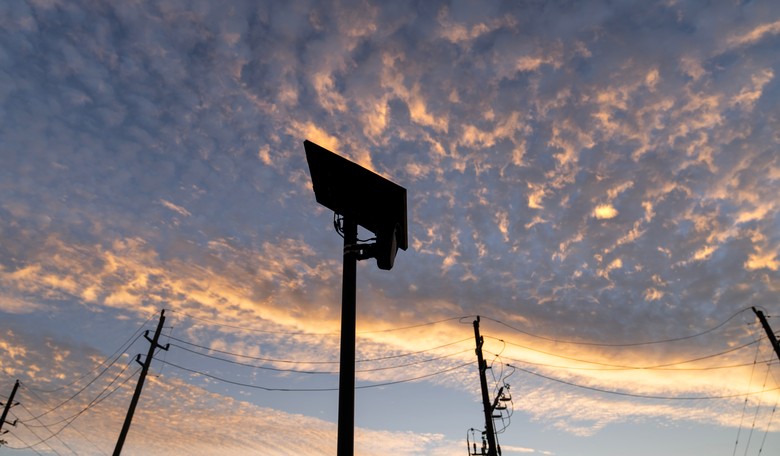
It seems that Flock cameras have sparked another debate that feels a whole lot like the fight over data centers. And while Flock cameras are not currently equivalent to China’s social credit score apparatus, the infrastructure could very well help create one here in the U.S.
Because a government cannot build a comprehensive behavioral-control system without first building the ability to identify, track, connect, and retrieve information about ordinary citizens. Flock supplies part of that capability via large-scale, searchable vehicle-location data.
According to Flock, it does not, nor has it ever, used facial recognition technology. But that doesn’t mean it couldn’t in the future — that could literally be one update away. And this surveillance is always on, y’all. It's recording everyone, not just "suspects." The database is created first; investigative relevance is determined later.
Flock is essentially a surveillance infrastructure layer. It doesn’t assign citizens a behavioral score or automatically punish them. But it creates another searchable data point about our movements that could eventually be connected with other data. Our phones already collect an enormous amount of information about where we go and what we do. Flock adds another dot to the board if someone in power ever decides to connect those dots.
And that's where my concern about China's social credit system coming to America kicks in. Not because Flock is that system today, but because systems like that require infrastructure before they require enforcement.
Some people in power will use this technology exactly as intended: to investigate crimes and help keep communities safe. But our standard for surveillance technology cannot simply be whether we trust the people using it today. We also have to ask what someone else could do with that same infrastructure tomorrow.
And before anyone says, "The government would never use something like this against American citizens," forgive me for being skeptical.
Because once the infrastructure is built, expanding its reach becomes a hell of a lot easier.
The majority of us deeply believe in the First Amendment, and yet we experienced legitimate issues during the Biden era and their involvement in social-media moderation and where the line between government persuasion and coercion should be drawn. So my concern isn't necessarily who's controlling this infrastructure today. It's who's controlling it 10 years from now.
If the Democratic Socialists of America (DSA) continues gaining influence within the Democratic Party, and actual socialists and communists continue winning positions of power, I'm not interested in handing any future government a ready-made surveillance infrastructure and simply trusting that they'll use it responsibly.
The government or NGO always introduces surveillance by telling us whom it will protect. But history tells us to ask whom it could eventually target.
A 2025 Senate Homeland Security Committee majority report stated that after January 6, TSA authorized watchlisting based solely on suspected travel to Washington, D.C., without specific evidence that the individual committed an unlawful act.
In 2024, Meta CEO Mark Zuckerberg wrote a letter to the House Judiciary Committee saying that the Biden administration pressured them to censor COVID-related content during the plandemic.
In a 2017 settlement, during the previous admin (Obama era) the IRS was found using inappropriate criteria to screen applications for 501(c) status and “federal law enforcement, including the Treasury Department's Financial Crimes Enforcement Network (FinCEN) and the FBI, facilitated multiple backchannel discussions with financial institutions to gather Americans’ private financial information” (2021/Biden era, 2024 report):
“This surveillance, not predicated on specific evidence of criminal conduct, targeted terms and transactions related to core political and religious expressions protected by the Constitution… Tactics included keyword filtering of transactions, targeting terms like ‘MAGA’ and ‘TRUMP,’ as well as purchases of books, religious texts, firearms-related items, and recreational stores, like Cabela’s, Bass Pro Shop, and Dick’s Sporting Goods.”
All of the above examples are showing government overreach or misuse — and this is just to name a few.
And now that we’ve gone down the conspiracy rabbit hole (and a decent amount of us were labeled conspiracy theorists during COVID, lest we forget), let’s talk about “hot lists” with Flock. A hot list is a list of license plates that Flock cameras have been instructed to watch for. When a camera detects a matching plate, the system sends a real-time alert to authorized law enforcement or security personnel.
There are two types: government/National Crime Information Center (NCIC) lists and those locally created. While NCIC-generated hot lists usually arise from formal records, the custom/local hot lists are much more discretionary. The level of protection depends on the law and the individual department’s written policy. Which leaves way too much wiggle room for my liking.
Going back to J6, in theory — say someone had all the credentials and relevant records and wanted to make a custom hot list using vehicle registrations matched to the TSA watchlist. Would that be possible, depending on independent policies and access controls? Sounds like it.
So please, tell me again that, "The government would never use something like this against American citizens.”
In summary: Hard pass. No thank you. No Flock(ing) way.