
Author's Note: All previous volumes of this series are available here. The first 56 volumes are compiled in the book "Bible Study For Those Who Don't Read The Bible." "Part Two," featuring volumes 57-113, was published in December 2022.
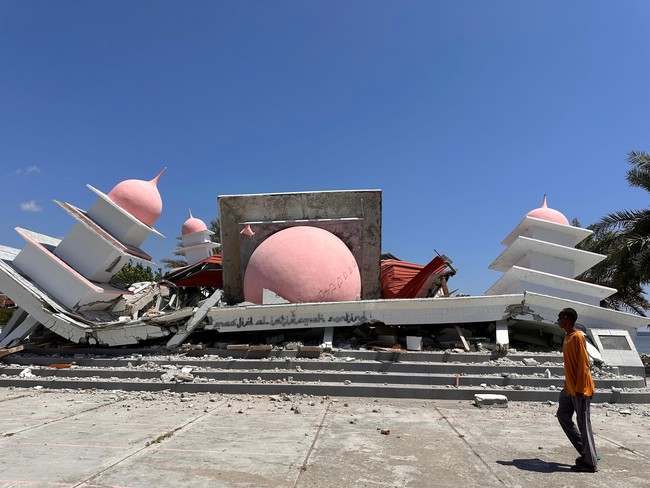
Thanks for joining our study. After a series of deadly recent earthquakes in Japan, Venezuela, and Colombia, plus a smaller one in California — possibly a prelude to “The Big One” — I was prompted to write this three-part series. While I began writing it, Indonesia was struck by a 7.7-magnitude earthquake, and this week, Peru was struck as well. I considered this a tragic yet divine confirmation from my “Assignment Editor.”
What is going on? Perhaps the Old Testament (Hebrew Bible) can offer some clues about earthquakes, and next week, the New Testament gospels. Three studies are needed because earthquakes are mentioned in numerous biblical passages at key moments, underscoring the power, majesty, and holiness of Almighty God.
We will read that earthquakes are often linked to His judgment, whether as a course correction or as punishment for humankind’s disobedience. Know that God created the earth and shakes it according to His will. Below, two passages illustrate that point.
In Exodus, the first biblical mention of an earthquake does not use the word; instead, it describes the visible effects. When God descended upon Mt. Sinai to give Moses the Law, we read:
“Mount Sinai was covered with smoke, because the Lord descended on it in fire. The smoke billowed up from it like smoke from a furnace, and the whole mountain trembled violently” (Exodus 19:18).
The second passage is from Numbers 16 but is recounted in Deuteronomy 11:6 as an example of those who “experienced the discipline of the Lord.” Both passages illustrate God’s use of earthquake-type destruction against those who rebelled against Moses, His chosen leader. Moses, told by God of the impending devastation, warned Korah, Dathan, and Abiram that the earth would “swallow them” because they “treated the Lord with contempt." The passage reads:
“As soon as he [Moses] finished saying all this, the ground under them split apart, and the earth opened its mouth and swallowed them and their households, and all those associated with Korah, together with their possessions” (Numbers 16:31-32).
Moving on to 1 Kings, the word “earthquake” appears for the first time. The prophet Elijah felt its effects as God passed by him. Yet in contrast to the earthquake's mighty power, God’s voice was a “low whisper.” This shows God’s total control over how He chooses to communicate and reveal Himself, as described below.
“And He [God] said [to Elijah], ‘Go out and stand on the mount before the Lord.’ And behold, the Lord passed by, and a great and strong wind tore the mountains and broke in pieces the rocks before the Lord, but the Lord was not in the wind. And after the wind an earthquake, but the Lord was not in the earthquake. And after the earthquake a fire, but the Lord was not in the fire. And after the fire, the sound of a low whisper” (1 Kings 19:11–12).
In the book of Job, the man himself describes God’s power over creation and, if He is angry, how quickly God can “shake the earth”:
“He who removes mountains, and they know it not, when he overturns them in his anger, who shakes the earth out of its place, and its pillars tremble” (Job 9:5-6).
Question: Is humankind making God especially angry these days? Does that account for the recent spate of powerful earthquakes? Turning to Psalm 18, King David connected earthquakes to God’s anger:
“Then the earth reeled and rocked; the foundations also of the mountains trembled and quaked, because he was angry” (Psalm 18:7).
However, given God’s destructive use of earthquakes, the writers of Psalm 46, “the Sons of Korah,” do not fear but famously believe:
“God is our refuge and strength, an ever-present help in trouble. Therefore we will not fear, though the earth give way and the mountains fall into the heart of the sea, though its waters roar and foam and the mountains quake with their surging” (Psalm 46:1-3).
My husband and I often discuss how we do not fear because “God is in charge” when our lives are challenging, or the world is going haywire.
Know that the prophet Isaiah wrote about earthquakes in relation to God’s anger: His people who “have rejected the law of the Lord Almighty and spurned the word of the Holy One of Israel” (Isaiah 5:24). The consequences were harsh:
“Therefore the Lord’s anger burns against His people; His hand is raised and He strikes them down. The mountains shake, and the dead bodies are like refuse in the streets. Yet for all this, His anger is not turned away, His hand is still upraised” (Isaiah 5:25).
The last sentence states that God’s “hand is still upraised,” meaning God is not finished punishing His people.
In Isaiah 13, God speaks about His return in a war prophecy against Babylon. I quote only the first and last verses of Isaiah 13:9-13:
“Behold, the day of the Lord comes, cruel, with wrath and fierce anger, to make the land a desolation and to destroy its sinners from it.” An earthquake is alluded to:
“Therefore I will make the heavens tremble, and the earth will be shaken out of its place, at the wrath of the Lord of hosts in the day of his fierce anger.” Again, an angry God sends earthquakes.
Buckle your seat belts because next in Isaiah 24, my study Bible subhead reads: “The Lord’s Devastation of the Earth.” Of course, earthquakes are mentioned as part of His apocalyptic judgment against evil forces. It begins:
“See, the Lord is going to lay waste the earth and devastate it; He will ruin its face and scatter its inhabitants” (Isaiah 24:1). The devastation God described to Isaiah:
“The floodgates of the heavens are opened, the foundations of the earth shake. The earth is broken up, the earth is split asunder, the earth is violently shaken. The earth reels like a drunkard; it sways like a hut in the wind; so heavy upon it is the guilt of its rebellion that it falls—never to rise again. In that day the Lord will punish the powers in the heavens above and the kings on the earth below” (Isaiah 24:18-21).
There are more earthquakes mentioned in the Old Testament, but you get the message. Earthquakes are signs of God's presence. He rules over the earth and can make it shake as punishment or judgment, leaving behind a path of destruction.
No matter how rich and powerful people, governments, or nations think they are, in an instant, God can reduce great cities to rubble.
Are you straying from His laws? Do you honor, worship, and glorify Him with your gifts and talents? Pray about that question. You can’t stop earthquakes, but perhaps you can be saved from one.
Next week, we will discuss earthquakes in the New Testament gospels. My favorite “earthquake” (I know that sounds weird) tore the Temple curtain in two. That magnificent curtain designed by God separated humanity from Him. (See Vol. 229 for more details.)
Interestingly, in May 2012, NBC News reported on a geological study of seismic activity on Friday, April 3, in the year 33. Could that be the day Jesus died on the cross, since Matthew 27:51 says the “earth shook” the moment Jesus “gave up his spirit”?
We will discuss that and other earth-shaking events, so stay tuned. Praise be to all who have read this far and have learned about God and earthquakes in His Word.
Myra Kahn Adams is a conservative political and religious writer. Her book "Bible Study For Those Who Don't Read The Bible" reprints the first 56 volumes of this popular study. "Part 2" reprints Vols. 57-113. Order it here.
Myra is also the Executive Director of the National Shroud of Turin Exhibit. You can help support our six-month exhibit at the Basilica in Orlando, Florida. Read more here. Contact: Myraadams01@gmail.com