
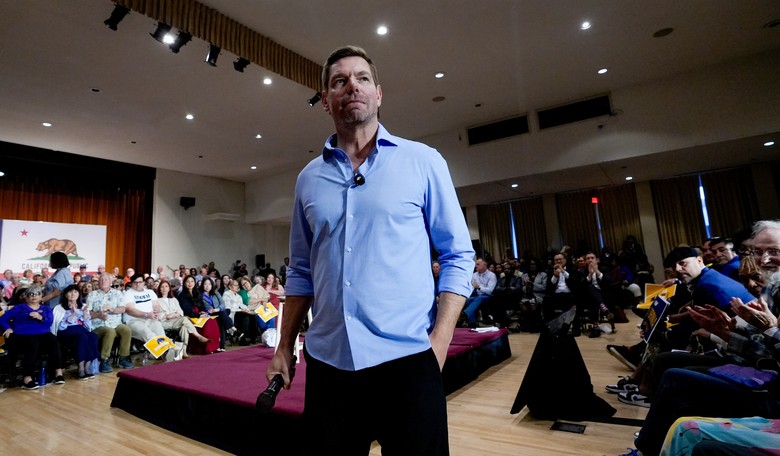
Amy had the story yesterday: former Rep. Eric Swalwell (D-CA) had multiple devices seized by federal agents, and his D.C. residence was also searched. It’s all part of the sexual misconduct probe, which nuked his gubernatorial bid and ended his career in public life. Yet another narrative emerged when these allegations of sexual misconduct and rape were dropped — possible intimidation. Some vestiges of that surfaced in May, when it was discovered that Mr. Swalwell was still using social media to contact his accusers (via NY Post):
FBI agents seized from Eric Swalwell on Saturday:
— Kellie Meyer (@KellieMeyerNews) August 20, 2026
One White Apple iPhone with charger, wall charger
One Apple MacBook Pro
Federal agents confronted Eric Swalwell at the San Francisco Airport on Saturday and seized his cell phone, a person familiar with the case told me earlier…
Wow. @ericswalwell's campaign co-chair, @AdamGrayCA, must be feeling the heat right now.@FBI has Swalwell’s phones, laptops, etc. They’re digging for texts, emails, calls...AND
— Christian Martinez (@CDHMartinez) August 20, 2026
"association evidence"
What did Gray know… and when did he know it? pic.twitter.com/k77VMOK93f
Eric Swalwell’s alleged pressure tactics in the final weeks of his imploding political career could be coming back to haunt him.
An FBI warrant used to seize Swalwell’s phone and laptop Saturday in San Francisco cites a federal civil-rights statute that can be used to prosecute public officials who abuse their government power — suggesting the feds may suspect Swalwell used his official role to silence women who accused him of sexual misconduct.
“The feds appear to be going after something more extensive than asking whether Swalwell sexually assaulted women. They may be asking if he willfully deprived somebody of a federal constitutional right.”
It’s “really bad news for Swalwell,” said Royal Oakes, a legal analyst for KNBC-TV.
Title 18, Section 242 — known as deprivation of rights under color of law — makes it a crime for a public official to willfully use government authority to deprive someone of rights protected by the Constitution or federal law.
The statute can apply even when officials exceed their lawful authority if they are acting, or purporting to act, in their official capacity. A basic conviction can carry up to one year in prison, but penalties an rise to up 10 years if bodily injury results or even a potential life sentence for crimes involving aggravated sexual abuse.
If there are any deleted texts or emails, and let’s be honest, we shouldn’t be surprised if there are, this legal odyssey will continue.
CNN’s legal analyst Elie Honig excellently explains how “Eric Swalwell is in far worse legal jeopardy than he was 24 hours ago.”
— Paul A. Szypula 🇺🇸 (@Bubblebathgirl) April 15, 2026
“As a pure mathematical proposition, now we have two different investigations being run by two different district attorneys…”
“The two cases can in… pic.twitter.com/lJ6PH3mPQw