
The most surprising result in the batch of primaries held this week over the vast stretch of America from Florida through Wyoming to Alaska was the defeat of famed anti-Trump whistleblower Alexander Vindman by state Rep. Angie Nixon in the contest for the Democrat nomination against appointed Republican U.S. Sen. Ashley Moody in Florida.
Of these candidates, Vindman was by far the best known nationally. His role in spurring the House's 2019 impeachment of President Donald Trump made him a hero to Democratic money-givers large and small. That helped his twin brother Eugene finance a successful race for a Virginia congressional seat in 2024 and helped Alexander raise $16 million for this year's U.S. Senate race.
The big surprise — and a disagreeable one for Vindman, whose campaign was evidently husbanding funds for the general election — is that he lost the Democrat primary by a 56 percent to 44 percent margin to Nixon, who raised only $974,000.
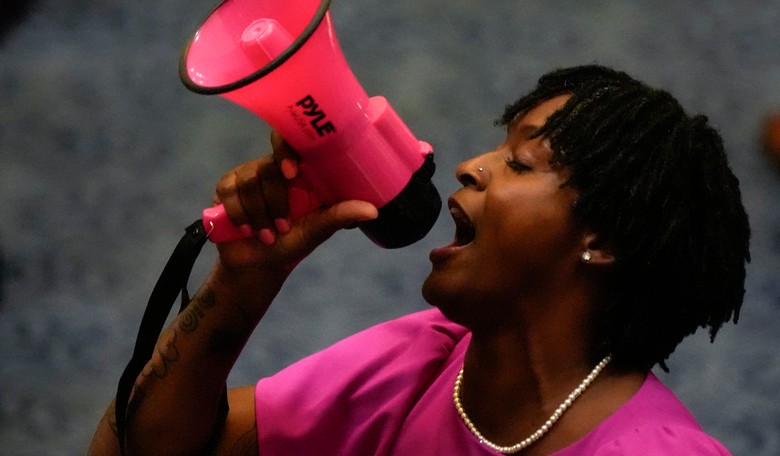
Nixon entered the campaign known to those Floridians who pay close heed to goings-on in Tallahassee as a legislator who charged the podium, speaking through a pink bullhorn, to protest a redistricting bill and who sponsored a 2023 bill for a ceasefire in Gaza that was voted down 104-2.
During the campaign, she signed up with the Democratic Socialists of America and campaigned on its more presentable platform planks, such as "Medicare for All" and a $25 minimum wage. In the general election, less palatable planks may get an airing from Republicans -- "demilitarize police departments," "defund the Department of War," "amnesty for all immigrants regardless of status."
Nixon carried her home base, Jacksonville, with 80 percent of the primary vote, and won 80 percent in Florida's one black-majority county, Gadsden, as well. Her winning percentages in counties including Miami, Fort Lauderdale, Tampa and Orlando suggest she owes much of her margin to Black voters, plus, like DSA-adjacent candidates in other states, support from college-educated voters with low incomes (including the two counties, Alachua and Leon, with the highest percentages of campus-oriented voters).
In contrast, she failed to carry the more affluent — and more elderly — counties centered on West Palm Beach, Naples and Sarasota. We seem to be witnessing a passing of the guard here, from the Democrats of the Resistance scrolling through Bluesky in search of candidates and causes with which to display their loathing of Trump to a younger generation of Democrats determined to display their support of "socialism" and opposition to "Zionists."
There is something redolent here of the seeming takeover of the Democrat Party half a century ago by a younger generation of voters and activists opposed to the Vietnam War that resulted in the nomination of George McGovern in 1972 and had a continual influence on elected Democrats and policymakers through most of the 1970s and 1980s. That came from a protest movement incubated on college and university campuses, centered on Vietnam but also influenced by tomes such as Charles Reich's 1970 "The Greening of America."
Similarly, the great motivating cause of DSA-adjacent Democrats seems to be statehood for Gaza, opposition to Israel, and, in very many cases, hostility toward Jews.
I see one highly visible difference between the 1970s and today: the composition of campuses and the ascendant groups of the Democrat Party.
In 1970, 58 percent of college and university students were men, while today an almost identical 57 percent are women. Similarly, men formed most of the leadership cadres and masses of support in the campus and political movements of half a century ago. Today, or so it seems to me, women do.
The media don't seem to be spending on exit polls in this year's spring and summer primaries, but some measure of support for DSA-type candidates can be gleaned from general election polls.
One that has attracted special attention was conducted by Fox News in Michigan, just after the DSA-adjacent Abdul El-Sayed won the Democrat primary for U.S. senator. Even as other Fox News Senate polls showed Democrats leading in states that Trump had carried in 2024, the Michigan poll showed El-Sayed trailing Republican Mike Rogers by 51 percent to 47 percent. By way of comparison, in an open-seat Senate race in 2024, Rogers lost to Democrat Elissa Slotkin by 49 percent to 48 percent.
In the Fox News poll, noncollege graduates favored Rogers by wide margins over El-Sayed — men by 63 percent to 37 percent, women by 60 percent to 38 percent. So did male college graduates by nearly the same margin, 59 percent to 39 percent. The odd persons out were female college graduates, who favored El-Sayed by 60 percent to 37 percent — a mirror image of the three other groups. That's a familiar pattern to those of us who read, and sometimes overinterpret, the internals of political polls.
Given those numbers, perhaps Nixon's victory should not have been much of a surprise. Certainly, it fortifies earlier results that have established socialists this year as the most dynamic and potentially the dominant force in America's and the world's oldest political party.
Michael Barone is a senior political analyst for the Washington Examiner, resident fellow at the American Enterprise Institute and longtime co-author of The Almanac of American Politics. His new book, "Mental Maps of the Founders: How Geographic Imagination Guided America's Revolutionary Leaders," is now available.