
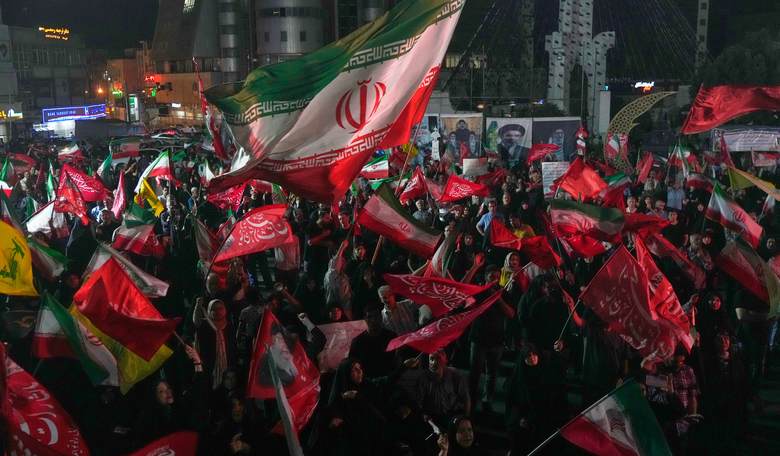
There are moments when a regime strips away the last pretence of civilization and reveals itself for what it truly is. Iran’s latest announcement is one such moment. On August 16, Iranian Army Commander-in-Chief Major General Amir Hatami announced a $30,000 bounty for anyone who kills or captures a US soldier and hands him over to the Iranian authorities. In a grotesque embellishment, Hatami said the reward would be doubled if the perpetrator were an Iranian woman. The regime even offered to purchase the weapon used in the killing and place it in a museum. The announcement has been widely reported, including by The Times.
This is hardly the language of a responsible government. It is the language of a gangster organization. Imagine the reaction if a Western government offered money to criminals for the kidnapping or murder of foreign soldiers. There would be universal condemnation, diplomatic expulsions and demands for accountability. Yet Tehran apparently believes it can place a price on the heads of American servicemen while still expecting the privileges of international diplomacy. The Iranian regime has spent decades perfecting this peculiar form of statecraft: threaten directly, attack indirectly, employ proxies, hire criminals, take hostages and then sit down at the negotiating table demanding concessions.
The bounty is merely the latest manifestation. Iran has constructed a vast network of armed proxies across the Middle East. Hezbollah in Lebanon, the Houthis in Yemen, Hamas and Palestinian Islamic Jihad, together with numerous Shi’ite militias in Iraq and Syria, have received Iranian weapons, financing, training or logistical support. The US Congressional Research Service has documented the breadth of this network, while US counterterrorism authorities continue to identify Iranian support for armed groups attacking American, Israeli and Western interests.
Tehran’s favorite trick is to subcontract the violence. The mullahs can send missiles and drones, yet when convenient they can claim that some supposedly independent militia acted on its own initiative. They can arm terrorists while pretending to be diplomats. They can threaten dissidents overseas while insisting that Iran respects the sovereignty of other nations. The evidence of this criminal outsourcing has become impossible to ignore. In July 2025, Britain joined the United States, Canada and European allies in condemning Iranian intelligence operations aimed at killing, kidnapping and harassing people in Europe and North America. The joint statement specifically warned that Iranian intelligence services were increasingly collaborating with international criminal organizations to target journalists, dissidents, Jewish citizens and former officials.
The European Union has gone further. In 2025, it sanctioned the Zindashti Network, identifying it as a criminal organization connected to Iran’s Ministry of Intelligence and Security and accusing it of assassinations and other acts of transnational repression. Britain subsequently sanctioned the Iranian-linked Foxtrot criminal network, citing the regime’s use of criminal gangs to threaten people across Europe. In July 2026, the UK went further again, designating the Islamic Revolutionary Guard Corps (IRGC) under new state-threat powers and sanctioning the Islamic Movement of Companions of the Right, an Iran-linked organization accused of attacks in Britain. This is the hallmark of a gangster state: when its own operatives are too conspicuous, it reaches into the criminal underworld and hires the services of thugs, smugglers, drug traffickers and hitmen.
Then there is the hostage business. For Tehran, imprisonment has repeatedly become a bargaining chip. Foreign nationals and dual nationals have been arrested on dubious charges, subjected to arbitrary detention and then transformed into human currency for diplomatic negotiations. The British Parliament has explicitly recorded its concerns over Iran’s arbitrary detention of dual nationals and the denial of normal consular access. The message is chillingly simple: come to Iran at your own risk, challenge the regime anywhere in the world and you may become a target; oppose it and your relatives may become leverage.
Now the regime has added an open cash incentive for the murder or abduction of American soldiers. And this comes as Tehran continues its confrontation over the Strait of Hormuz. Iran has insisted that it alone will decide when the strategic waterway opens, while the United Arab Emirates has accused Iranian forces of attacking commercial vessels associated with ADNOC, the Abu Dhabi-based energy group. The Strait carried roughly one-fifth of the world's tradable oil before the conflict, making Tehran's attempt to weaponize the waterway a threat extending far beyond the United States.
The West should finally recognize the pattern. Iran's rulers behave less like a conventional government and more like the heads of an enormous criminal enterprise. The IRGC functions as the muscle. The Quds Force operates abroad. Proxy militias provide disposable foot soldiers. Criminal networks provide deniable assassins. Hostages provide bargaining currency. Terrorist organizations provide strategic depth. Diplomats provide a respectable façade. And Western governments continue to treat the façade as though it were the reality. Enough. A government that places a bounty on American soldiers, sponsors terrorist organizations, employs criminal gangs to murder and kidnap opponents, takes foreign nationals hostage and threatens international shipping has forfeited any claim to normal diplomatic treatment. Diplomatic relations are supposed to facilitate peaceful coexistence between civilized states. They should never become a protective cloak for state-sponsored gangsterism.
The answer should therefore be clear. Western democracies should sever diplomatic relations with Tehran, expel intelligence operatives masquerading as diplomats, close the regime’s centers of influence, intensify sanctions against the IRGC and MOIS, and pursue every criminal responsible for transnational repression. Above all, governments should stop rewarding hostage-taking and stop pretending that another round of polite negotiations will somehow transform the Islamic Republic into a normal state. The $30,000 bounty has ripped away the mask. The Iranian regime has declared open season on American soldiers. The civilized world should respond by declaring the mullahs’ diplomatic immunity from consequences over.
Struan Stevenson was a member of the European Parliament representing Scotland (1999–2014), president of the Parliament’s Delegation for Relations with Iraq (2009–14) and chairman of the Friends of a Free Iran Intergroup (2004–14). He is an author and international lecturer on the Middle East.