
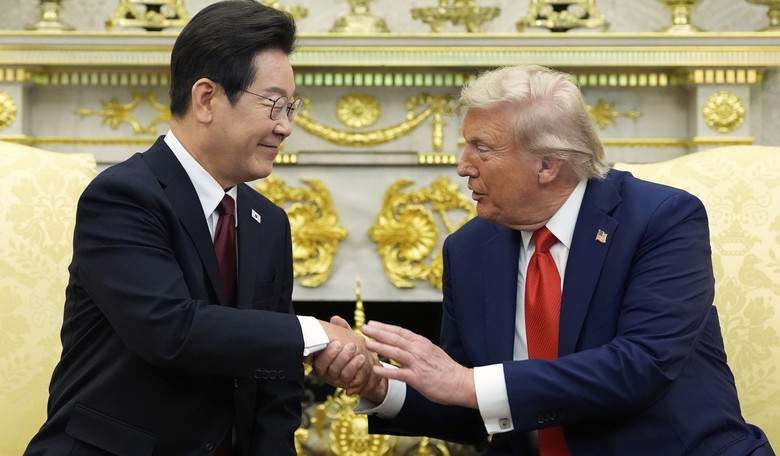
When President Trump announced on August 16 that he ordered Secretary of War Pete Hegseth to roll back joint military exercises with South Korea, he said that continuing such exercises "would send a signal that is totally inappropriate and hostile" to North Korea.
But the president's latest move is just the most recent in a broader fracturing of the relationship between the U.S. and South Korea, unfolding on several fronts: economic, regulatory, and even in national security.
Back in December, South Korean President Lee Jae Myung and Korean lawmakers had difficulty hiding their disdain for American tech companies that have found tremendous success in Korea. Government agencies, including tax authorities, intelligence services, financial regulators, and even local police, were attacking American companies that were competing with Korean businesses.
In June, Secretary of State Marco Rubio raised the alarm about Korea's treatment of U.S. firms, including online retailer Coupang. During a House Congressional Hearing, Rep. Darrell Issa asked Rubio about this, with Issa noting that Korea had taken "a strong bent to the left" while opening up more avenues for China.
Secretary Rubio told Issa that the treatment had become a focus of U.S. engagement with Korea.
"Our companies aren't just facing challenges and getting targeted in South Korea. They're facing it throughout Europe. I think this becomes a feature in our engagement with South Korea even if we have things we are strategically aligned on," he said. Rubio also noted the challenges had impacted America's ability to reach a trade deal with the nation.
The treatment of American firms concerned U.S. lawmakers and led to a hearing and report from the House Judiciary Committee noting that several companies — including Yahoo and Ford — pulled out of Korea entirely because of anti-U.S. business regulations, creating a regulatory vacuum that allowed Chinese companies in. That report details "South Korea's history of discriminatory treatment against American-owned businesses and the ways in which it has escalated over the past several years."
It also found that South Korea discriminated against Coupang, with one White House official saying in an emailed statement that the company had been "singled out" by the Korean government, and that the Trump administration is "deeply concerned with the ROK government's discriminatory targeting of U.S. technology companies."
"The Trump administration will not tolerate unfair trade practices, including those that limit market access for U.S. digital services," the email read.
The attacks have been so severe that it risked compromising the $350 billion trade deal President Trump announced last year.
Speaking of that trade deal, U.S. officials in the Trump administration believe the Korean government is slow-walking its commitment, per Politico.
Washington is particularly concerned about the divergent national security concerns between the U.S. and Korea. At the end of July, former Utah Rep. Chris Stewart wrote in The Hill that Korea was adopting Beijing's playbook:
Ceremonies and symbolism matter. But alliances are ultimately measured not by public displays of friendship, but by how governments treat one another’s citizens and businesses. On that score, South Korea’s recent treatment of an American company should concern anyone who believes our alliances should be grounded in the rule of law rather than political expediency.
During my time on the House Intelligence Committee and the House China Task Force, I spent years studying how authoritarian governments use state power to pressure American companies. I never expected to see an American ally adopt tactics that look so familiar.
Yet that is exactly what the Korean government is doing to Coupang, a Fortune 150 U.S. tech company and American exporter with major operations in Korea and throughout Asia.
Stewart asked, "What kind of message does it send to Beijing" when South Korea discriminates against U.S. companies, noting that "every time an ally treats an American company as a political villain rather than a market participant, the Chinese Communist Party notches a win."
A June 1 Wall Street Journal story noted that Korea's "hard-left turn" against America is turning up global pressure and giving China tremendous leverage.
Mr. Lee and Minju have made clear they aren’t on America’s side in the China competition. During his presidential campaign, Mr. Lee declared that he didn’t care what happens to Taiwan. In April, Mr. Lee’s defense minister discussed bilateral defense cooperation with China’s ambassador to South Korea.
Taken individually, any one of these disputes might be dismissed as normal friction between two longtime allies. Taken together, however, they paint a much larger and more troubling picture of an international relationship that has been fractured for a long time.
For decades, the relationship between the U.S. and South Korea has depended on shared economic and national security interests, mutual trust, and the understanding that both countries ultimately face the same threats in the region.
Increasingly, Washington appears to be questioning whether that is still the case and South Korea doesn't seem eager to assuage those concerns.
The Trump administration is confronting Seoul over its treatment of American companies and the slow implementation of its $350 billion investment commitment, while lawmakers are sounding alarms about South Korea's evolving posture toward China. Now, that economic strain is spilling unmistakably into the nations' military relationship and broader national security concerns.
President Trump's decision to scale back joint exercises, therefore, shouldn't be viewed in isolation. It may instead be the clearest indication yet that the cracks in one of America's most important alliances in Asia are getting harder to ignore.