
Walk through this with me for a second.
Imagine you're jogging down a basketball court on a fast break, minding your business, mid-layup, doing the exact thing you get paid to do. Someone comes up from behind and clotheslines you across the face and neck hard enough that officials review the tape and decide, yeah, that one gets you ejected. You pop up. You're a little heated, understandably, because a stranger just tried to remove your head from your shoulders on national television. And within minutes, the person who did it posts two words on social media aimed squarely at you: "WHITE PRIVILEGE."
Not "my bad." Not "heat of the moment." Not even a defiant "I don't regret it." Just an accusation, lobbed at the person still rubbing her jaw, that the foul she just absorbed to the face is somehow evidence of a systemic advantage she enjoys.
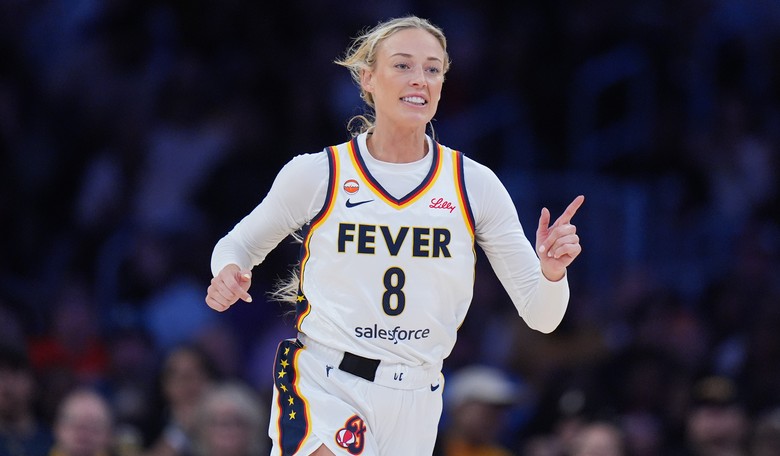
This actually happened Saturday. Chicago Sky guard DiJonai Carrington delivered a Flagrant 2 foul to Indiana Fever guard Sophie Cunningham during a fast-break layup, connecting with her head and neck badly enough to get tossed from the game. Cunningham, not exactly known for backing down from anybody, got up, went after Carrington, and had to be physically separated by a teammate. Afterward, Cunningham called the foul intentional, in language colorful enough that I won't reprint the family-newspaper version here. And Carrington's response to getting ejected for hitting a woman in the face was to post "WHITE PRIVILEGE," tag the Fever's account, and let the internet sort out the rest.
Naturally, Florida's attorney general weighed in, because it's 2026 and apparently that's a thing state AGs do now, joking on X that a play like that would never fly in the Sunshine State. Fair enough.
But it's the "white privilege" part that got me.
If getting hit is privilege, is not getting hit also privilege? Is being upset about getting hit privilege? Cunningham's crime, evidently, was popping up off the floor with some fire in her eyes rather than accepting the blow with a serene, grateful nod.
I'm trying to figure out what she was supposed to do.
She got hit. She got angry. She got back up.
That's basketball.
Nobody is claiming Cunningham threw the first punch. Nobody disputes that Carrington's arm connected with her head and neck on a play officials deemed excessive and unnecessary. Those are the physical facts of what happened.
And yet somehow we're discussing Cunningham's "privilege."
That's where this stops making sense.
Because now we're not talking about basketball. We're talking about whether someone's reaction to being physically struck can itself become evidence against her. Get angry? Privilege. Stay calm? Someone could probably find privilege in that too.
Heads I win, tails you're privileged.
It's a framework with no exit door.
And maybe that's what bothers me most about the entire episode. We've become so accustomed to filtering ordinary human encounters through enormous ideological categories that sometimes we seem incapable of describing the thing directly in front of us.
Sometimes a hard foul is just a hard foul.
Sometimes the person who gets hit gets angry.
Sometimes she gets back up.
Worth noting, too, that this isn't Carrington's first run-in with a referee's whistle or her own social media account in recent seasons. She's picked up flagrant fouls before, including one last season on a fast-break block that sent another player crashing to the floor. And after a heated exchange with an official a few days before this incident, when a security guard was brought over to stand between them, Carrington posted online that summoning security during what she called "a civil conversation" felt like a microaggression.
I bring that up not to pile on, but because it reveals something about the pattern here. Every hard edge, every consequence, every moment where someone in a position of authority says "that's enough" gets reinterpreted through the same lens. It's never simply a foul, or simply a technical, or simply a security guard doing his job. It's always something bigger, something structural, something happening to her rather than something she did.
That's a tidy way to never have to sit with a bad moment.
I'll grant Carrington this much: some players undoubtedly get treated differently than others in professional sports. Stars get calls. Veterans get respect rookies haven't earned yet. Reputations matter. Officials are human.
But none of that changes what happened on this particular basketball court.
One player delivered the foul.
The other absorbed it.
And somehow the accusation afterward landed on the player who got knocked down.
That's quite a trick.
If we're going to talk about accountability in professional sports, perhaps we could begin with the least complicated version of it: own what you did.
No sociology seminar required.
No grand theory.
No attempt to explain away somebody else's anger at getting hit in the face.
You committed the foul. Officials reviewed it. They threw you out.
The other player got up angry.
Funny how that works.